Historical Essay 65

Posted on 23 December 2010 by LeslieM

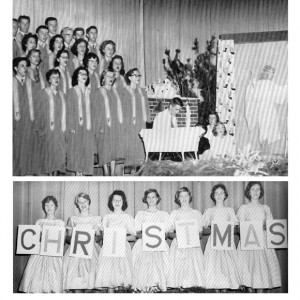
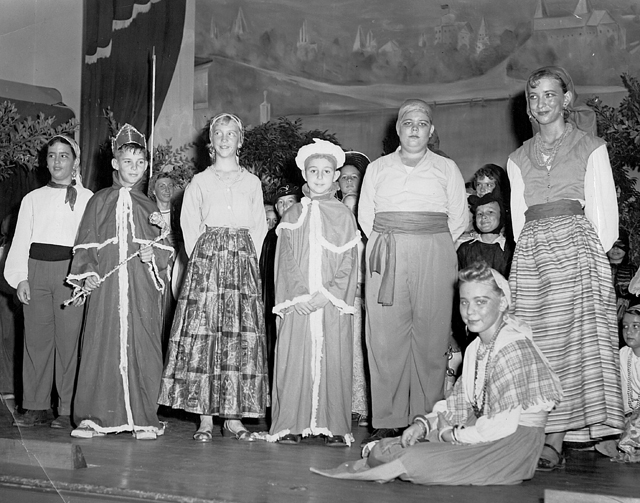
How Christmas used to be celebrated

— at Pompano Beach Senior High School

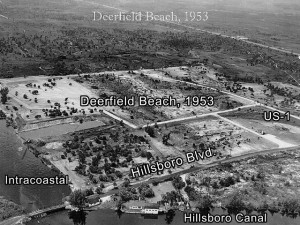
With students from Pompano, Deerfield, Hillsboro, Lighthouse Point

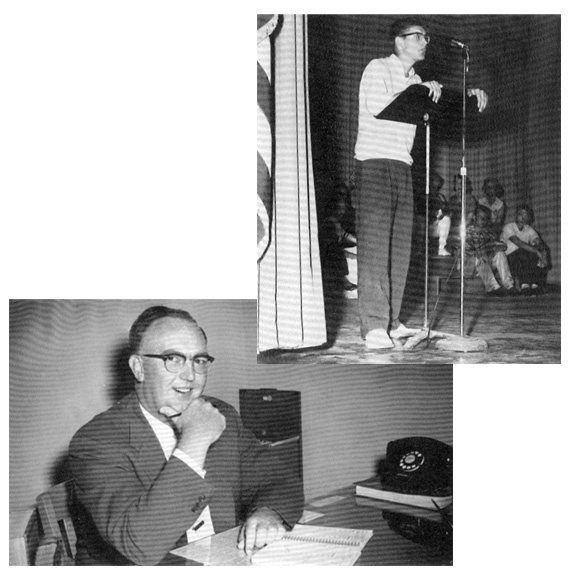
In the fall of 1958, when I was elected president of the student body at Pompano Beach High School, there was a lot of stress going on in the schools of our country. Students in the schools of the South historically had been separated by race, including our school. Therefore, there were usually “white” schools and “black” schools in each town. When the U.S. Supreme Court ruled that to be illegal, and demanded they be integrated, there was a lot of stress occurring within the schools. President Eisenhower even had to federalize the National Guard and send troops into Little Rock Arkansas’ largest high school in May of 1958 to force racial integration there.

Meanwhile, by September 1958, here in Florida, at Pompano Beach High School, the stress was palpable also. Part of the reason was that our school’s official name for its sport’s team was the Pompano Beach Bean Pickers because beans had been the most prominent crop in the area. However, since most people actually picking the beans were black, confusion reigned; especially among the newcomers from the North arriving. Many of them complained to me, and it became an issue during my election campaign for student body president. Consequently, I took a position that if elected, I would lead an effort to change our school’s name.

After my victory, I sat with our Principal Larry Walden, who agreed we could change the name, but it should be voted on properly. Since a tornado had recently struck the area, and blue and gold were our team colors, we came up with the idea of changing the name of the school team to The Pompano Beach Senior High School Golden Tornadoes, which it still is today.

Comments Off on Historical Essay 65

Historical Essay 64

Posted on 22 December 2010 by LeslieM

How to win an election

In my previous essays, I’d explained that back in the early 1950s, Deerfield did not have school for its children to attend beyond elementary school 6th grade. For 7th grade through 12th, we all had to take a bus to Pompano High School. Sometimes when we were getting off the bus, the Pompano kids standing around would laugh and say “Here come the kids from Deer Patch!” We would mostly just smile, but sometimes a couple of our boys would show them a finger.

The area was growing fast, however, and Deerfield, Pompano and Margate all got junior high schools within a couple of years. So, by the time I was in the 10th grade, our Pompano Senior High School was limited to 10th, 11th and 12th grades.

There was one Pompano boy, Robert Moore, whose widowed mother was a teacher at Deerfield Elementary. I got to know him pretty well, even though he always attended Pompano schools, because he sometimes came to Deerfield with his mother.  When I started school at Pompano, he and I became good friends. With blond hair and a big smile, he played point guard on the basketball team and was popular with the girls. He used his popularity to get himself elected as President of each and every grade class.

When 10th grade came, he had some tough opposition for President. So being smart politically, he asked me to run on his team as his Vice President to bring in the Deerfield votes. It worked, we won. I got my first taste of politics and liked it.

When our junior year (11th grade) came around, Robert Moore, as usual, ran and won President of our junior class. But I decided to run for Vice President of the whole Student Body instead of just being a junior class VP.  I won. It was fun and very satisfying as I represented our entire school at many events.

But toward the end of spring of 11th grade, Robert came to me one day and said “I just want to let you know I’ve decided to run for President of the Student Body next year instead of class president.”  Momentarily taken aback, I practically shouted at Robert: “You’re not qualified to be Student Body President — you’ve never even served on the Student Council! So why do you want to do that?” He laughed and said “Because the Student Body President is ‘higher’ than class president.” He continued: “You can be senior class president, and I will be Student Body President next year!”

“I don’t think so,” I practically shouted at him. “I should be Student Body President as I’ve had a year of preparation so I can do a good job!” “Good luck,” he laughed, walking away, “but you will never beat me!”

Devastated, I didn’t know what to do. So I prayed about it and came up with a plan: Aware that people like it when you greet them by name, and knowing that the election would be held the second week of classes after school started in the fall, my plan was to memorize over the summer the first names of all the new students who would be feeding into Pompano High in the fall from junior high schools in the area. When school started, I would work the hallways and sidewalks where new kids would congregate and greet them by their first names. All I had to do was arrange to get a copy of the yearbooks from the feeder schools and every day during the summer, practice connecting names to faces. To help them know who I was, I would wear a big button saying “ELLER’s the FELLER for Student Body President.”

By the time school started in the fall of 1957, I had memorized faces with the first names of over 300 entering sophomores. I walked the hallways where they typically congregated with a large “Eller’s the Feller for Student Body President” sign on my chest and back. I’d study each face and if it registered in my memory bank, I’d say “Hello Sally” or “Welcome to Pompano High, Fred” for a whole week before the election. The students would typically look surprised that I knew their name, then read my sign. The results of the election were Robert and I split our own Senior Class about 50/50. He carried the junior class by 65/35 percent, but I wiped him out in the largest class — the new Sophomore class — by getting nearly 85 percent of the vote!

Robert came over to congratulate me and asked how I’d done it. When I explained how I’d memorized names and faces of most of the sophomores, he laughed and said, “Well you certainly earned the victory. Congratulations!”

Robert and I remained friends, and after high school, a local doctor sponsored him for a scholarship. He went on to become a medical doctor in Alabama, specializing in microscopic surgery.

David Eller, Publisher

Comments Off on Historical Essay 64

Historical Essay 63

Posted on 02 December 2010 by LeslieM

My First Formal Date

It was 1958 and the Pompano Beach Senior High School Prom was coming up soon. The first thing I noticed was the girls were suddenly a lot friendlier than normal. They didn’t just nod their heads in recognition as you walked by, but actually started smiling big and saying something like “Hi David” as they passed by in the hallway. As the big day got closer, some of them even started asking who I was planning to take to the prom. I found that to be embarrassing because I didn’t have a girlfriend yet and wasn’t planning to go.

However, I had been elected Vice President of the Junior class by then, and Mr. Hagman, our student advisor, told me that “as an elected leader” you are expected to go to school events, including the prom. So there I was, kind of stuck. Then, I soon found out that most of the girls, who had previously caught my eye, already had dates.

Social pressure was building. There was one possibility, however, that came to mind. A new girl, a petite brunette named Gwen, had recently moved into town from Georgia. She hadn’t had a chance to get hooked up with a boyfriend yet, so I moved quickly. I knew where she lived, drove there on Saturday morning and introduced myself to her dad when he opened the door. He invited me in, offered me a seat on the couch and said “Gwen is still putting her face on.”

Not used to that term, and a little taken a back, I started thinking that was the one thing I hadn’t liked about her when we first met. Too much makeup turns most guys off, including me. But then, I thought: “beggars can’t be choosers.” So I sat there and talked to her dad, it seemed like an hour.

Finally, she came out. The first thing I noticed after the makeup was the puffiness under her eyes. Of course, we all have some of that when we first wake up, so I don’t know why I was being so critical. We talked briefly about Friday night’s football game, and then I blurted it out “Would you like to go to the prom with me?” She smiled and hesitated for a moment. I was beginning to hate her when she finally said “You’ll have to ask my dad.”

Her dad had stepped outside, so I went out and asked his permission. He didn’t hesitate, but did say “As long as you have her home, I mean in this house, by 12 o’clock.” I immediately agreed and sighed in relief. I had a date for the prom! Whew!

David Eller


Comments Off on Historical Essay 63

Historical Essay 62

Posted on 07 October 2010 by LeslieM

My First “really big” kiss was a surprise…

In previous Essay No. 61, I shared about how I bought my first car, a 1949 Ford, for $100, from my Sunday school teacher, Joel Horne. I didn’t have a girlfriend yet, but I did notice the girls started getting a lot friendlier when they found out I had my own car.

We lived in Deerfield on Dixie Highway, where the tennis courts are now. One night, I drove my car across the street to Pioneer Park to watch the Lions Club men play softball against a Pompano team. Proud of my first car, I parked close to the bleachers and decided to sit on the front fender to watch the game and simultaneously show off my “new” brown Ford. Sure enough, within five minutes, two girls I’d grown up with came swaggering over.

One of them said “Oh David, is that car yours?”  I smiled and nodded affirmatively. “Take us for a ride.”

I said “Ok, jump in.” They both climbed into the front seat. I backed out, being careful not to bump Uncle Jim Butler’s car parked next to me.

“Take us to the beach,” one of them said. So off we went, turning east on Hillsboro Avenue, crossing Federal Highway and over the bridge to the beach where we parked for a few minutes and looked for sand crabs at the wave break.

Then one of the girls said, “I better get back before my parents notice I’m gone.”  So we hurried back to the game, where she got out of the car.

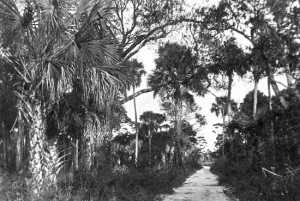
The other girl immediately slid right up next to me and said “Let’s go back to the beach, I want to show you a neat place.” Anxious to drive my “new” car some more, I agreed but asked her to move back over to her side of the seat. She did, so I backed out and headed back to the beach. Just as we passed over the Intracoastal bridge, she told me to make a left turn, and then another, which headed us onto a small dirt road surrounded by cabbage palms where Hillsboro Landings is today.  I stopped at the Intracoastal waters’ east edge and started to back up. Suddenly, she slid over, grabbed me by the back of my head and planted a big sloppy kiss squarely on my mouth. Astonished, I pushed her away, proceeded to back up, and drove her directly to her home.

On the way home, I explained that I thought of her as a friend, like a sister, not a girlfriend. This didn’t seem to help. When we got to her house, she refused to get out of my car, saying “Kiss me or I won’t get out.”

I told her “No!” and demanded she get out. This went on for about 10 minutes when I gave her my final ultimatum: “Get out now because I’m about to drive home and you’ll have to walk back home alone.” She still refused to get out. So I drove to my house (about three blocks away) with her still in my car. I parked in my usual backyard spot, told her “Good night!” went into my house and went to bed.

I’d only been in bed a few minutes when my mother, who had looked out her bedroom window and saw someone in my car, came to my bedroom and asked, “David, who is that in your car?” I told Mom what had happened. She chuckled; then she asked for my keys and went outside and drove the girl home. When Mom returned, she came to my room and told me I’d done the right thing. I slept well that night, and the girl and I remained just good friends for many years.

David Eller

Comments Off on Historical Essay 62

2010 Subaru Legacy: Redesign puts sedan in the fast lane

Posted on 05 August 2010 by LeslieM

By Ric Green & Joe Castello

Over the past few years I have become a big fan of Subaru’s for their engines performance, all-wheel drive and handling.  But the looks were always polarizing. Now comes the redesigned 2010 Subaru Legacy and I feel its appearance has changed for the better. I am sure the new skin will attract more drivers to the midsize sedan.

Subaru has always ventured outside the box.  Their standard all-wheel drive vehicles all sport horizontally opposed “boxer” engines. From their off-road wagons to their turbo compacts that sport gigantic hood scoops and rear wings they have thumbed their nose at traditional designs. But with its all-new fifth-generation Legacy Subaru has a sedan has traditional looks balanced with competitive performance, passenger volume, and fuel economy.

At first glance, there’s no mistaking that the new 2010 Subaru Legacy is larger and more substantial. Compared to the ’09 model, the 2010 Legacy is just 1.4 inches longer, but it’s nearly four inches wider, three inches taller, and has a wheelbase that’s been stretched by more than three inches.

If it weren’t for the badge on the car, you would not know this is a Subaru. With flared fenders, prominent rocker panel side skirts and raked side profile, it has a more aggressive and sporty personality than the outgoing model.

Legacy continues the transformation with a revamped interior that sports a classy look with a good mix of satin and brushed aluminum accents on all black background. Drivers of various sizes will find the space more than adequate, thanks to long adjustment ranges for both seats. But the real change is in the rear as the backseat gains 4 inches of legroom.

The 2010 Subaru Legacy has a model for every south Floridian.  Whether your main concern is performance, safety or appearance, there is a Legacy to match.

The all-new, larger Subaru Legacy sedan is priced at $19,995 for the 2.5i. The base model is equipped with a tilt-and-telescope steering wheel, electronic parking brake, auto headlights, and remote keyless entry.

The 2.5i Premium will have a starting price of $20,995 with the manual transmission. It ads a power driver’s seat, automatic side windows, leather-wrapped steering wheel, and 16-inch alloy wheels.

The 2.5i Limited with the standard CVT has a starting price of $24,995. Additional features include a manual-override feature for the transmission with paddle shifters, leather seats, 17-inch wheels, and the all-weather package.

Fitted with a 256-hp six-cylinder engine, the 3.6R model will start at $24,995, the 3.6R Premium at $25,995, and 3.6R Limited at $27,995.

Then there are the editions I would want to own.  The Legacy 2.5GT Premium ($27,995) and Limited ($29,995) models are powered by a 265-hp turbocharged four-cylinder engine with a six-speed manual transmission. The Limited version adds in the harman/kardon audio system, plus leather interior and power front passenger seat. And as it should be, there is no automatic transmission available with the turbo.

I have become a big fan of Subaru over the years.  Maybe it is my passion for performance cars, because I always feel I am driving something special when I am behind the wheel of a Subaru.

Comments Off on 2010 Subaru Legacy: Redesign puts sedan in the fast lane

Historical Essay 61

Posted on 01 July 2010 by LeslieM

Softball, Guitars and Singing -was Deerfield’s main means of entertainment in the old days

Watching our 30- and 40-year-old fathers play softball was one of the main summer entertainment activities for several years in Deerfield, Pompano and other South Florida communities. Most teams were sponsored by Service Clubs, like the Lions Club.
But some teams were sponsored by businesses. Like the Boca Raton Hotel team, who paid their players. However, the Clearwater Bombers were considered the best professional team and won the World Championship for several years in a row. My parents knew the Bomber’s main pitcher, Herb Dudley, because my mother’s brother had been his catcher on the U.S. Navy team.
One Saturday, he and his wife came by to visit us. Herb was urging my father to apply to get on the Softball Commission, which had something to do with setting the rules for the game. My Dad agreed to apply, was accepted and, eventually, became the Commissioner of Softball for South Florida, a position he held for several years.
After their meeting, Herb noticed my guitar in the corner and asked who played. Dad, who also played, differed to me, saying his fingers were out of shape. Always ready to play, I picked up the Gibson and proceeded to run out a few chords. Herb and his wife had great voices and we all quickly joined in to sing about an hour or two of country, gospel and folk music. It was great fun and he and his wife gave me a lot of encouragement.
Herb, who was also a lay minister of the gospel, went on to share with me that my namesake, King David, was also a guitar player. I replied that I thought he only played a harp. He said that according to some of the Bible translations, David is described as playing “string instruments” which would include the harp and the lyre, a musical instrument very similar to a guitar. He went on to share that later on, during the time of Soloman, David’s son, there were choirs in Israel having up to 4,000 singers (I Chr.23:5) accompanied by hundreds of harps, lyres and cymbals.(I Chr. 25:6-7)
I was greatly inspired by Herb’s encouragement … so much that it is still a rare day when I don’t pick up a guitar at home, at the office, on a cruise ship and “run out a few chords”.
David Eller

Comments Off on Historical Essay 61

Historical Essays 51 to 60

Posted on 13 June 2010 by LeslieM

Historical Essay 60

Fishing was Awesome in the “Old Days”

5-13-10
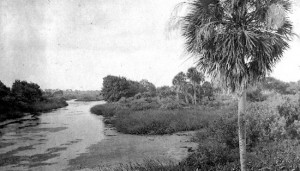
My father, Marlin Eller, used to tell me about when he was a boy in the 1930s growing up in Deerfield, the water in the Intracoastal Waterway and Hillsboro River/Canal was clear most of the time. According to him, you could see all the way to the bottom and use treble snag hooks and cast nets to catch fish from the bridges or docks.
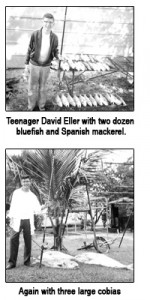
When I was a boy growing up some 20 years later in the 1950s, we only had clear water in the Intracoastal in Deerfield a few days a year, and it was never really clear in the Hillsboro Canal. However, the water was always clear in the Intracoastal on the back end of an incoming tide near the Hillsboro or Boca Raton Inlets. In December each year, the shrimp would start running, that is, they would float and swim in from the ocean by the thousands on an incoming tide. The run would continue through April. However, January and February seemed to be the best. And the very best was three days before and after the full moon. You could only see them at night with a light, because in the daytime they kept near the bottom. We would anchor our boat at the beginning of an incoming tide just off the channel so as not to interfere with boat traffic. Then, we would put our bright lanterns out on extender poles. Extending our dip nets out over the water just behind a lantern, we were ready to catch some shrimp. At night, the shrimp tend to swim near the surface, and you can see them coming because their eyes shine bright pink. Sometimes, they would be in groups of two or three and you could get them all with one swoop. But mostly it was one at a time.
Once you had a few in the net, you would dump them into the 5-gallon bucket in the middle of the boat. We would generally “shrimp” for two to three hours and then quit because it was pretty tiring and, sometimes, it would be biting cold. Back home, Mother would take the ones she wanted for frying or boiling and we’d put the others in the bait freezer.
Fishing was also good that time of year. We sometimes used a homemade lure, which we thought looked like a shrimp when trolled. We made it by cutting Mother’s orange and yellow embroidery threads into 5-inch-long pieces and tying them onto the links of a dog chain about 4 inches long. A ball sinker in the front and regular fish hook in the back finished off the lure. We’d troll between Boca Raton and Hillsboro Inlets in about 15 feet of water next to the first reef and catch lots of blue fish and some Spanish mackerel. If they weren’t biting there, we’d go into the deeper water of the second reef in about 50 feet of water and try to catch some kingfish or cobia. If that didn’t work, we’d anchor and chum up grouper, red snapper, yellow tail and the always dependable grey snapper or grunts. We could always catch fish. We had lots of fun and never worried about having something to eat.
David Eller

Historical Essay 59

My First Car … a 1949 Ford

15 Apr 2010
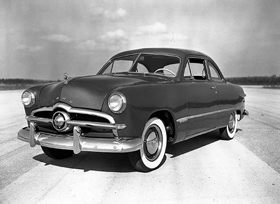
When you are 16 years old with a drivers license, but no car, life can be tedious. At least, it seemed that way to me. My parents would let me use their 1954 Chevrolet sparingly. They weren’t too enthused about me using their car for dating for some reason, so most of my early “dates” were limited to going out to Howard Johnson’s for ice cream on Sunday nights after church with one of the parents driving.
One of the girls in my Sunday School class was Sharon Bourne, whose father’s farm was what is now the Royal Palm Housing Development at the corner of the Hillsboro River, Federal Highway and the Intra-
coastal Waterway in north Boca Raton. After our ice cream, we would often drive around their farm with the lights on in her father’s truck, looking for rabbits to shoot with my “pumped air” pellet gun. We never killed one that I remember, but we had lots of fun trying.
We also sometimes played a game at their house after church called “three minutes of heaven.” Boys’ and girls’ names were put on different colored paper cards and put in a bowl. The girl drew a card, and if she agreed to … went into the closet with the boy whose name she drew for three minutes. She didn’t have to, and nothing beyond a little hugging and some kissing (primarily on the cheek) was expected. It was mostly just whispering in the closet with occasional giggling and guttural sounds, which in our innocence we thought was funny.
My Sunday School Bible teacher was Mr. Joel Horne. His parents had moved to Deerfield in 1903 (see Historical Article No. 46). He was a very sincere teacher and encouraged us to pray for other people and for ourselves last. I remember asking him one time if he thought it would be alright if I prayed to God to somehow have my own car. He looked at me seriously and then replied tenderly, “As long as you’re not going to use your church tithing money to buy it.” I agreed and started praying real hard.
A few weeks later he asked me, “Are you still praying for a car?” I, of course, answered in the affirmative. He smiled real big and said “I’ve already talked to your Mom and Dad, and they say it would be alright with them if you would like to buy my car. It’s a 1949 Ford and needs a paint job and some new tires, but I’d be willing to sell it to you for $100!” I didn’t hesitate because I knew I had the hundred dollars in my bedroom drawer. Dad spoke up then and said, “If you don’t have enough for new tires, I’ll throw those in for you!”  I gave Joel a big hug, Dad a big hug and Mom a kiss on her cheek – as it was obvious they had all conspired to make this happen. Life was good.
David Eller, Publisher

Historical Essay 58

U.S. Government’s Unclear Labor Laws

– Nearly bankrupts my Dad in 1955 –

1 Apr 2010
My Father, Marlin Eller, was a very honest businessman, and would never knowingly violate a law. However, when laws are passed, there are often  “gray areas” which have to be tested and clarified in our court system. That is what happened to my Father with a U.S. Labor law situation requiring time-and-a-half pay for any hours worked over 40 hours. When it was passed there were a lot of exemptions made. One of the exemptions had to do with agriculture-related businesses.
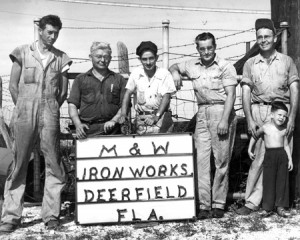
Most of our business at the time was related to the repair and manufacturing of farm equipment. In addition, Dad’s investment partner at the time was a farmer, and a lot of our company’s work related to maintaining equipment on his farm. Normal working hours, at the time, were five eight-hour days plus four hours on Saturday morning for a 44 hour work week.  Dad did it that way for years and paid straight pay for 44 hours. The business was small and, besides Dad, there were typically two machinists, two welders, two laborers and I, as a teenager part-time after school.
One of our long-time machinists, Horace Holliway, decided to quit us and go to Alaska to make some big money. So Dad hired a 30-year-old young man named Bart, who had just moved down here from up north and assigned him to the 24”Nebal lathe near our large front door facing Dixie Highway.  Bart was a very good machinist and very personable. In fact, he liked to meet our customers as they entered the front door and find out what they needed. Dad began to notice that some of the customers bringing items in for repairs woul
d leave with their items shortly after talking to Bart.
Suspicious, Dad called one of the customers and asked why?  The customer told Dad sheepishly that Bart had told the customer to bring the work to his, Bart’s place, on Saturday afternoon and Bart would do the work for a lot less than Dad would charge. Furious, Dad called all our workers to the front of the shop. Pointing his finger at Bart, Dad explained what he had found out and loudly told our other workers “This man is stealing from you and me, and I’m firing him right now!” Bart gathered up his tools and slunk out the side door.
A few weeks later, a heavy set man in a white shirt and tie with a goatee, carrying a clipboard, walked in and handed Dad his card. He was with the U.S. Department of Labor in Miami. He said there had been a complaint filed by a man name Bart who asked to see Dad’s payroll records. He, then, asked Dad why he wasn’t paying time-and-a-half for the four hours worked on Saturday. Dad explained that it was his understanding that because most of our work was farm-related, it didn’t apply to us. The man asked to see our invoices. Going through them he noticed that we also had done work for a rock quarry west of town. He said that disqualified us from the agricultural exemption.
By this time, our workers were clocking out and standing around to find out what was happening. When they heard Dad arguing with the man and saying that if that was the way it was, there would be no more Saturday work. Hearing that, our workers started getting agitated with the government man and all agreed that they would sign a petition asking to be exempted from the time-and-a-half in order to get the extra four hours pay.  This seemed to make the government man mad. He left in a huff and then served Dad with papers ordering him to go back three years and pay extra half time to all workers involved, and the workers were not allowed to refuse it. Dad did it, but it almost broke our business.
Dad even had to mail our top former machinist, Horace Holliway, a check up in Alaska. When Horace got the check he called Dad to see what was happening.  When he found out, and then learned that Dad had fired Bart, Horace admitted that Alaska was too cold for him and asked for his job back. Dad quickly agreed. So something good came out of the situation. Horace, who Dad always said was the best and fastest machinist “in the world,” came back to Deerfield to work for us until he retired.  Dad assigned me to work with Horace, on the lathe next to him, until I went off to college. He trained me well. I was able to get machinist jobs in the research departments at both Stetson University and the University of Florida years later, when I went off to college.
David Eller

Historical Essay 57

Alligators in the Hillsboro River and me

18 Mar 2010
Back in the 1950s, there was no public swimming pool in Deerfield. So in the summertime, my young friends and I would often swim in the Hillsboro River near where the boat ramp in Pioneer Park is today. There used to be a big rubber tree next to the river, with its largest branch extended out over the water. Someone had tied a long rope with knots in it on the branch. We could grab the rope, swing out over the river, let go and fall into the deep water below and swim to shore. It was lots of fun.
We never worried about alligators because it was common lore that local men had killed off all the alligators all the way to the Everglades many years ago. At least we thought that was true. However, one of our neighbor’s dogs had disappeared recently shortly after someone had seen him swimming in the river. Thus, we were on alert, watching for the dog.
One afternoon, I was fishing for mangrove snappers on the west side of the Dixie Highway bridge crossing the Hillsboro River when , suddenly, I saw an alligator about 6-feet-long swimming slowly along the shore almost directly under me. It appeared he was stalking some birds on the water’s edge. I took note that he was only about 100 yards from our swimming hole on the river at Pioneer Park. I instinctively knew it would be all right with my dad for me to kill the gator. However, time was of the essence, since he might swim away and hide.
So I ran as fast as I could to our house (about 150 yards away), grabbed my single shot 22 caliber rifle from the closet, a few hollow point 22 long bullets and ran without stopping back to the bridge. I put a bullet in the chamber before leaning over the bridge looking for the alligator. Sure enough, the gator was only a few feet away from where I’d first seen him. He was still stalking the birds. I leaned over the bridge railing, took careful aim at his temple about 2 inches behind his right eye and squeezed the trigger. The shot hit him right where I aimed. His tail splashed out of the water, his body jerked sideways and he rolled over and sank. I never saw that alligator again.
However, a few days later, I was fishing near the same spot and saw a much smaller alligator, about 3 ½ feet long, lying on shore. I had my gig with me, which is a three-prong spear with a rope tied to the end. I threw the gig at the gator hitting him in his side with one of the prongs just behind his right front leg. I was afraid he would get off if I tried to lift him up to the bridge. So I jumped down to the ground, flipped him over on his back (which automatically puts alligators to sleep) and drug him by his tail all the way home.  When I got to our back screen door, I hollered to my mom to come out “and look at something.” She didn’t respond fast enough so I opened the door and drug the alligator up the steps and into the kitchen where mother was cooking supper. She was stirring black-eyed peas and didn’t look around at first. I had the gator, still on its back, about a foot behind her when she looked around. Seeing the alligator, she let out a scream and jumped, throwing black-eyed peas into the air and all over the kitchen. I was laughing, but she didn’t think it was funny.
I put my new alligator friend into a pond we had in the backyard leaving him firmly tied by the rope attached to his tail. But when he went under water we noticed bubbles coming out of his back where my gig had penetrated him. Dad suggested that we should take him to the new Animal Park, which had opened, recently on Federal Highway in Pompano. So we put him in the trunk of mom’s car and drove him down there, always keeping him on his back. The manager of the park seemed glad to get him, said he would fix his wound. He didn’t give me any money for the alligator when I asked, but did give me a year’s worth of free passes to the park. We went to see my gator a few times after that, but I don’t think he ever recognized me.
– David Eller

Historical Essay 56

Guitar works wonders … with girls

4 Feb 2010
In the last two historical articles, No.’s  54 and 55, I shared how I’d spent my first two teenage years, ages 13 and 14, in Deerfield flat on my back in a body cast to correct a spinal problem. I was in recovery mode through most of my 15th year, and developed a great interest in guitars and girls. In that order, I might add.
My Dad had an old acoustic Gibson guitar he kept in the closet behind the suitcases. One night, I dug it out and asked him to teach me how to play it. He’d been working hard in our machine shop all day, and at the time, was relaxing in his favorite recliner chair reading the newspaper. His response to my request was to lower the newspaper, look at me briefly and say: “Your hands aren’t big enough yet.”
He had used that excuse several times already, and I was beginning to get frustrated. Especially, since a new fellow my age, Richard S., had recently started Pompano High School in my class and had performed for our assembly program at high school by playing the guitar. His hands didn’t seem to be any larger than mine, and he could really play that guitar and sing. The girls were always very friendly to him, which I admit made me a little envious.
I had also become enamored by one particular girl in the class behind ours. She was just the right height for me, had medium length bright blond hair, a good figure and a great smile. I’d spoken to her a few times and knew she lived in Lighthouse Point and was allowed to date. Her name was Gail, she was gorgeous, and was always nice to me when we chatted. I had dreams of taking her out on a date as soon as I turned 16 and got my driver’s license.
That day finally arrived. I passed the test for my driver’s license the first time, got permission from my parents to use their car on Saturday night, and waited around the school hallway on Tuesday where I knew Gail would be walking. Sure enough, she was right on schedule as I sauntered up next to her and blurted out, “I got my driver’s license yesterday and my parents said I can use their car Saturday night. Would you like to go to a movie?” She hesitated for a moment. It seemed like forever. Finally, she said slowly, “OK. What time?”  I told her 6:30, and when she agreed, I just wanted to give her a big hug. But knew I shouldn’t, at least not yet!
Wednesday and Thursday were wonderful days. Friday was, too, up until my last class, when I got out and I saw Gail waiting for me with a serious look on her face. I went to her and said: “What’s up?” She said, “I can’t go out with you tomorrow night!” Thinking maybe she was sick or something I said, “I’m sorry. Are you OK?” Without any expression or apology she simply said, “Oh, Richard S. invited me out, and I’d rather go out with him.” I felt like someone had slugged me in the stomach. I said, “Why would you rather go out with Richard than with me?” She immediately replied, “Richard plays the guitar and sings.”
I was not a happy camper. So that night, when Dad gave me his standard excuse for not teaching me the guitar, I did not quit. I told him what had happened at school that day and insisted he teach me “Now! Tonight.” So, he did. He sat with me that night and explained that most songs can be played on a guitar by using only three chords in a progression. However a few songs only use two chords. Since I was just beginning, he taught me the same two-chord song he had learned as his first song – “Birmingham Jail.” It’s played using only the chords “D” and “A7.” By the time I went to bed that night, I had mastered those two chords and that song. Within a month, I’d mastered several more chords and many more songs. I never did have a date with Gail. But I never lost out on another girl I was interested in dating to someone who could outplay me on a guitar either.
-David Eller

Historical Essay 55

My Best Christmas – Walking Again

17 Dec 2009
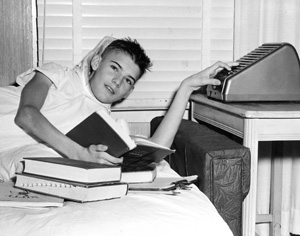
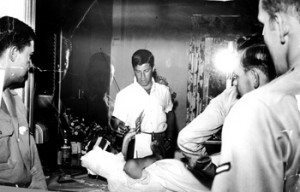
In previous article, No. 54, I described how as a 13-year-old boy in 1954, I was diagnosed as needing an operation to prevent spinal curvature caused by an accident when I was much younger. It was an experimental operation consisting of inserting a 12-inch hard plastic rod into my back next to my spine. However, after about nine months, the doctors determined that the plastic was not bonding to my back. Therefore, a second operation was necessary to remove the plastic and insert a bone, which did bond, and is still there today. The doctors assured me that I would have the strongest back in town. They apparently knew what they were talking about, as I’ve never had any back problems since.
It’s been said that small towns have big hearts, and it was certainly true in our case. My eighth grade classes were completed at home
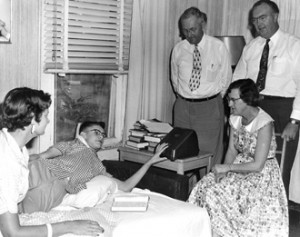
under the direction of Mrs. Lorena Lasher, who came twice per week teaching me and helping to keep my spirits up. My teenage friend James Stills visited me regularly, and Dad even took the two of us fishing once in our new 14-foot fiberglass boat. I was probably the only person to ever go fishing in a boat while in a full body cast. James teased me as he carried me into the boat, saying I would make a good anchor. Another friend, Johnny Dickens, loaned me his short-wave radio, which occupied many an hour; and the only town barber at the time, Clint Hayes, even drove to Miami once to cut my hair. When Dad tried to pay him, Clint said jokingly that he didn’t take money from his ‘regular customers.’
By ninth grade, a new communication technology had arrived on the scene. It was a telephone system wherein a speaker/receiver was installed next to my couch in Deerfield with a corresponding portable
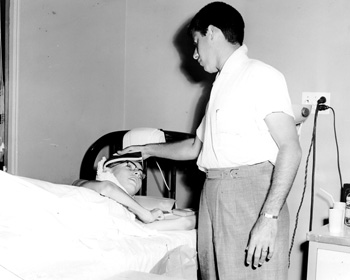
unit plugged into each of my classrooms at Pompano High School. (Deerfield did not have a high school at the time.) I was able to listen to the teacher and my classmates in class and push a button whenever I wanted to ask a question or speak. It was reportedly the first such system in Florida, and received a lot of publicity. The telephone company charged $52.80 per month for the toll charge, and the Deerfield Beach Council of Clubs, led by Robert Sullivan, guaranteed and paid for it.
During this almost two-year endeavor occupying most of my 13th and 14th years of my life, a lot of people felt sorry for me. That, of course, is normal, and I felt sorry for myself some days. However, in retrospect, what I went through was a real blessing in that I became a ferocious reader and was able to obtain and study the text books for my ninth, 10th, 11th and even some senior year classes way ahead of time. Thus, I was able to make almost straight A’s through the rest of my high school career and, ultimately, receive several scholastic scholarships paying much of my college expenses.
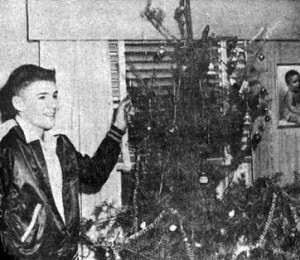
On Dec. 22, 1955, the doctors removed the body cast and I was able to stand up next to the Christmas tree in our living room wearing my “South Florida Little League Baseball Champions” jacket, which I had earned just two years prior. I couldn’t walk at first. I actually had to learn again. But I committed myself to walk by Christmas day, and I did. And every Christmas, I think about it again and thank God.
Merry Christmas!

Historical Essay 54

Jerry Lewis Comforts Me In Miami’s Children’s Hospital

3 Dec 2009
It was October of 1954. I’d just turned 13 years old and returned from playing in the Little League Baseball SoutheastUnited States Championship in North Carolina when my parents told me they had been waiting for the baseball season to finish before taking me to an appointment with a Dr. Kaiser at the Children’s Variety Hospital in Miami to get my back/spine checked out. It was because my back had been injured eight years earlier at age 2 ½ (See Historical Series No.18 ) and, although I never had any back pain, there was a concern by our family doctor, Dr. Martin, that my upcoming teenage growth spurt might cause me to have excessive curvature of the spine unless corrected.
Dad went with Mother and me to meet Doctor Kaiser, a kind-looking middle-aged man with receding black hair, wearing rimless bifocal glasses. He first examined the X-rays and then, my back. Next, he turned to my parents and solemnly confirmed that I needed a spinal operation. Dad immediately wanted to know what it would cost. Dr. Kaiser disarmed Dad by saying something like “Don’t worry about the cost. You probably couldn’t afford it if we charged you. This is actually going to be an experiment, so we won’t be charging you anything.”
That seemed to satisfy Dad, but I didn’t like the “experiment” description. However, there was nothing much I could do but to go along with the adults. Doctor Kaiser said we should come back the following Monday, prepared to check me into the hospital. We did, and thus began a journey which lasted nearly a year and a half, with me spending it mostly in a post-operation body cast.
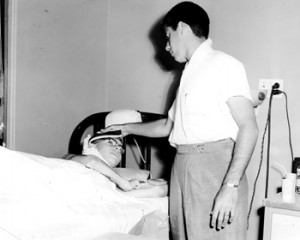
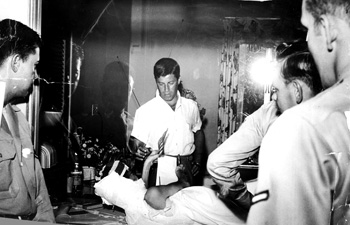
I don’t remember much about the operation itself except they put me to sleep using something called a spinal tap. They then inserted a hard plastic rod about a foot long in my back next to my spine and sewed it into my back. When I awoke, they wrapped me in a plaster body cast from the top of the back of my head, down to the lower part of my left hip, and then down my right side around my right leg to my knee. I could not sit up, and soon found out I couldn’t even roll over. However, they did leave about a 7-inch round opening in the front of the cast at my stomach area, so I could breathe, which I greatly appreciated.
A few days later, I was told that the famous comedian Jerry Lewis was coming to the hospital to visit the children, including me. When he arrived, I was expecting to see his big smiley face like I’d seen on TV and in the movies. However, when he walked into the room and looked at me in my full body cast, his face reflected tremendous sympathy, rather than humor. He looked at the name tag on my bed, which listed me as “James David,” and said “James how are you doing?” I gave him my best smile then lied and said “fine.” He patted me on top of my head and left. But I really appreciated his coming to the hospital to visit us. In fact, I still make a point of watching his muscular dystrophy telethon on Labor Day every year and usually make a donation.

Historical Essay 53

1954 was an important year … in many ways

19 Nov 2009
I was 12 years old and about to become a teenager. When on …
Jan. 14 – Joe DiMaggio married Marilyn Monroe.
Feb. 10 – President Eisenhower warned against U.S. intervention in Vietnam.
Feb. 23 – Salk vaccine was used for first mass inoculation against polio.
Mar. 1 – U.S. exploded first 15 megaton hydrogen bomb on Bikini Atoll.
Mar.25 – RCA manufactured first color TV set. Was 12 ½ inch and cost $1,000.
Apr. 12 – Bill Haley & the Comets recorded “Rock around the Clock.”
Apr. 18 – Col. Nasser seized power and became Egypt’s Prime Minister.
May 17 – U.S. Supreme Court unanimously reversed “separate but equal” 1896  decision for the nation’s public schools.
June 14 – President Eisen-hower signed order adding “under God” to the pledge of allegiance.
June 17 – Rocky Marciano beat Ezzard Charles in 15 rounds for heavyweight title.
July 6 – Elvis recorded first hit “That’s All Right Mama.”
July 12 – President Eisen-hower introduced plan for interstate highway system.
July 15 – The first commercial jet plane, a Boeing 707, had its first test flight.
Sept. 21- The first nuclear submarine, USS Nautilus, was commissioned.
Nov. 23 – The Dow Jones Industrial Average closed above the peak reached in 1929 just before the crash … and my little brother, Dwight, turned 6 years old.

Historical Essay 52

“Peeping Tom” Unites Neighborhood

8 Oct 2009
Air conditioning didn’t exist in Florida and Deerfield in the early 1950s. In the summer, it was so hot that we had to leave our windows open to try to catch a little breeze. Although wire screens across the windows kept most of the mosquitoes out, at night you could hear them buzzing around trying to get in. My bed was next to a window, and often a mosquito would bite me on the tip of my nose when I would press it up next to the screen to try to catch a little fresh air. Thus was life in Florida at the time.
In order to be comfortable, it was necessary for people to leave their screened windows open in the summertime. Thus anyone inclined to could walk up close and look into people’s windows, to see whatever there was to see going on inside.
Our neighbors across the street were “Bear” Moseley and his wife Vernell. Bear’s father lived at the south end of the block on the corner of Dixie and Hillsboro. His other son, Jay Moseley, lived around the corner and had been Deerfield’s Mayor while still in his twenties — which at the time was the youngest mayor in the United States. It was a close-knit neighborhood.
Shortly after my father, Marlin Eller, was elected as Police Commissioner in Deerfield, the Moseleys complained to Dad about a “Peeping Tom,” who was coming around their houses, looking in the windows. Since we and the Moseleys had all recently gotten telephones for the first time, Dad told them to call him the next time they saw the “peeping tom,” and Dad would sneak down the street and get behind the rascal. Then the Moseleys could rush out and help Dad catch him.
The plan worked perfectly, at least almost perfectly. Dad got the call from Bear in the early evening on a weekend night. Dad jumped up from watching TV and quietly ran around the back of our house, down the side street and came around toward the Moseley home. He spotted the peeping tom and quietly snuck up behind him. Dad grabbed the Peeping Tom, wrestled him to the ground and then pulled him up, holding both arms behind his back until Buck ran out of the house to help him. Dad was still holding him from behind as Buck drew back his fist and swung with all his might at the face of the Peeping Tom. As Buck’s fist came forward, the Peeping Tom simply cocked his head to the side and Buck’s fist hit Dad squarely in the face. With that, Dad was knocked backwards and let go of the culprit, who took off running down Dixie Highway toward Boca Raton, never to be seen again. Mother patched up Dad’s bruised face. It was the last time Dad took matters into his own hands alone when it became necessary to arrest someone.

Historical Essay 51

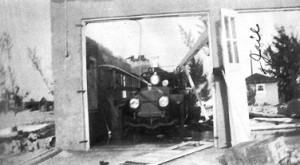
My Father, Marlin Eller, built Deerfield’s first Fire Truck  in 1954 for $2,800

24 Sep 2009
Dad apparently lost money on the deal because he never built another one. It was built on the chassis of a 4-wheel drive 1953 Dodge power wagon and had a Champion Pump. Myrle Johnson had been appointed as chief of the 15-man volunteer fire department, and some of his volunteers, especially M.A. Peterson, helped Dad build the fire truck. They added heavy-duty fenders to the frame and a water supply tank. After  it was all painted red, they attached a hose with nozzle, a siren and radio. It did the job well and cost less than $3,000. Today the city has reportedly spent over $500,000 for just one fire truck, and they have several.
The first fire station was located at the intersection of NE 2 Street and NE 3 Avenue just across the street and south of Pioneer Park. It had a dirt floor inside a barn-like building with two double doors.  When the fire alarm sounded, it could be heard all over town. Myrle would leave with the first group of volunteers to arrive. But before leaving, he would point a rotating wooden arrow mounted on a compass at the fire station in the direction of the fire for the volunteers who had not yet arrived to know which way to go.
When one of the young teenage volunteers was found to be starting some of the fires to get the stipend to participate in putting them out, the city decided to pursue a more professional force.
Subsequently, in 1956, the City of Deerfield hired Herbert E. Gimmel from Cleveland Heights, OH as its first full-time fire chief.  He and City Manager Clarence Landsitell, along with local contractor and City Commissioner Odas Tanner, led the charge to create Deerfield’s first paid fire department. Bill Abernathy and Horace Freeman were hired in January 1958. They each alternated on a 24-hour on, 24-hour off duty schedule so that a working fireman was on duty at all times.
By 1973, the City of Deerfield, with a population of 27,700, had 27 personnel in the fire department, or one fireman per 1026 residents. Many of the firemen had also been cross-trained as state-certified Emergency Medical Technicians (EMTs). By 1976, a second fire station was occupied adjacent to Century Village, Deerfield’s population had increased to 31,200, and there were 47 personnel in the fire department, or one per 664 residents.
In 1981, a third fire station was added on SE 21st Avenue; population was 50,422; there were 75 fire department personnel, or one per 672 residents. Today, there are 150 fire department employees to serve Deerfield’s population of approximately 80,000 people, plus Hillsboro Beach’s 2,400, for a total of 82,400 people. There is one fire department personnel per 545 residents, or approximately twice the number of firemen per unit population as it was in 1973. Productivity is going in the wrong direction, and it makes up a huge amount of the city budget. Does anyone out there care?

Comments Off on Historical Essays 51 to 60

Subaru Outback’s redesign is right for the sunshine or rain

Posted on 27 May 2010 by LeslieM

By Ric Green & Joe Castello

When I heard they had redesigned the Subaru Outback for 2010, I was like “WHY?”   I was happy with the 2009 and its predecessor.  It was comfortable, all-weather and beach or everglades ready, able to haul all the fishing gear or golf clubs four South Floridians could pack for an afternoon of sunshine.

But changes were made for 2010 and the Outback just keeps getting better. In fact, Motor Trend has named it Sport Utility of the Year and Popular Mechanics has named it their Most Versatile Car for 2010.

First off there is more room in the back. The previous model’s smaller doors had put a strain on the comfort of anybody that didn’t call “shotgun.” By extending the wheelbase 2.8 inches, the rear doors got longer adding an extra 3.9 inches of leg room.

Although the new Outback is 0.8 inch shorter in overall length, a height gain of 4.1 inches contributes to the increase in interior space of several cubic feet, most of it in the rear seat. Cargo space with the rear seats in place is up only 0.8 cubic foot, but when you fold the 60/40 split rear seat backs, nearly six more cubic feet are realized. The change from a multilink rear suspension to a control-arm system allows for a better layout of the cargo hold.

Subaru’s 2010 All-Wheel-Drive (AWD) crossover also got an extra dose of the stuff made its predecessor popular with the active-lifestyle market.

Visually, the 2010 Outback got a makeover that included redesigned sheet metal and lights.  Its shorter length and taller profile coupled with a 2.0-inch bump in width and its segment-leading 8.7 inches of ground clearance, gives it a more aggressive stance.

Under the hood the Outback has two choices of engines and three types of transmission, trim level, and AWD. The base engine is the 2.5i, an SOHC four-cylinder powerplant with 170 hp and 170 lb-ft of torque.  It can be mated to a six-speed manual or the Lineartronic CVT which comes with paddle shifters that create a virtual six-speed transmission, with shifts taking a tenth of a second.

The 3.6-liter DOHC is a boxer special that benefits from being expanded by six-tenths of a liter over the current Outback engine. The numbers jump to 256 hp and 247 lb-ft – with 225 lb-ft available from 2,000 rpm. It comes fitted to a five-speed automatic transmission.

The 2.5i can be mated to the six-speed manual and the Lineartronic CVT, while the 3.6 makes do with the five-speed auto. The CVT also comes with paddle shifters that create a virtual six-speed transmission, with shifts taking a tenth of a second.

The 2.5i manual comes in at $22,995, $23,995 if you go for the CVT, plus $694 destination. That’s thousands less than most of the competition Subaru has identified.  Step up to the base 3.6 and you’re in for $27,995. The tip top 3.6 Limited starts at $30,995, a $1,000 drop from the current, smaller-engined Outback 3.0 Limited, to $33,995 fully dressed.

Subaru has built its reputation on doing things differently and yet it works out as the right way to do things. The Outback has already established itself as the wagon of choice in the Northeast, Northwest and Rockies, and I think the folks in Florida will follow this lead thanks to the redesign. It  is easy to see why the 2010 Subaru Outback is an excellent vehicle.

Comments Off on Subaru Outback’s redesign is right for the sunshine or rain

Historical Essays 41 to 50

Posted on 20 August 2009 by LeslieM

Historical Essay 50

Linda Eller “markets” Deerfield Beach

20 Aug 2009

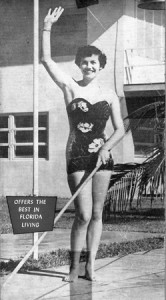
I admit to being a little embarrassed when, as a 12-year-old boy, pictures of my 15-year-old sister,

Linda, posed in a bathing suit, was the front page of the 1954 Chamber of Commerce brochure promoting Deerfield Beach. However, I was also kind of proud of her, even though I thought the bathing suit she had borrowed for the photo session from her good friend Shirley Jones in Pompano Beach was ugly. Mother wouldn’t allow her to wear a two piece.

The Chamber brochure was very successful, and helped Deerfield nearly triple its population to 9,573 people by the 1960 census. Most of that population increase, however,

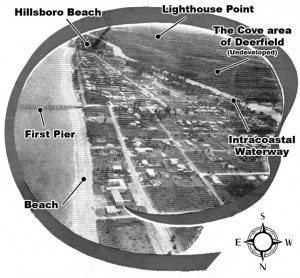
was brought about by one man, Bob Sullivan, (see Historical Article No. 19) who bought and developed the 500 acres called “The Cove” just east of Federal Highway all the way to the Intracoastal Waterway and from Hillsboro Boulevard south to Lighthouse Point. Although Deerfield had been incorporated as a city in 1925, it had grown slowly until Sullivan and a few other developers started “pushing it” in the mid 1950s. Meanwhile, Lighthouse Point was incorporated on June 13, 1956, when 107 people there voted to do so. Mr. R.E. Bateman was the first one there to buy any extensive acreage for development.

Meanwhile, my sister, Linda, mastered the piano as a young lady and went on to play and sing semi-professionally for a few years. She also attended the University of Florida in Gainesville, where she met her husband, Jim Boudet. They raised their five children in Vero Beach, where she still lives.

Historical Essay 49

Deerfield gets it‘s first Black Policeman in 1954

-Moses Bryant hired by Police Commissioner, Marlin Eller-

9 Jul 2009

When my father, Marlin Eller, was elected to the Deerfield Beach City Commission in the early 1950s, and made Commissioner of Police, Deerfield had a substantial number of African-Americans, or blacks in its population, but it had none in its small police force. The white policemen were afraid to go into the black neighborhoods, especially at night. So the black population of Deerfield was left unprotected from the criminals in their midst.

When Dad first ran for commissioner, he knew this was a problem and promised his black friends and employees he would try to do something about it. However, there were a lot of strong feelings from some of the whites in the community to having a black policeman. I remember one of our neighbors across the street telling my Dad that if he hired a black policeman and that policeman tried to arrest his wife or daughter, that would be the last person he ever arrested.

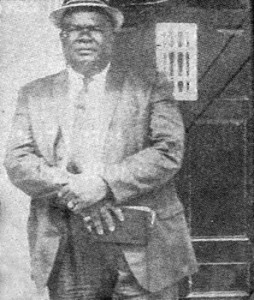
Dad was not amused. But he waited until the second half of his commission term to make his move. After interviewing a number of prospects, he hired Moses L. Bryant to be Deerfield’s first black policeman.

To put it mildly, all hell broke loose within parts of the white community. In fact, Dad had to ride with Moses when he went on duty for awhile to protect Moses from threats which were being made.  Dad put out the word that anyone wishing to cause a problem for Moses would have to deal with Dad first.  Dad in his prime, well built, nearly 200 pounds, with boxing as a hobby, was not challenged as far as I know.

Moses eventually was accepted by most of the community and life in Deerfield went on. When he moved to Deerfield from Shamrock, FL, Moses had three sons: Bobby Lee, Robert Lee and Clarence. While on the police force he had seven more children, three more boys and four girls, for a total of 10 children. Most went on to get a college education and some became school teachers. When Moses eventually retired from the police force, he became a Christian minister.

The City of Deerfield Beach honored him a few years ago by renaming SW 5 Court, Rev. Moses L. Bryant Court. My Dad, Marlin Eller, would have been proud.

Historical Essay 48

Local Little League Team Wins 1954 State Championship

-Goes to North Carolina for National Playoffs –

11 Jun 2009

As my classmates and I gather for our 50th reunion, I wanted to write about our Little League experience. Since our family, the Eller family, has lived in Deerfield Beach since 1923, I’ve often been asked to put in writing some of the history of the area, either experienced personally, or that I heard from my parents or grandparents.

– David Eller, Publisher

Life was good in 1954. Dwight Eisenhower was the U.S. President.

On Feb. 23, the first mass inoculation for polio prevention was done with Salk vaccine. On Mar. 1, the U.S. exploded its first 15 megaton hydrogen bomb at Bikini Atoll .On Mar. 15, The  CBS Morning Show premiered with Walter Cronkite and Jack Paar. On Mar. 20, the first newspaper vending machines were used. On Apr. 2, plans to build Disneyland in California was announced. On Apr. 5, Elvis Presley recorded his debut single, “That’s All Right.” On Jul. 12, President Eisen-hower put forward a plan for the interstate highway system.

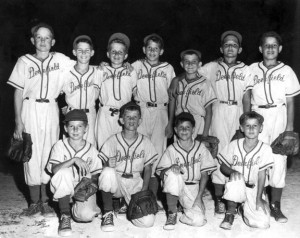
Meanwhile, in Deerfield Beach, Pompano and Wilton Manors, large crowds were coming to watch the North Broward Little League Baseball Team All Stars beat Ft. Lauderdale, Palm Beach, Miami and Orlando teams. Winning the South Florida Little League Championship qualified the team to go to North Carolina to play for the National Championship of Little League.(Florida was divided into two halves at the time by the Little League: South Florida and North Florida)

Our parents drove up to North Carolina. The team took the

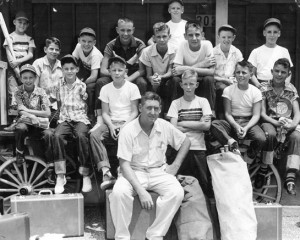
train. Someone, I was later told it was “Uncle Jim” Butler, who came to every game sitting in his car and watching us, donated new uniforms for us to wear. Rev. Briggs, of the recently established Presbyterian Church in Deerfield, was at every game, helping Police Chief Manning and Policeman Roy Bennett coach us.

We were good. At least we thought we were. My own claim to fame was that my Father’s good friend, Herb Dudley, a professional pitcher, had taught me, a left-hander, how to throw curve balls that would “break” one to two feet just as they reached the plate. My fast balls weren’t anything to brag about, but my curve balls struck out lots of batters. That is, for about five innings —after which my elbow would hurt so badly I had to retire to the dugout.

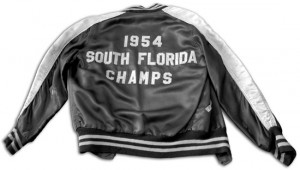
We arrived in Greenville, NC and stayed in the dormitory at East Carolina University. We thought we were hot stuff and unbeatable. When it was time for our first game, we came out early to warm up. We looked good in our new uniforms and maroon colored jackets with “1954 South Florida Champs” printed on the back.

I’ll never forget what it felt like when our North Carolina opponents arrived on the field.  They came from a mountain area and were an average of four inches taller than us. Some of them had slight beards. Their voices were several octaves lower than ours. They were wearing overalls. Our coaches were concerned and wondered out loud about the ages of our opponents. But, when the umpire shouted “Play Ball! “ it was too late to worry about it. We played our hearts out. They scored the first run. We came back and tied them. We held them until the fifth inning, when they scored their second run. We never scored again, so the game ended with them beating us two to one. We cried, and it was the end of my baseball “career.” I never played again, although some of my teammates went on to play high school, college and a couple made it into the Pros.

Historical Essay 47

Famous Golf Pro Sam Snead can’t beat my Dad -out of money, that is-

4 Jun 2009

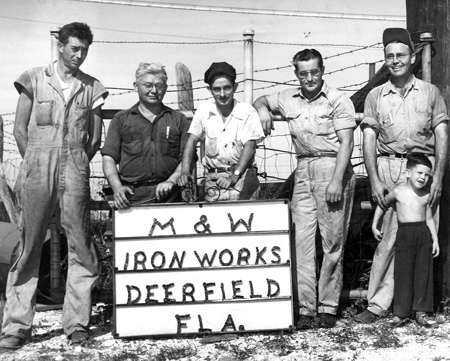
When I was a child in Deerfield in the early ‘50s, the “Boca Raton Resort & Club” was the main source of economic activity, next to farming, in this area. Other than the hotel, most of the land in Boca Raton was largely owned by the Butts family (See Essay No. 13) or the Japanese farmers (See Essay No. 14). Thus, Deerfield, with its approximately 1,000 residents, was actually much larger in population than Boca Raton at the time. And, it provided much of the small business support for both communities — like two grocery stores, two clothing stores, a drug store, two gas stations and one welding/machine shop, which my Dad, Marlin Eller, owned. It was located on Dixie Highway, where the tennis courts are today. We lived next door to the shop in a wood house painted white with red storm shutters and a white picket fence all around.

Dad would get up early every morning and sit at the dining room table drinking coffee and reading the Bible before going next door to open “the shop” about 7 a.m. We were one of the only machine and welding shops between Ft. Lauderdale and West Palm Beach at the time. Local farmers were our main customers, but we also provided service to the State Road Department, Vrchota Trucking, Deerfield Rock Industries and the Boca Raton Hotel.

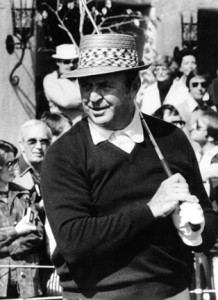
One night over supper, Dad told us about an incident he’d had that day with a gentleman wearing a hat who had come in to get some welding done on some sort of golf ball handling device. It had gotten broken and needed to be welded. We had a minimum charge at the time of $3. When the job was complete, Dad made out an invoice to “Cash” for $3 and handed it to the gentleman. The man looked astonished and said to my Father, “You’re not going to charge me, are you? Don’t you know who I am? I’m the pro at the Boca Raton Hotel and my name is Sam Snead!” Dad, who did not play golf, was a bit taken back and responded with, “I don’t care if your name is George Washington …or Abraham Lincoln. You owe me $3!” Sam, reluctantly, reached for his wallet, paid up and left muttering to himself. Dad later found out that Sam Snead was the most famous golfer in America, but had a reputation for trying to avoid paying for anything. He didn’t “get” Dad, but I sure wish Dad had gotten his signature. It probably would have been worth a lot more than the $3!

Historical Essay 46

Deerfield’s Horne Family

14 May 2009

In the last essay I mentioned that Joel Horne was my Sunday School (Bible)

teacher when I was 12 years old in 1954. Joel’s mother and father, J. R. and Ardena Horne, had moved in 1903 from the Lakeland, FL area to this small village, then called Hillsboro,* later changed to Deerfield. Citrus growers and vegetable farmers, they came to Deerfield because the steam-powered trains on the recently built Florida East Coast Railroad had to stop here to take on water from the Hillsboro River to make steam. This stop allowed farmers located here, including the Hornes, to load their winter-grown crops and citrus on those trains for onward transport to northern markets.

J. R. Horne was quite successful and ended up owning a large amount of land in the area, including what is now the Deerfield Beach Country Club, which was his citrus grove, and lands east and west of that all the way to Powerline Road.

But unfortunately, he was murdered at his citrus grove in 1920 when he came across thieves, reportedly railroad workers, stealing his citrus. The murderers were never caught. His wife was left with small children to raise and had to sell off their property to support the family.

*The area’s name originated from the Earl of Hillsboro, who had received large land grants from King George III during England’s hold on the area between 1763 and 1783. In 1897, reportedly an engineer working on the construction of the Florida East Coast Railroad named C.E. Hunt renamed the area from Hillsboro to Deerfield because of all the deer in the area.

Historical Essay 45

God and Me in 1954 at age 12

9 Apr 2009

Last week, I wrote an essay entitled “Seeking God as a 12-year-old boy in 1954.” This is a sequel to that story. When I had NOT joined most of the youth in my church by “going forward to accept Christ” during a church-held religious retreat, our pastor Bob Rowe asked me “Why?” When I explained that I needed to know more about other religions of the world first, he encouraged me to do just that. He told me that our Christian faith was about God reaching out in love to mankind, as opposed to mankind having to fear a vengeful God. My subsequent studies verified that to me. I started my Bible study by re-reading the first chapter of Genesis where it starts off by saying: “In the beginning God created the heavens and the earth …” It took me a few days to get almost through the second book, Exodus, where in Chapter 20 God used Moses to give us the 10 Commandments. I started scanning through the rest of the Old Testament, ending with the last book of Malachi, in one particular series of verses where God is speaking really got my attention: Malachi 3: “Will a man rob God?  Yet, you rob me.” But you ask, “How do we rob you?” “In tithes and offerings … Test me in this,” says the Lord God Almighty, “and see if I will not throw open the flood gates of heaven and pour out so much blessing that you will not have room enough for it.” I really liked that scripture, still do, and

I am a living testimony that it is true. During the next few months, I read all of the New Testament and got excited about how the birth and life of Jesus fulfilled many prophesies made in the Old Testament hundreds of years prior. About that time, in the summer of 1954, we had an evening revival at our church led by a young minister named Bill Taylor. The first night I went into church with my best friend at the time, James Stills. He was one of my classmates who had “gone forward to accept Christ” a few months prior. We went down the right aisle of the church about midway and he went in to get seated on the right side first. He stopped shortly after stepping into the seat section, leaving me to his left right next to the aisle. After appropriate singing, the Reverend Bill Taylor started preaching. He was a lot

younger than Reverend Rowe and seemed to be preaching directly to me. After the sermon, we were standing up singing when he invited all those who would like “to accept Christ” to come forward, Suddenly, my whole body got stiff. I couldn’t move. James, without even bothering to say anything to me, just shuffled to his left, poking me softly with his left arm pushing me out into the aisle. I stumbled sideways into the aisle for a moment, steadied myself and looked up as the Reverend Bill Taylor, 30 feet away, had his outstretched arms reaching out for me.  Suddenly, I felt myself, in an almost out-of-body experience, “floating” forward toward the Reverend Taylor. When I reached him, he hugged me and said something like “Praise the Lord! “I found out later that nearly everyone in church was praying for me to go forward to “accept Christ.” It worked and is still working. I was baptized by immersion the next Sunday.

Historical Essay 44

Seeking God as a 12-year-old boy in 1954

2 Apr 2009

An age-old question in many cultures is when does a boy start to become a man?

I noticed at age 12 that my parents started treating me a little differently.  For one thing, I was the only child in the church my age that had not “gone forward” — that is, walk down the aisle at the end of a church service during the invitation to “accept Christ.” Most of the kids my age had “accepted Christ” when the Church Pastor Bob Rowe had taken the whole youth group at First Baptist Church up to Ft. Pierce  for a retreat. Intensive Bible study for a week was followed by emotional preaching, ending with invitations for all of us to come forward to accept and commit our lives to Christ.  I was the only young person from our church who did not go forward to “accept Christ” at the retreat and agree to get baptized. Since my parents had always said that it was important that I made that decision on my own, I decided to wait. Pastor, Rev. Rowe was concerned.  He sat with me on a park bench later and asked me why I didn’t want to “accept Christ?” I told him that I wanted to find out about other religions in the world and what they believed, before making such an important decision. He seemed to understand and suggested that I might want to use the new Compton’s encyclopedia that he knew my parents had just bought, and go to the religious section and see what I could learn about other religions.  He further offered to loan me any of the books in his personal library, which might help. Furthermore he suggested that I might want to read the entire Bible,  starting with Genesis of the Old Testament and ending with Malachi. Then I should read the New  Testament starting with Mathew and read all 27 books ending with Revelation. And most importantly, he said I should pray each time before reading and ask God to help me understand the truths that He has revealed to us through His Holy Scriptures. Rev. Rowe then said  that he would be available anytime if I wanted to consult with him or ask any questions. Thus began my quest at age 12 in the year 1954 to do a lot of reading on faith and religion. I wanted  to learn more about who I was, where I came from and where I was going. Fortunately, I was supported in this endeavor by both of my parents, my Sunday School teacher, Joel Horne, and, of course Rev. Rowe. It was a great year.

Historical Essay 43

Deerfield Beach used to be a Party Town!

19 Feb 2009

In the early fifties, television changed social life in Deerfield Beach, just as it did in communities throughout the United States. Before television, Deerfield had an active social scene with people regularly visiting neighbors and friends and often bringing food and sometimes musical instruments with them to make their own entertainment.

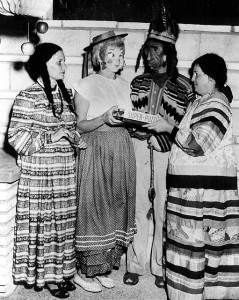
House parties were common and sometimes involved a theme or even costumes. My parents, Marlin and Lorena Eller, were active participants, both throwing and attending parties. One party in particular that I remember them attending was at the large new home of Alvin and Betty Jones on Hillsboro Boulevard. It was a costume party. Dad went as an Indian Chief and mother as a cartoon character, Little Annie. They won first prize and received a Super-Puzzle game. I remember Dad telling me he had to wear his sleeves long to cover up his hands in order to keep people from recognizing him.

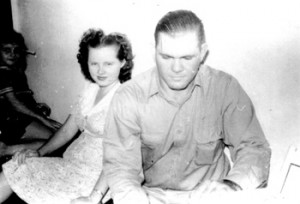
Mary Jones, to mother’s right, dressed as a Seminole Indian, hosted the most parties in town. She could afford to because her husband Alvin was a successful farmer and Chairman of the first and only bank in town at the time, the Deerfield Beach Bank and Trust Company. Ethel Jones, to Dad’s left, also in Indian garb, was married to Alvin’s brother, Leo Jones.

We knew all of our neighbors then. Life was simple. Life was good. We didn’t even have to lock our doors at night. Brownie, our mutt dog, protected us with his bark and, if necessary, with his bite.

David Eller, Publisher


Historical Essay 42

From dead buzzards, to best drinking water in the state

22 Jan 2009

There are a lot of reasons that cause people to run for public office. My Dad, Marlin Eller, ran and was elected as a city commissioner in 1953 (see Essay No. 38) on a platform to improve and increase the city’s parks and recreational areas. Victorious in the election, he was confronted immediately with the fact the City didn’t have money for such projects. However, being the resourceful businessman that he was, he was able to find more money for the city by getting hundreds of acres of vacant land, in what is now called The Cove, reevaluated in value for the tax roll.(See Essay No. 39 ). The City used these additional funds then to build the pier on the beach, assist with the beach pavilion project, and install the boat ramp at Pioneer Park.

Just prior to Dad’s election, the City had built a new elevated water tank located where the fire department is now at Federal Highway and Hillsboro. I remember being happy because the water pressure was much stronger, allowing me to fill the bath tub up quicker and to squirt my sister with the hose outside from a further distance. However, as time went on, we all noticed that the water tasted worse and worse.

One morning I heard my parents talking about it. Dad had met with the men running the water department and had determined that they all seemed to be doing their jobs properly and the water tasted fine there. Something else apparently was happening to make the water taste bad before it reached our homes. Someone reported that they had seen birds flying around the top of the new elevated water tank. So Dad took Chuck Craven, a welder that worked for Dad, and who had worked in Chicago for a company who built elevated tanks, with him to climb up that tank and check it out.  Dad was a little afraid of climbing so high, but Chuck helped him and they went up together.

When they reached the top, they couldn’t believe what they found. Everyone had always assumed that there was a top on the city water tank. However, Dad and Chuck found out there was no top. It was wide open, and full of dead birds, including buzzards. I remember Dad saying the stench was awful and made him nauseous.

Back on the ground he immediately called an emergency meeting of the City Commission to discuss what to do. Chuck offered that he could put a top on the tank, based on his experience in Chicago, but would need some help and would expect to get double pay for the risk and difficulty involved. This was conveyed to the other commissioners who immediately agreed to have Chuck do it on an emergency time and material cost basis. Dad abstained from the vote but everyone else voted to do it. Thus Deerfield got a top on its first elevated water tank, and has had excellent, good tasting water ever since.

Years later when Dad was up for reelection, I remember a sleazy looking newspaper reporter from the Palm Beach Post, wearing dark glasses and a crumbled dark brim hat, came to our house one night, apparently with a hidden agenda. Dad welcomed him and when he started asking questions about the water tank project Dad went next door to our shop office, and got the file. He invited the reporter to look through the time cards to verify the charges, and suggested he could interview Chuck and other employees as well. The reporter declined and then wrote a nasty little article with insinuations which were completely untrue. It made my mother cry. This event shaped my opinion of the newspaper business. It made me realize how important it is that newspaper reporters be fair and accurate in their stories, without a hidden agenda. If mistakes are made, they need to be corrected, and opinions should be reserved for the editorial pages by those assigned the task for doing so.

And incidentally, since then, the water in Deerfield Beach has won many awards for quality and is rated one of the best in the State of Florida.

David Eller, Publisher


Historical Essay 41

Christmas 1953: The Tree and the Tramp

18 Dec 2008

When I was 12 years old Deerfield was just a small rural community. Dixie Highway was our main north-south road, and our family home was the first house on the east side coming south from Boca Raton.  There was no such thing as a store-bought Christmas tree back then —at least not in Deerfield. So at age 12, a few days before Christmas, it became my job to go find a tree “in the woods” (i.e. in Boca Raton), cut it down and haul it on my wagon back to the house down Dixie Highway. I’d received my own hatchet for my birthday in October, so I was anxious to use it to cut down a tree. I hid my wagon in some bushes and searched the area just north of the bridge on the east side. While searching, I heard some voices down by the river. So I crept down to see what I could see. I saw three hobos sitting under the bridge talking. One was coughing badly and he looked really skinny. I felt sorry for them, especially the one coughing (because it was really cold and they didn’t have on jackets). But I knew better than to approach them, as they might be dangerous. They hadn’t seen me, so I headed back north by the highway looking for a Christmas tree. I finally found one that was shaped just right and about as big as I could put on my wagon. So I chopped the tree down, dragged it to the highway and put it on the wagon. Then I pulled the wagon with the tree back over the bridge, above the hobos, and to our house about 100 yards south of the bridge. When I got the tree home, Mom congratulated me and we installed it in a special sand-filled bucket container with spreader legs that Dad had made for that purpose. We added a little water and started the decorating process. While we were decorating, I mentioned to Mother about the hobos I’d seen and how cold they looked and how one was coughing real bad. I knew that sometimes Mom had made sandwiches for hobos who knocked on the door. So after we finished the tree, she went into the kitchen and started making peanut butter sandwiches. She put them in one brown bag and then got another bag of old sweaters and jackets which Dad didn’t wear very often and one old blanket. She then told me to go back down to the bridge and drop the two bags down to the hobos without saying anything to them. Then I was to run back run back home quickly making sure they didn’t see where I went. With mission accomplished, I was proud to have done something to help those poor fellows. I remember Mother and Dad talking about it that night and Dad saying that it happens every winter. When it gets cold up north, the vagrants, as he called them, come south looking for warm weather. They apparently don’t realize that it can get cold down here, too. So they end up unprepared when a cold spell hits. The next day was a Saturday and I was watching Hop-Along Cassidy on TV when the police car pulled up front. The policeman, Mr. Lloyd Newman, came to the front door carrying the same brown bag I had dropped down to the hobos the previous evening. He said, “Mrs. Eller did you make some peanut butter sandwiches for some hobos by any chance?” Mother said “Yes, I did. David dropped them off to the hobos down by the bridge yesterday afternoon.”  Officer Newman continued, “Well, we found a dead man, a hobo down under the bridge this morning, with a half of a eaten peanut butter sandwich in his hand. We just wanted to make sure he hadn’t been poisoned or anything like that. But if you made the sandwich then I know everything is alright. So…you have a Merry Christmas, you hear?”  Mother responded “Thank you Lloyd. And Merry Christmas to you too!”     I share this true story as a reminder that we all need to be sensitive to the needy in our midst. Happy Hanukkah and Merry Christmas to all.

David Eller, Publisher

Comments Off on Historical Essays 41 to 50

Historical Essays 31 to 40

Posted on 20 November 2008 by LeslieM

Historical Essay 40

1953 at Deerfield Elementary School

Published: 20 Nov 2008

While my father, Marlin Eller, was busy serving on the Deerfield Beach City Commission, I was enjoying myself in the sixth grade at Deerfield Beach Elementary School. At first we didn’t have a teacher for our grade so Mrs. Henry, the principal of the school,did the teaching until Mrs. Sawitzke arrived to take over the job. She was a very good teacher and even introduced us to acting in a play about gypsies. I was King of the Gypsies and Lynda Dame was Queen. It was a little embarrassing because over the previous summer Lynda had grown to be about 6 inches taller than I was. I don’t think she grew an inch after that summer, so I eventually caught up and passed her in height.  The “lead” actors in the play (left to right) were Tommy Gannon, yours truly David Eller, Lynda Dame, Richard Rieth, Jimmy Phillips, Peggy Hahn (seated) and Beatrice Manning. Richard Rieth was the shortest member of our class, but very smart in math and science. He wrote the following: “With the help of my scientific mind and my chemical analysis, I am going to try to look into the future and tell what I see my classmates doing 10 years from now. I see, yes, I see Dewey Bennett playing big league baseball with the New York Grankees, I mean, er…the New York Yankees. I also see Tommy Gannon leading a big band in New York, and his name in neon lights. As for Mildred Gordon I see her as a nurse working in the largest hospital in the world. Yes, and David Eller playing baseball with the Boston Beans, oh, I mean the Boston Red Socks. As for Beatrice Manning I see her working as a clerk in a bakery. I also see Diane Ash as a schoolteacher teaching sixth grade, and doing just as wonderful a job as our teacher Mrs. R.S. has done. The night of our operetta, there was a big movie producer from Hollywood, California in the audience, who promised great careers for Peggy Hahn and Lynda Dame. Now they can be seen in the great musical hit South Atlantic. I also see Jimmy Phillips working in a circus as a trapeze artist. Yes, and Donald Williams and James Stills becoming great farmers and growing new kind of fruit trees by use of chemicals and grafting. With Deerfield growing as it is, I see a newspaper all its own, published and edited by Janice Brown and Jessie Beard, with the gossip column headed by Susan Whitney. As for myself, with my interest in electricity and my experimenting with chemistry, I’ll be lucky if I’m still here 10 years from now.”   Richard Rieth. Note: One of his predictions came true: Tommy Gannon, a tremendous trumpet player even in sixth grade, went on to have his own big band in California. Richard Rieth graduated from our high school a few years later and received a full scholarship to Rensselaer Polytech  University in New York to study engineering. He went on to help develop our modern telephone systems. Yours truly, David Eller, ended up as publisher of the newspaper in Deerfield instead of Janice Brown and Jesse Beard. And finally, Mildred Gordon wrote the following poem dedicated to the graduating sixth grade class at Deerfield Elementary School in 1953:

Six more years have we to go

down the path of life abroad,

Down the sunny lane to school

Where we always obey the rule.

We’re half way through the school life now,

Six more years upon our brow.

When it’s hot when it’s cool

We’ll still be in school;

Even though we’re half way through

We’ve still got six years to do

Now we sing farewell to you

And to wondrous teachers too

David Eller, Publisher      11-20-08

Historical Essay 39

Elected to the Deerfield Beach City Commission

Published: 16 Oct 2008

Elected to the Deerfield Beach City Commission in 1953, my father, Marlin Eller, had campaigned on promises to the voters to build more parks and recreational facilities for the town. Once elected, however, he found out that the town was nearly broke and, thus, could not afford any such projects. Dad was very frustrated. He had hoped to build a boat ramp on the Hillsboro River in Pioneer Park and a fishing pier and pavilion at the beach. But the city did not have enough tax money coming in to afford such projects. Frustrated, he started looking into the city finances.  The problem was that most of the land in Deerfield was owned by the Kester family of Pompano Beach, who also owned the only bank in the area, the Pompano State Farmers Bank. Mr. Kester was content to keep the hundreds of acres of land he owned in Deerfield essentially undeveloped, since it was on the tax roll valued at only $500 per acre, and, thus, did not cost him much each year in taxes to leave it undeveloped. Dad suspected that the Kester land was undervalued. He decided to get an opinion from one of the only real estate brokers in the area at the time:

Boynton Realty (See previous Essay No. 19 ). Shortly thereafter, Boynton Realty notified Dad that they had a qualified buyer who would pay $1,500 per acre for the Kester owned property in Deerfield. Dad had the city clerk notify Mr. Kester that the city was going to meet on a certain date and vote to increase the taxable value on his property to $1,500 per acre. Mr. Kester was not a happy camper. In fact, he showed up at the meeting, stood up and angrily said that he would sell every piece of property he owned in Deerfield if they raised the tax value to $1,500. Dad responded by asking him if he was sure of that? Mr. Kester responded in the positive. With that said, Dad invited Mr. Forney Horton of Boynton Realty and his client Robert Sullivan to the podium. Mr. Sullivan presented a letter from his bank guaranteeing that the funds were available to buy the approximate 500 acres of land at $1,500 per acre that the Kesters owned in Deerfield, running from Hillsboro Boulevard to the current Lighthouse Point boundary and  from the Intracoastal Waterway to  Federal Highway. Mr. Kester, apparently surprised, immediately agreed to the sale, in front of the whole audience. Thus, the City of Deerfield nearly tripled its income that night, and Dad was able to proceed in accomplishing his promises for a boat ramp, a fishing pier and a beach pavilion for the citizens.

David Eller Publisher        10/16/08


Historical Essay 38

Marlin Eller, my father, wins big in 1953 election … for Deerfield City Commission

Published: 2 Oct 2008

Dad ran for the Deerfield City Commission in 1953 and won, receiving nearly 80 percent of the votes cast. In fact, he got more votes than anyone else running for any of the commission seats that year. There were only a little over 500 voters in that election, and Dad got more than 400 to vote for him. He was 37-years-old and very happy. Deerfield did not have a City Manager form of government at that time. It had a mayor and four commissioners, each of which was responsible for managing a portion of the city government. Each commissioner selected the part of the city government he or she would like to “run.” The commissioner who received the most votes could select first. There was a commissioner responsible for utilities, a commissioner responsible for streets, another for the fire department and another for the police. Dad selected to be the commissioner of police.  It was not such a big job, because there were only four or five policemen. Deerfield even had its own small jail at the time, approximately where the city council chambers are located today. The police also had their office there. It was only a block from our house and factory, which made it very convenient for Dad to go there as needed.   Dad had not run on a campaign to be the Commissioner of Police. He actually ran on a campaign to improve and increase the city’s parks and recreational areas. Once elected, however, he realized he could do more for the city as Police Commissioner to fight for some other issues which were festering in our small southern town. For instance, Deerfield had a sizable black population, but had no black policeman. Crime was rampant in the black neighborhoods, and the white policemen seemed afraid to go there. When they did, there seemed to be a tendency to use too much force, out of fear, or other reasons. Dad had many friends in the black community who had supported him and quietly solicited their help to find the right person to hire. Meanwhile, he started working on other projects which the city needed. The most urgent was that there were not street markers at the corners of most streets which identified the street. Without street signs, it was very difficult for visitors to find their way around. Dad brought it up at his first commission meeting. The city clerk, Mr. Richardson, reported that Deerfield’s budget did not include any money for pursuing such a project.

In frustration, Dad blurted out that he thought he could get concrete street markers donated from the new concrete company which had recently moved into town. The other commissioners then agreed that if Dad could get the street markers donated, they would pay to get them installed… The new concrete company Dad was depending on to make the donation was located just east of the Sea Board Railroad crossing, where JM Family’s headquarters is today. Dad had done the owner a few favors by working at nights and on weekends doing some emergency welding and machine work on some of the concrete company’s equipment. He took me with him on Saturday morning to see the owner, a tall bald headed man, and make the request. I could tell Dad was a little nervous. He finally got the request out for 6- by 6-inch concrete pilings, 5 foot long to be donated to the city. Without hesitation, the owner said, “Marlin, is that all you want? Just let me know how many. It would be our pleasure.”   By the following Saturday, the piles were delivered to our shop. That’s when I learned that it was going to be my job to help paint the street numbers, through stencils, on the pilings. When I think about it, I can still smell the black asphalt based paint we used to give Deerfield its first street markers.

David Eller Publisher      10/02/08


Historical Essay 37

President Eisenhower’s Inauguration … caused me to break my arm

Published: 28 Aug 2008

I was 11 years old, and maybe it wasn’t directly Ike’s fault. But if it hadn’t been for his being inaugurated as U.S. President on January 20, 1953, I probably would not have broken my arm that day.  It began with my mother, who was President of the PTA at Deerfield Elementary, requesting Mrs. Hendry, the principal of DeerfieldElementary School, to allow me to leave school early and come home to watch the inauguration on our new television set. Mrs. Hendry approved it with the caveat that I was to give a report to the class the next day. When I got home from school to watch, my parents along with some neighbors, were already watching the 14-inch black and white TV in our living room. It was a little after 11 a.m., and after about 30 minutes of watching politicians talk, I got bored. I heard the announcer say that the big event, or actual inauguration itself, would not take place until noon. My parents were busy watching the TV and talking to their friends, so I decided to slip out into the backyard to play on the new monkey bars Dad had recently made for me. I climbed to the top and instead of using my hands like you’re supposed to do, I decided to see if I could walk across the top of the bars.  That was a big mistake because I didn’t even get a third step

in when I found myself falling and twisting at the same time. I put my right arm out to break the fall and landed on the palm of my hand with a stiff arm carrying all my weight. A loud cracking sound of my right arm breaking … is a sound I will never forget. The pain was intense. Crying and embarrassed, I ran back into the house holding my arm. Everyone followed me out into the backyard as I explained what happened. The closest hospital to Deerfield  at the time was the Good Samaritan Hospital in West Palm Beach. My parents let their friends and neighbors stay to watch “Ike” get inaugurated as president on our new TV, while they drove me to the hospital. My parents were especially irritated as it turns out because it was the first time either had a chance to actually see a live presidential inauguration. Things did not get better at school the next day. Mrs. Hendry, the principal, saw me coming into school with a cast on my arm. She asked me what had happened. I told her. She looked upset as she said: “I let you out of school to watch the presidential inauguration, and you went playing instead! I’m surprised at you David. See what happens when you don’t do the right thing!” I never forgot her scolding. If I had been watching the inauguration like I was supposed to be doing, I wouldn’t have gotten hurt. Another lesson learned.

David Eller, Publisher


Historical Essay 36

A Giant Catfish and the Devil … got me into trouble!

Published: 14 Aug 2008

I was a very busy boy in my eleventh year of age in 1953. My job every Saturday morning, working in my father’s machine shop as an assistant to Roosevelt LeGreer, was now bringing me in one dollar each week, which Dad paid me with four quarters. I kept two of those quarters in my pocket to spend and saved the other two in a glass canning jar made by the Ball Company, with a brass colored metal threaded cap on top. I kept the jar in my bedroom on a shelf next to my bed. Every day I counted the quarters, so I knew exactly how much money I had. I decided then to only spend two quarters each week, one half of my income, and save the rest for what some people might call a rainy day. But in my case, I was thinking about saving for times like when the fish weren’t biting (see previous Essay No. 35). It is a habit I never broke and continue to this day. My Saturday afternoons were filled with Little League Baseball practice or games. My Sunday mornings were taken up with Bible study at First Baptist Church. Most Sunday afternoons were spent with my mother visiting my grandparents, aunts, uncles and numerous cousins in Boynton Beach. Therefore, between work, baseball and church, I wasn’t getting in much fishing anymore. I really missed it. So I started thinking about my weekly schedule and what I could do to get in more fishing time? Suddenly, an idea entered my eleven-year-old brain from somewhere, which my mother later said was the Devil. I could hide one of my fishing poles and some bait down by the Hillsboro Canal, about where the dock and boat ramp is today. After Sunday School, I could walk into the church, making sure my parents saw me, and then scoot out the back door before service started and run down about 100 yards to the canal where I’d hidden my fishing gear the night before. I could then fish for about an hour and then show up back at church about the time the service was getting over. My scheme worked the first week. It also worked the second week. However, by the third week the Holy Scripture prediction “be sure your sins will find you out” came true for me. I hooked and caught the largest catfish I had ever seen, even until today. It  was about 30 inches long and twenty-five pounds in weight. I fought him for about thirty minutes before I was able to slide him up on shore. I knew church was going to be over soon, so I ran the 200 yards or so to my house to get my wagon. I ran back with it and loaded the catfish in the wagon. I pulled the wagon with the fish as fast as I could through Pioneer Park to our house where the tennis courts are today. I left the catfish still breathing in the wagon in our backyard and ran east through the park again to the church.  Fortunately Reverend Rowe was long-winded that day, and I arrived back to church just as people were coming out. Mom was the first to spot me as I tried to stroll casually up to the church, breathing heavily. “Where were you during church, David?” she asked. I couldn’t lie to my mother so I just blurted it out, “Mom, you got to see this huge catfish I just caught!” She didn’t smile.  Neither did Dad. The ride home seemed to take forever. First out of the car, I ran to my wagon and pulled it with the catfish right up to the back door seeking approval. Dad didn’t even come out to look at it. Mother came out, took one look at it and said loudly, “David, that is a Devil fish! The Devil made you skip church and go fishing! Now take that fish and throw him back into the river!”  I did, and the catfish, still alive, slowly swam away. I never fished on Sunday morning again — even up unto today. David Eller, Publisher

Historical Essay 35

Fired at age 10….so I go fishing

Published: 24 Jul 2008

I first started work when I was nine years old. My Dad cut off my 25 cents per week allowance and told me I had to start working for a living. He offered me a job paying 50 cents per week to sweep and clean up his office adjacent to our machine shop, which was next door to our house on Dixie Highway. The job had to be done every Saturday morning. Dad also had a long time African-American employee named Roosevelt LeGreer who swept up the rest of our shop. Roosevelt and I were good friends, but I always felt funny when he would call me “Mr. David”. Dad liked him, too. He even gave him his own water fountain. There was a little sign above that fountain that said “colored”. I tried it out one day but I couldn’t tell any difference in the taste from the water in the other water fountain, and it didn’t seem to have any color to it either. When I asked my Dad about it, he seemed to get a little embarrassed. The next day the sign was down, the fountain was gone, and Roosevelt had to drink from the same fountain as everyone else. When I reached ten years old Dad was still only paying me 50 cents per week. I wanted to make more money. I asked Dad how could I make more money. I understood him to say something to the effect that to make more money you had to do more work, and suggested I talk to Roosevelt. Roosevelt suggested I take over the part of his job, which included cleaning up the metal shavings falling to the floor from the lathe cuts. It was hard work using a shovel, a broom and a wheelbarrow. I worked hard the first Saturday, filling up the wheelbarrow and dumping the shavings in the scrap yard area behind the shop. When I finished, I went to Dad expecting to get at least 75 cents. Dad grinned and suggested I go talk to Roosevelt, “because he hired you.” When I asked Roosevelt for my money, he just shrugged his shoulders and said he didn’t have any money. Then I heard the other workers laughing, including my Dad. They thought it was funny, and I was the butt of the joke. However, at ten years old I didn’t think it was funny. So I took the wheelbarrow back out to the scrap yard and loaded all the shavings back into it. I rolled the wheelbarrow back through the shop right to my Dad’s office. My Dad had already gone back inside. I dumped the whole wheelbarrow load of steel shavings out right in front of my Dad’s office door as the workers continued to laugh. I scooted out the side door toward our house to get my fishing pole when I heard my Dad come out of his office and shout; “You’re fired!” I didn’t really know what that meant, but I knew I wasn’t going to work for him or anyone else and not get paid.  So I rode my bike down to Pop’s Fish Market, which at the time was on Dixie Highway about a block south of Hillsboro Avenue. I went in to speak to Pop. A kindly older man, who generally wore a cap, he knew me well. I asked him how much he would pay me if I caught fish for him. He said he would advance me bait on credit and pay me 5 cents a pound for mullet and junk fish, and 10 cents a pound for snapper or snook (which were legal to catch at the time). So I went to work for Pop. I went back home and got my cast net, my gig, and two more rods and reels. I set up on the Dixie Highway Bridge going over the Hillsboro Canal and started fishing. By five o’clock that afternoon I had caught twelve mullet with my cast net, eight mangrove snappers with my rods and reels, and gigged a fifteen-pound snook. I put them all in my wagon and rushed back to Pop’s.

He weighed everything and paid me $2.80 after taking out for the bait. Back home in time for supper I proudly displayed the money from my afternoon’s “work”. Mother was proud and Dad seemed impressed. He apologized for teasing me at the shop and told me I could have my job back and he’d pay me 75 cents. I promptly declined and told him, “Why would I work for you for 75 cents on Saturday when I can make $2.80 fishing?” Dad just smiled and seemed to agree. So the next Saturday I started fishing early. I fished all day and only caught two little snappers and three mullet. Pop paid me 30 cents after deducting for bait. The same thing happened the next Saturday. Fishing was bad for some reason. Maybe the moon wasn’t right? Anyway I decided by the next Saturday that the assured 75 cents from Dad for a couple hours work in the shade was a lot better than fishing all day in the sun for 30 cents. Dad agreed to hire me back, and the rest is history.

David Eller Publisher


Historical Essay 34

“Be careful who you talk about in Deerfield”

Published: 10 Jul 2008

In Deerfield, the Butlers are related to the Wiles and the Jones… who are related to the Rileys… who are related to… etc. I remember my mother, Lorena Eller, once giving advice to a new friend who had just moved into the small town of Deerfield in the old days, i.e. 1950’s. “Be careful who you talk about in Deerfield,” my mother advised, “because a lot of people here are related to each other.” That is bound to happen in any small town, of course, and

Deerfield was no exception. In Historical Essay No. 2, which we published on November 16, 2006, I wrote about how the Butler family had moved here from Texas in 1915 and were instrumental in establishing the vegetable farming industry. It revolved around the Florida East Coast Railroad’s trains having to stop at the Hillsboro River to get water for

their steam engines. This stop-over allowed local farmers to load the train up with fresh vegetables, grown here in the winter time, to carry to northern markets. Jim and Emory Butler were the first members of their family to come here, and they were so successful that other family members eventually followed. Their sister, Nellie Lee Butler, married William Belton Jones of Georgia and moved here in the 1930’s. Belton Jones and his son Berney became the first bridge tenders at the Hillsboro Ave. and Intracoastal Waterway bridge. Eventually, their other five sons, Clarence, Osrich, Leo, Alvin and Emery Jones, also moved here from Georgia, as well as their daughter, Corrine Riley. Emery and Alvin Jones were my father, Marlin’s age, and the three of them became good friends. In fact, my Dad had gotten into the trucking business about that time, hauling fertilizer from Port Everglades to the Lake Okeechobee farms, and occasionally Emery Jones would go with Dad for the ride and give him a hand. The Jones boys were
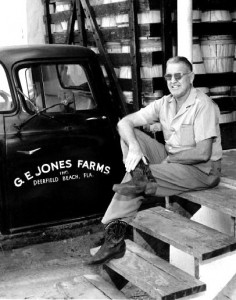
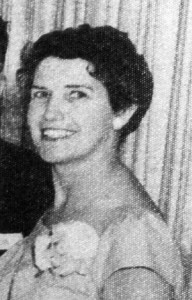
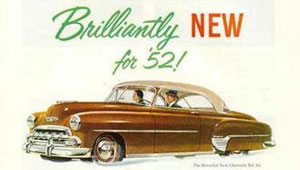
also good farmers. Whereas the Butlers were mostly growing beans, the Jones got into staked tomatoes. They were so successful that when Alvin Jones decided Deerfield needed a bank in the 1960’s, he started Deerfield Bank and Trust Company, which was Deerfield’s first and only bank for many years. Emery’s daughter, Janice Jones Stills, is a retired school teacher still living in Deerfield; as is Kenneth Jones, Alvin’s second son, who is retired from the banking business. When my Grandfather, Hoyt Eller, decided to retire in the 1950’s he sold his farm west of Boynton to Alvin Jones for a little over $50,000, which allowed Granddad to retire. Alvin grew tomatoes on it for thirty plus years. J.B. Wiles once told me that when Alvin’s widow, Mary, eventually sold my Granddad’s old farm, she got a little over $15 million for it. He then said, “What do you think about that!” I said, “God Bless her, and God Bless America!”’

David Eller, Publisher


Historical Essay 33

In 1952 we got our first new car…and our first television set…

Published: 5 Jun 2008

Dad’s manufacturing business by 1952 was going great guns. His new patented Slice-O-Lator land clearing machines were the main reason, but the pump business was also doing well. He had enlarged the factory on Dixie Highway just on the west side of Pioneer Park, bought some more lathes, hired more welders and even got a secretary for his office. The secretary was the twenty-something-year-old daughter of a family from Georgia who had recently moved into town, and was renting a house Dad owned down the street. Her name was Lanette, and I could tell immediately that Mom didn’t like her. At first it was something about the short shorts she wore around town being too short. After she applied to work for Dad and he hired her, the girl started wearing high-heeled shoes and fancy dresses to work. Mother really didn’t like that. Dad apparently agreed and admitted that his workers were spending too much time in the office. So his new secretary started wearing blue jeans to work. Mother said something to the effect that the jeans were so tight that she must be pouring herself into those jeans every morning. As a 10-year-old boy, I couldn’t figure out what Mother meant, but the next thing I knew Lanette didn’t work there anymore, and mother was working in the office part-time. Lanette and her family moved back to Georgia a few months later, and Mom worked in the office the rest of her life, some 36 years. Dad also bought us our first TV set that year. Mother had been after Dad to get us a TV set ever since I’d gotten in trouble breaking into Allen Ballard’s house to watch TV (see Historical No. 30). Dad resisted

buying the TV because he’d just spent a lot of money buying us a new Chevrolet from Mayes Chevrolet in Pompano.  “Bugs” Hardy, the salesman, worked real hard to get Dad to buy that car. The word that Dad was spending money apparently made its way over to Wesley Parish’s General Electric Store on Atlantic Boulevard in Pompano.  Wesley, who had gone to Pompano High School with Dad, called and invited Dad to come look at the latest TV sets. The new black and white screens were 14 inches measured diagonally, which apparently impressed my father since the ones before that had only been about 10 inches. So on Saturday afternoon our family got into our new Chevrolet and drove to Pompano to shop for a TV. I was really happy. Wesley met us and started going over how the TV worked. Dad asked a lot of questions. But when it got to the price, I could tell Dad was not pleased. He finally shook his head, turned to leave, and told Mr. Parish to call when the price went down. I looked at Mother and could tell she was disappointed and embarrassed. We all followed Dad out the store, and Mr. Parish followed us to our car.  He told my Dad that he would try to do something about the price, but meanwhile would Dad allow him to bring the TV to our house in Deerfield for us to try it for a week. My sister and I started shouting “Yes Dad!” “Please, Dad!”  I looked at Mother, and she was smiling. Of course, Dad reluctantly agreed. After a week, all of us, including Dad,

were watching TV each night. There was no way Dad could have refused to buy it. It was a lesson I took note of, and many years later used to sell our own products. When Wesley came to pick up the TV the next Saturday, Dad wrote him a check for the TV. It was only the third TV in Deerfield Beach. Our lives changed forever.

David Eller, Publisher


Historical Essay 32

Playing baseball beat out Scouting

Published: 22 May 2008

1952 was a busy year in Deerfield. My father, Marlin Eller’s decision to run for City Commission as described in previous essay No. 31, was going to keep him busy during much of the year… Meanwhile, I had joined the Boy Scouts in January, along with a few of my 10- and 11-year-old friends. Mr. Dickens was our Scout Master. He was also a school teacher at Pompano High School, teaching shop class. The main reason we joined was that Mr. Dickens told us we could all camp out in tents and fish on his and his wife’s acreage. It was located about five miles west of downtown Deerfield, on the west side of the Turnpike, right on the Hillsboro River/Canal, where the Adios Golf Club is today. He also had rock pits there with perfectly clear water full of bass. It was a beautiful spot, and his son Johnny Dickens, who was already 13 years old, would be our leader.  It was a lot of fun for a few months. We memorized a lot of things and swore to be loyal to God and Country. We all started off as Tenderfoots, received a few pins and moved up to Second Class and some to First Class as we learned and advanced in Scouting.  However, the opportunity to play Little League Baseball suddenly entered the picture. Deerfield did not have enough boys to support both Boy Scouts and Little League Baseball at the same time. I distinctly remember Mr. Dickens telling us that if we chose to play in the Little League Baseball Team being organized, it would conflict with being Boy Scouts, and we needed to decide which we wanted to do.  It took me a minute or two to decide that I’d rather play baseball. Everyone else made the same decision, which ended the Boy Scout experience, and began my three-year baseball career. This is a picture of the first Little League Baseball team in Deerfield Beach. It was 1952. This writer, David Eller, is the second from the left, standing up, with his eyes shut. I was a left-handed pitcher known for a mean curve or drop ball. I learned to pitch from a professional ball player named Herb Dudley. He had pitched on the official U.S. Navy Softball team, with my mother’s brother, Uncle Forney Horton being his catcher. After the war, Dudley had taken a job with the Boca Raton Hotel, who paid him to pitch for their official softball team. He spent a lot of time eating meals at our house. After eating we would go in the backyard, and he would teach me how to pitch curve balls, drop balls, and even an occasional knuckle ball. When not pitching, I played shortstop or first base.  The player to my left, with our arms around each other, is Donald “PeeWee” Williams. He played shortstop or second base. His father owned the Williams Dairy in Deerfield on the property which he later sold to Irvin Levy, who built Century Village on it. PeeWee’s father also helped sponsor our teams’ uniforms, and did some coaching. To my right was a big red-headed boy named Lee King, an outfielder whose favorite past-time was hitting home runs, bull riding and fighting.  Next to PeeWee was Dewey Bennett, our catcher. I can’t recall the short fellow next to Dewey, but the taller fellow with his arm around him is Henry Harden, a fastball pitcher and the only member of our team who went on to become a professional baseball player. My buddy, James Stills, who played outfield is next to him. In the front row are Steve Rowe, a third baseman and the son of Rev. Bob Rowe, the Baptist preacher at First Baptist. He substituted at several positions, but mainly second base. Next to him is Ray Boggs, a pitcher and first baseman. Substitutes Kenny Bennett and Pete Manning rounded out the team. Our coaches were all policemen: Lloyd Newman, Roy Bennett and Chief Manning. Our biggest fans were probably Presbyterian Minister Reverend Arlen Briggs and his wife, Margarett,  who had recently moved to town and attended nearly every game. Within two years of this picture some of us would earn our participation in an All Star Broward County Team, which beat Miami, Palm Beach and Orlando, and went to Greenville, North Carolina, representing the State of Florida in the National Little League championship series in 1954. We had a lot of fun and learned about values like discipline, loyalty and hard work.

David Eller,  Publisher

“Pee Wee” Williams recalls DB Little League Dear David: This is a “voice from the past,” saying it has been a long time indeed! I wanted to write you, and let you know, that a friend, read your article of March 6, 2008, on the history of Deerfield Beach, Fla., and mailed me a copy. It was a nice surprise to me to see your name on this newspaper article, and that you remembered my father and me, and his family in such a nice memory. Thank you so much. My father enjoyed being involved in the community of Deerfield Beach, Florida, with Little League Baseball. I enjoyed playing the game, going through high school baseball in Pompano High. My father moved his dairy to Okeechobee County, Bassinger, Florida, in 1960, and continued to be involved with Little League Baseball. There was no organization for little league baseball at the time, just a few games a few teams, etc. My father sponsored the “Indians,” and I was the coach. We had a great time building the baseball field in his honor. I am very proud of that. I found this picture in my album of our ball team when you and I were little guys. You are second from left, standing, I am third from left, standing next to you. This picture does bring back some good memories.

Sincerely , Don “Pee Wee” Williams


Historical Essay 31

My dad, Marlin Eller, gets into politics

Published: 1 May 2008

I was 10-years-old in 1952 when my father, Marlin, decided to run for the Deerfield Beach City Commission. I remember my mother, Lorena, was not happy about it. She did not want Dad to get involved in politics. In retrospect, I realize that mother knew his tendency to be outspoken, knew what some of his issues would be, and was concerned that he would probably create some enemies within the establishment in the community. Besides, Dad’s business had started to grow rapidly. The U.S. Government had recently awarded him a patent on a land-clearing machine, which he called a “Slice-O-Lator”, and the farmers were almost standing in line waiting to buy them at $500 each. He eventually sold hundreds of them, and had to hire more people, and expand the little factory on Dixie Highway, to keep up.  Dad had also come under the influence of Deerfield’s first lawyer, “Dutch” Ulrich, who had just recently moved into town and caused a minor uproar at city hall when he insisted on registering to vote as a Republican. It seems the city clerk had only one book for registering voters, and it was marked “Democrat”. This was typical of southern USA towns at the time as a carryover from the War Between the States, or Civil War, wherein Lincoln’s Republicans were victorious over southern Democrats, and some ill will continued in the South even a hundred years afterwards.   Apparently all voters in Deerfield, including my dad and mother, had been registered as Democrats until “Dutch” came along, and the city clerk, Mr. Richardson, had to drive to Pompano to buy another book for Republicans. Anyway, I remember “Dutch” coming to our house one night and talking to Dad about running for the city commission in order to straighten out some things in town which both he and Dad thought were wrong. For one thing, a U.S. senator from Tennessee by the name of Kevaufer had recently held congressional hearings in Ft. Lauderdale having to do with the influence of illegal gambling on Broward County politics. In seemed that an illegal game of chance called bolito was going full blast with the full cooperation and protection of some Broward political, business and police interests. I remember Dad saying that it was a problem in Deerfield, too, as a lot of the workers in our little factory were spending most of their money on this illegal game, resulting in their wives coming to Dad to borrow money to buy groceries. Dutch Ulrich convinced Dad that someone needed to stand up for right, and convinced Dad to run for city commission by quoting the famous Edmund Burke: “ The only thing necessary for the triumph of evil is for good men to do nothing.” Dad agreed and signed up to run for Deerfield City Commission. At 35 years of age, with a wife, three children, and a growing business in town, he was also frustrated about some other situations. For instance, Deerfield had a nice beach, but there was no place for people to change clothes or take a shower after swimming; and there was no pier on which to go fishing. Dad had recently bought a 14-foot fishing boat, but there was no boat ramp in Deerfield to launch it. Deerfield’s streets were not marked with any street signs, so it was difficult for strangers to figure out how to find their way around. The town had just built a water plant, and the water was being pumped to an elevated tank, but it did not taste right. There were rumors that not everyone was being billed for, nor paying for water. The town had a substantial black population, but all three Deerfield policemen were white, and reportedly afraid to go into Deerfield’s black areas to enforce the law. Thus, Marlin Eller, my Dad, having lived in Deerfield since he was eight years old, and now 35 years old in 1951 and committed to stay here, filed his papers to run. Politics in Deerfield was about to get interesting.

David Eller, Publisher


Comments Off on Historical Essays 31 to 40

Advertise Here
Advertise Here