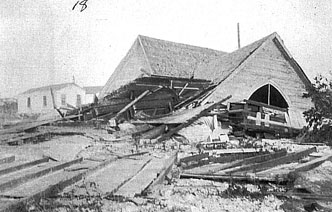
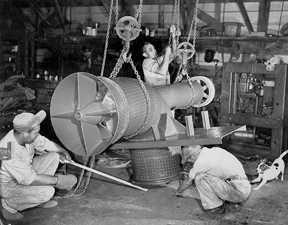
Historical Essays 21 to 30

Posted on 17 April 2008 by LeslieM

Historical Essay 30

Watching Hopalong Cassidy on TV in 1951 got me in trouble with the law

Published: 17 Apr 2008
Well,  I guess it wasn’t really Hopalong’s fault. But when you are 10-years-old and are used to watching the exciting adventures of the famous cowboy Hopalong Cassidy every Saturday morning, it hurts when you can’t watch it one Saturday. My problem was that we didn’t have a TV set. In fact, hardly anyone in Deerfield Beach had a TV set.
The first person in Deerfield to get a TV set was Doctor Higgins. He was a very tall man, kind of bald, and the only doctor in town. He practiced his medicine initially in the same house where he lived with his wife and daughter, Betsy, who was my age. Their house and office was on Hillsboro Boulevard, across from the U.S. Post Office, in the same house that the Kraeer Funeral Home is in today. Betsy was tall and skinny, had long blonde hair and wore glasses. We were friends, but not too good of friends. She was taller than me by two or three inches, and one of my biggest  competitors for getting the best grades in our class at school. When the Higgins first got a TV set, we were all invited to come over and watch on Saturday. But after the second or third week, Betsy told us we couldn’t come anymore because her father had said that he had patients coming and we might disturb them.
We children were heartbroken. No TV? No Hopalong Cassidy on Saturday?
But it didn’t take long for one of our fathers to step up and pay the price to buy “all” of us kids a TV set. Well maybe it wasn’t really for “all” of us, but it seemed like it at the time. Mr. Allan Ballard (the father of Johnny Ballard, who recently retired as the longtime chief of police in Hillsboro Beach) stepped up to the plate and bought the second TV set in Deerfield Beach. Not only that, but he and his wife, Miriam, let it be known that all the children in the neighborhood were welcome to come to their house on Saturday morning and watch it with Johnny and their daughter, Susie. Their house was located on property which is now part of Deerfield’s City Hall east side parking lot.
Everything was going along fine with our TV watching for months until one Saturday morning we got to their house and no one was home. One of the kids said that he heard they had gone up to Georgia on a vacation or something. I remember thinking, “They must have left us a key or something so we could get in to watch Hopalong.” We looked under the front door mat. No key! We looked under all the flower pots. No key! We started to panic, because Hopalong was going to start in a few minutes. Maybe they forgot to leave us a key!
Suddenly I got a great idea. I told the kids I’d be right back. I ran as fast as I could the 100 yards or so to my Dad’s shop. I ran in to where I knew there was a crow bar. I grabbed it and ran as fast as I could back to the Ballard’s house. Someone scooted an old chair from their backyard up to a side window.
I stood up on the chair and used the crow bar to pop open the wood frame window. Pushing it up as far as it would go, I pulled myself up to the window sill and scrambled inside their house. I ran to the TV and turned it on, and then came back to help the other kids get into the house. We all made it inside and sat down on the floor to watch just as Hopalong Cassidy came on. “Whew,” I thought. “Barely made it!”
We hadn’t been watching Hopalong five minutes, when suddenly a deep voice came through the open window: “What do you kids think you’re doing breaking into Ballard’s house?” I looked over and recognized the policeman. Everyone else kind of froze, so I got up to explain to him that we always come over on Saturday morning to watch TV at the Ballard house. He responded by asking, “Do you always come in through the window?” I said, “No, but I’m sure it is all right. Mr. Ballard just forgot to leave us the key!”
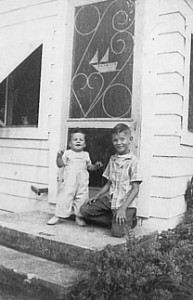
I could tell he was trying to keep a straight face. He asked who brought the crow bar. I raised my hand. He told everyone else to go home, but ordered me and Tommy into his car. He drove us the 100 yards or so to my father’s machine shop. We got out and went in. Dad was running a lathe. The policeman told Dad where he’d found us. Dad stopped the lathe, looked around real serious-like, and said “Guess you’ll have to put ‘em in jail!”
I couldn’t believe it. I started to cry. As we turned to get back in the car, Dad hollered out and told the policeman, “Be sure to get their fingerprints too!”
It seemed like a long ride back to the police station,” even though it was only two blocks. We went in and the policeman had us dip our thumbs in an ink pad and put them on a pad of paper. Deerfield had its own jail at the time and most of the prisoners were local drunks. I could hear them laughing and making fun of us; and I was really scared. About that time, Dad walked in. He said something to the effect, “Do you think he’s had enough?” The policemen nodded, and then he and Dad started laughing. The policeman then said to us: “Let this be a warning. The next time we might have to put you in there with those guys,” as he pointed toward the drunks in their cells.
It was a lesson I never forgot.
David Eller

Historical Essay 29

James and I thought we were Tom Sawyer and Huckleberry Finn

Published: 3 Apr 2008
My friendship with James Stills got off to a rough start. When he arrived at Deerfield Elementary School from Tennessee, he immediately became the biggest kid in our class of fifth graders. With his large crop of wavy black hair, brown eyes and enormous hands, he was also an inch or two taller than me and classmate Dewey Bennent, and probably out-weighed us by 10 or 12 pounds.  When recess came on his first day at our school, Dewey pulled me aside and suggested that we needed to find out “how tough” the new kid was. Dewey said that he would get on his knees behind James and I should walk over and pretend to “fall” into James so that he would be knocked over Dewey. We did it perfectly, expecting James to get up ready to fight.  James got up from the fall, but did not respond to our belligerent attitude. He simply looked at us and our fists poised for a fight and said, “My mother told me not to be fighting.”
I was immediately relieved as I’d already figured out that I didn’t want to fight him anyway, and I didn’t think Dewey did either. It was just our way of sizing him up. I kind of liked the way he handled us, and decided immediately that I wanted to be his friend. So on Friday, I invited him to come to Sunday school and church at First Baptist on Sunday morning at 9:30. Sure enough, he showed up with his mother and his sister, Barbara, who was two years older than him. Thus began a life-long friendship, which continues to this day.
We began our friendship as 10-year-old boys by exploring the swamp near our house just east of Dixie Highway. The swamp was just over the Dixie Highway Bridge north of the Hillsboro River in what is now part of Boca Raton. Boys of Southern heritage at the time were expected to learn how to shoot a gun by around the age of 10, and I was no exception. Dad and Mother had given me a pellet rifle for my 10th birthday and Dad had taken me down to the swamp to practice. We shot land crabs. They are interesting creatures with blue bodies about four inches in diameter, with eight legs which can carry them quite rapidly  when they decide to run. They typically live in swampy areas in holes in the ground, which they dig down a few feet to hide from predators like big birds and 10-year-old boys. James and I took turns shooting the rifle and watching the crabs explode.
One of the books that was required reading in school at the time was The Adventures of Tom Sawyer and Huckleberry Finn.  James and I were just the right age to really get into that book. One of the episodes, which thrilled us both a lot, was when Tom and Huck built a raft with a sail and rudder to explore the Mississippi River.  With encouragement and help from my parents, James and I built our own raft to sail up and down the Hillsboro River. The main body of the raft was made from bamboo, which at the time was plentiful growing at the edges of the Hillsboro River. We only selected and cut down bamboo shoots that were at least four inches in diameter. We selected about 20 shoots and sawed them into lengths eight feet long. We then strapped them together with aluminum flat bar straps which Dad had provided, to make the raft. A steel plate with a pipe welded on top in the middle supported the mast for the sail. Mother provided a bed sheet sail for the mast, and I built the rudder from ¼” plate steel in our welding shop. Dad helped us get everything assembled and transported 100 yards or so, down to the Hillsboro River where we launched it.
It worked beautifully. We quickly became pretty good sailors. James worked the sail and I worked the rudder. Typically, we would let the tide current take us east, and then put the sail up and let the easterly breeze fill our sail and carry us back to the west. We did it over and over again until we got tired. Tom Sawyer and Huckleberry Finn would have been proud. We had lots of fun.
David Eller

Historical Essay 28

Standing up for German neighbors got me into a fight at school

Published: 20 Mar 2008
In the fall of 1951 we had a German family move into the two-story house at the end of our block. They had two children, a boy and a girl. The boy was my age and his name was Martin Marback. He had bright red hair, and wore leather pants with white shirts and suspenders. He did not speak much English when we first met, but he was really good at climbing the mango trees with me which were in the grove between our houses. Therefore, our play was mostly limited to climbing trees, gathering the mangos, eating some and putting the others in a box for my mother to give away. I quickly learned that he did not understand hardly anything I said, but would copy me in almost anything I would do.
His sister, who was two years older than him, also wore “funny” clothes: typically a white blouse over a red, black and white plaid skirt. She was way overweight, and had long brown pigtails. Whereas her brother Martin was kind of skinny like me. Martin would try to speak some English with me, but I do not remember his sister ever speaking a word. She would simply stand back and watch Martin and me play.
By the time Deerfield Elementary school started in September, Martin and I had become “friends”, even though we could not communicate very well.
We had only been in school a few days when “the fight” happened. About six of us were lined up in front of the water fountain to stand upon a wooden box and get a drink of water. Martin was in front of me. Robert Sloan, a year younger than us, but a few inches taller, was at the end of the line. Suddenly, when Martin started to get his drink in front of me, Robert Sloan jumped out of the line, rushed forward, grabbed Martin by the back of his head pushing his face into the fountain and twisted the fountain handle to keep the water flowing onto Martin’s face as though he was trying to drown him. He also was simultaneously screaming “you’re a dirty Nazi.” Martin started sputtering, lifted his head and tried to get away from Robert and the fountain.
Before I could even think about it I grabbed Robert Sloan’s shoulder with my left hand and shoved him backwards away from Martin and the fountain. He responded by hitting me with his right hand to the side of my face. I tackled him and we proceeded to roll around on the floor of the hallway with fists flying. Everyone else was screaming. Within seconds it seems, Ms. Henry, the school principal, was there and grabbed the back of my shirt collar pulling me up and off of Robert.
Ms. Henry took us into her office around the corner from the water fountain, and demanded to know why we were fighting. I told her that Robert started it by attacking Martin. She asked him why? He told her that his father had been a soldier and Germans had killed a lot of his father’s friends. She looked at both of us kindly, but firmly told us that fighting was not allowed. She told us to go to the chair next to her desk and bend over, then she reached for a wooden paddle. She proceeded to spank both of us with about three strong licks. Neither of us cried, but neither did we ever fight again.
David Eller, Publisher

Historical Essay 27

In 1951 the world is changing–Deerfield starts growing–and more boys my age move to town

Published: 6 Mar 2008
In 1951, the Korean War was going on and Seoul, Korea, fell to the communist forces from the north. The 22nd Amendment to the U.S. Constitution, limiting the number of terms a president may serve, was ratified. Julius and Ethel Rosenberg were sentenced to death for treason, having given the Soviet Union our secrets for building atomic bombs. The cost of a first-class stamp was $0.03. The NY Yankees defeated the NY Giants in the World Series 4-2. Color television was first introduced in the USA, and the Best Movies were The African Queen and A Streetcar Named Desire, and for most of the year, I was nine years-old.
My father always said that Deerfield and this northeast Broward County area started to grow because so many of the soldiers who were based at the Boca Raton Airfield during World War II liked the weather here, and eventually decided to come back to live permanently. I’m sure that was true in the big picture of things, but from my perspective as a nine-year-old boy, it was when the Williams Dairy arrived, located where Century Village is now, that Deerfield started to grow.
Mr. Williams moved his dairy here from Dade County in 1950-51. He had two sons, Mitchell, who was two years older than me, and Donald, who had the nickname “Peewee,” who was my same age. They were both very athletic, and could ride their own horses at their father’s dairy. Also two other boys, Jimmy Phillips and Jessie Beard, whose fathers worked on the dairy, were in our class, as well as Tommy Gannon, whose father was an electrician and mother was a nurse, had just arrived in town. Tommy and I became good friends as he lived only two blocks away. When summer came and our Baptist church had Vacation Bible School (VBS), he and I were both surprised and confused when his parents told him he could not go to our church for VBS. (An annual event in the summer where the kids learned stories from the Bible, and got lots of ice cream). His mother kindly explained to me that Tommy and their family were Catholics and even though they did not have their own church to go to in Deerfield yet, she didn’t want Tommy to get confused and therefore did not want him to go to VBS at our church. Tommy and I looked at each other in a somewhat confused manner, but quickly acquiesced to her instruction. When I asked my mother about it, she explained that this was normal, that it was good that Tommy’s parents were religious, and that Tommy and I could still be friends.
Meanwhile, Miss Hinson (my mother called her an old maid) was our teacher in the fourth grade at Deerfield Elementary School. She had previously replaced our third grade teacher, Miss Riggs, in the third grade. Miss Riggs only taught us for a few months, when our principal, Mrs. Henry “fired” her. I was later told that I was the one that had gotten Miss Riggs fired. I didn’t mean to. I only told my mother and father that Miss Riggs was a lot different than Mrs. Slover, our second grade teacher, or even our first grade teacher, Mrs. Hartman. Specifically, Miss Riggs did not have us say the Pledge of Allegiance to the American flag, and she had us singing songs from a country called Russia, which she had said was the best country in the world. My mother later told me that Miss Riggs had been fired because she was a communist. My, how things have changed.
David Eller

Historical Essay 26

Lyons Road named after Dad’s largest customer

Published: 31 Jan 2008
Back in the late 1940’s and early 1950’s, when I was a boy of elementary school age, my father Marlin would often take me with him after school as he visited customers. Our machine shop/pump factory was located on Dixie Highway in Deerfield, where the tennis courts are today. In previous Essay No. 13, I wrote about our good customer, the Butts family in Boca Raton, for whom the Butts road in Boca is named. In Essay No. 14 I also wrote about our Japanese customers in Boca and the Japanese farmers there for whom the Yamato Road and Park is named.
However, our largest customer back in those old days was a rancher and farmer west of Deerfield named Cossie Lyons. I believe he was originally from Tennessee. I do know that he owned an enormous amount of land in the northwest part of Broward County and southwest part of Palm Beach County, which is now part of Parkland, Coral Springs, and western Boca Raton. I remember my father telling me once that Cossie’s property, just on the west side of Highway US441/State road 7, was approximately six miles long and two miles deep. He raised cattle mostly, but also had large plots of vegetables on parts of it.
My dad and Cossie Lyons were good friends. Cossie, in his sixties, treated my father, in his thirties, like a son. In fact, I was there when Cossie offered to give my father 10 acres on the west side of Highway 441 for Dad to build us a new machine shop/factory. Dad, accustomed to walking out the back door of our house on Dixie Highway to go to work in our “shop” next door, turned him down. I remember Dad telling Mr. Lyons: “I don’t want to have to drive that far (seven miles) to go to work every day”.
Cossie was a single man with no children, and depended a lot upon his nephew, James, to actually run the farm. James, about my dad’s age, always wore a crumpled old brown hat, and had two or three horses which he took turns riding. Dad and Cossie would talk about what needed to be done on the farm, and James would make it happen.
Cossie also had a beautiful young secretary/bookkeeper named Alma. In her late twenties, she was taller than Cossie or my father by about six inches. She had long black hair and always dressed up, even in their office. She wore high heels and a fancy hat when she sometimes came to Deerfield’s First Baptist church, where she always sat alone midway down the left aisle. The hat and the heels made her look even taller.
One day Cossie confided to Dad that he and Alma were going to get married. When Dad told Mother over our supper table that night, Mother got very upset. I remember her saying that Cossie was way too old to marry that young woman. Dad just smiled.
Shortly thereafter Cossie Lyons and Alma were married in a private ceremony and went off on their honeymoon. The next day Dad got a call from Cossie’s nephew, James. He told Dad that Cossie had died from a heart attack on the first night of his honeymoon. Alma, therefore, became a rich young widow within hours of her marriage to Cossie.
Alma continued to come to our church occasionally, and was always friendly to my father. The women of the church, however, seemed to keep her at a distance. Within a few years she had sold off Cossie’s land and moved to Gatlinburg, Tennessee. She got married again to another short man and became Mrs. Alma Regan. Together they invested in real estate and helped build Gatlinburg into the huge resort that it is now. She died about 20 years ago, probably with a smile on her face.
David Eller
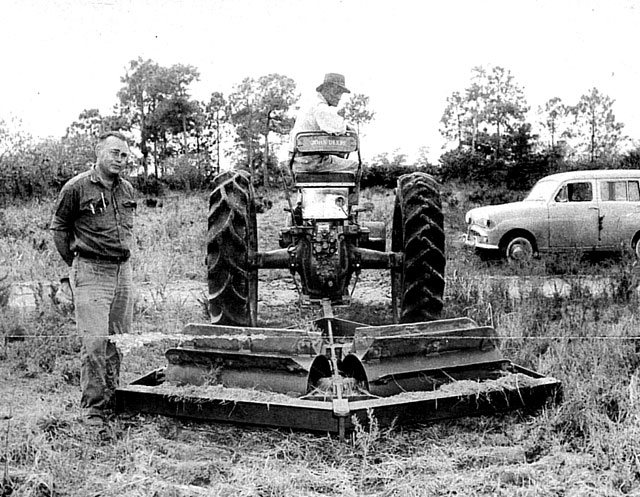
Historical Essay 25

Big 1949 Hurricane with 150 mph winds…plus another boy my age (8) arrives in Deerfield

Published: 13 Dec 2007
It was right before school started in 1949 when the big hurricane hit. Back then they had not gotten around to giving hurricanes names like they do now.  They simply numbered them in order. The center of Hurricane No.1 of the 1949 season hit “between Pompano and Palm Beach” about 6 p.m. on August 26. Winds had to have been over 150 mph when it hit because they were actually measured at 125 mph as the center crossed Sebring, Florida a few hours later.  Dad had shuttered up our house and driven the family to Boynton Beach to ride out the storm at my maternal grandparent Horton’s house, next to Boynton’s elementary school. However, as the hurricane approached the coastline, the winds picked up, and Granddad Horton’s wooden frame house started coming apart. There was a large screened porch facing south, which was the first to go. The screens blew out and the roof started tearing off in pieces. My father, Marlin Eller, ordered me, my mother, Lorena, and my sister, Linda, to follow him. He held my little brother, Dwight, in his arms and started toward our car parked in front of the house. But the wind was too strong to stand up, and tree branches and coconuts were flying through the air hitting us. So Dad lay on the ground and started rolling toward the car. We couldn’t hear his specific instructions through the loud howling of the wind, but we just naturally started doing the same thing he was doing and rolled on the ground to the car. He got one door open on the other side of the car and we all crawled in. I remember Dad was shivering and seemed afraid. Mother was crying.
Dad started the car, drove a few blocks over to Federal Highway, U.S. 1, turned left and headed north. I remember him saying that this direction should get us out of the storm. We drove through heavy rains and winds, for what seemed like hours, until we got to a town called Fort Pierce. There, palm trees had fallen across the highway, coconuts and tree branches were flying through the air, and it was impossible to proceed. Dad turned into a gas station and parked, joining dozens of other cars parked there. There we spent the night, in the car, mother especially praying for safety. It came the next morning as the winds died down. We got gas in the car, headed home to Deerfield, working our way around fallen trees and power lines all the way. Granddad’s house in Boynton was essentially destroyed, and had to be rebuilt. Our house in Deerfield, however, with wooden shutters closed, weathered the storm beautifully. The lesson I learned was that you should build your house strong enough to handle any known potential hurricane wind force, and stay home during the storm. Many years later I did that exact thing as I designed and built my own house for 200 mile an hour winds. It cost me about 10 percent more to build, but I’ve never worried about it weathering a hurricane, even until today.
The next thing I remember about the summer of 1949 was that Dewy Bennett arrived in town. Dewy was my age, eight years old, and would be starting third grade with me in the fall, which meant that I would no longer be the only boy in my class at Deerfield Elementary School. Dewy came to my backyard one day in the summer of 1949 with his cousin Butch Bennet. They started singing a song that was popular on the radio at the time by Hank Williams which went:  “Hey…good looking; what cha’ got cookin’, how’s about a’cooking something up with me!” I went out to meet them as they walked slowly over to the empty lot on the south side of our house, and started picking fruit off our guava tree. Seven-year-old Butch started talking first. He introduced me to his eight-year-old cousin Dewy, who he said had moved into town and would be in the third grade with me soon. Butch went on to say that he’d told Dewy about me beating him up (a few weeks ago), and that Dewy would settle matters with me. I looked at Dewy and figured he was about my same size. I asked him what he wanted to do. He said that he understood I had beaten up Butch, and would I like to try to beat him (Dewy) up. I replied that if Butch would stay out of it, “Sure”!  With that we both went at it. His head went into my belly knocking me backwards as he swung both fists. But I soon got him into a headlock and rolled him over on his back. He pushed me over, and we rolled around in the sandspurs for a few minutes. But once I got my right forearm around his neck with my left hand gripping my right wrist, pulling a hard scissors grip on his neck, I knew I had him.  He should have given up, but he refused. We rolled over in the sandspurs a few more times until we were both sweaty, exhausted and out of breathe. Finally one or both of us said, “I’ll stop if you’ll stop.”  With that we let go of each other, stood up, and Dewy gave me a great compliment:  He said: “You’re a pretty good fighter”. I said: “You are too!”  We shook hands, and became friends, which continues even until today.
David Eller
Historical Essay 24

Deerfield gets its first park –Pioneer Park!

Published: 29 Nov 2007
Deerfield got its first park in 1948. It was named Pioneer Park and was built just east of our house. There was a narrow rock road, later abandoned, between our backyard and the park. Our house sat where the office for the tennis courts sits today, with the front yard facing west to Dixie Highway and the backyard facing east to a forest of pine trees.
The park was built by the local Lions Club, part of the International Service Organization. My father, Marlin Eller, was a very active member of the club, and volunteered to be on the committee to get the park built. The first problem was to get the land. The Kester family of Pompano owned most of the land in Deerfield at the time, including the land on which the Lions Club wanted to build the park. The Kesters also owned the Pompano Farmer’s Bank, the only bank in North Broward County at the time, which provided financing for most of Deerfield’s businesses. My father told me once that Mr. Kester donated the land for Pioneer Park, as well as the land for the cemetery on the north side of First Baptist Church.
Anyway, all I knew at age seven was that one day bulldozers started pushing down the trees and clearing the land. I was very unhappy because those woods were my backyard playground. I practiced hiding behind trees and shooting at imaginary enemies in those woods. I could chase butterflies, or hide from my sister in those woods. Now the trees were being knocked over, pushed into piles, and set on fire. I cried.
Dad and Mother tried to reassure me that it would be better. They (the adults) were going to build a ballpark on that land. I pouted. Dad tried to get me into the excitement about having a new ballpark right next to our house. He suggested I help him and the other men to plant the grass for the park (back in those days there were no sod farms and grass was planted as individual twigs in the ground a few inches apart). So I rather reluctantly joined my dad and the other men in his Lion’s Club to plant grass for the new park.
However, the club also wanted to have big lights at the park to operate at night games on the top of high poles. My dad was in charge of raising the money for those poles and lights. Apparently it was hard to raise the money. I remember Dad complaining a lot, but he eventually got the money and poles donated, and Pioneer Park became a reality. Dad and Mother were both very happy.
Times were different then in many ways. In retrospect, I think the biggest thing was that people did not have television to take up so much of their time. Therefore, at nighttime after work, people provided their own entertainment, and neighbors socialized with each other extensively. The new ballpark quickly became the center of that activity.
Since Deerfield had a new ballpark, they needed a ball team to play at the ballpark. So the Lions Club stepped forward again and organized a softball team, complete with matching uniforms. It consisted of 12 players and a coach. There were five farmers, a sheriff’s deputy, a plumber, an electrician, a gas station owner, a railroad station manager, and a couple of small business owners. My father didn’t actually play ball, but he got very involved in the organizational part of the sport. In fact, he was appointed as the Soft Ball Commissioner for South Florida and served several years in that position. Our whole family typically went to watch the games. Unbeknown to me at the time, the ballpark experiences would affect my whole life, including up until today.
David Eller, Publisher
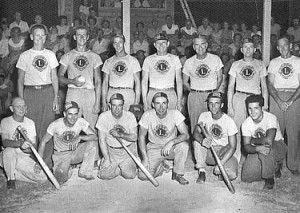
The 1948-1949 Lions Club Softball Team:
(L-R, bott
om row):  Willy Dame, Alan Ballard, Red Arnau, Bob Phlegal, Jack Butler, and unidentified; (top row): M.A. Peterson, Bob Butler, Milton Vincent, Jay Mosley, Barney Chalker, Hubert Morris, and Alvin Jones.
Photo courtesy of Jack Butler

Historical Essay 23

In 1948 Harry Truman wins…a child is b

orn…and my sister, Linda, saves me at Deerfield Elementary School

Published: 15 Nov 2007
1948 was a pretty good year, and I had learned to read by then. My parents had both voted for Harry Truman for President, which made them happy when he won. Right after the election my brother Dwight was born, and I started my life’s journey as a middle child. My parents were also glad when the country of Israel, where Jesus lived, was re-established. Dad, who read the Bible a lot, said this was very important because it had been predicted in the Bible, and was something that had to happen before Jesus could come back. He was also worried about a city in Germany named Berlin, which was being surrounded by the Russians and not allowing people in or out. He was happy when our government started flying airplanes in to bring the people food. Dad bought a PolaroidTM camera that year which had just come out, but he complained about the film costing so much. My mother always wanted to see the movies which won the awards each year, so she took us to the theatre in Fort Lauderdale to see Hamlet which had won the best movie award, with a man named Lawrence Olivier, who also had won the award for best actor as the star. I believe Dad went with us to see the movie Johnny Belinda, because he always liked Jane Wyman who had won the award for best actress.
When I started second grade at Deerfield Elementary School in 1948 I was again the only boy, although one more girl had moved into town, making the ratio six to one. Badly out numbered in my own class, I tried to make friends with other boys, specifically brothers George Bigler in the third grade, and his brother Jeff in first grade. Their mother was the school cook. They actually lived in Boca Raton, but the boys attended Deerfield Elementary because their mother worked there.
They were both fun to play with at first, and excelled at climbing up palm trees. But eventually the younger brother Jeff started poking at me for no reason that I can remember. He apparently thought it was cute to come up behind me and kick me during recess. When I tried to catch him to reciprocate in kind he would run to his brother, or into the school kitchen area for his mother’s protection.
One day we were playing on the grassy area on the west side of the
main building when Jeff snuck up and kicked me from behind. I had been watching for him, and spun around quickly and caught him by his ankle before he could get away. I jumped on his back as he lay on the grass and tried to get his left arm up to where I could twist it and make him promise to leave me alone.
Suddenly I heard the sound of someone running toward us, and felt the impact as his big brother George tackled me from behind. The impact knocked me off of Jeff and the two of them proceeded with fists flying to teach me some sort of a lesson.
I was on my knees with both eyes shut, trying to cover my face, when I heard an even heavier running sound coming toward us with a guttural scream, which sounded quite familiar. I opened one eye and caught the image of my 10-year-old, fifth grade sister, Linda, (who incidentally looked a lot like Lucy in the Peanut cartoons) flying through the air horizontally in a counter attack against both boys.  I didn’t have to do anything as she proceeded to beat the tar out of both of the Bigler boys.
I never had a problem with either of the boys after that, and I gained a respect for my sister, which continues to this day. In fact, don’t try me. She’s still lives only two hours away.
David Eller

Historical Essay 22

Games and lessons learned in first grade

At Deerfield Elementary School…1947-1948

Published: 14 Nov 2007
In the last essay I shared how I was the only boy in the first grade at Deerfield Elementary School in school years 1947-1948. I shared the class with five girls. For some reason I thought that was normal. I know I liked it. The girls all seemed to like me for some reason. They taught me how to play a game called “jacks”. It consisted of sitting in a circle on the floor in the hallway during recess with a small rubber ball and a bunch of metal things called jacks. To play you would take 10 jacks and toss them on the terrazzo floor so as not to scatter them too far apart. Then the first player would pitch the ball up in the air slightly with one hand, and immediately sweep up one jack being careful not to touch any of the other jacks. The ball would bounce once during this pr
ocess, and you had to catch it before it bounced twice while simultaneously holding the jack you’d just swept up. You would put that jack back into the box and repeat the process sweeping up two jacks, this time being careful not to touch any of the other jacks on the floor. If you were successful you would continue sweeping up three jacks the next time, and the final four jacks after that. However, you would lose immediately if at any time you did not catch the ball, or if you touched any extra jack during the process. The loser would then pass the ball and the jacks to the next player, and the game would continue until someone won by picking up all the jacks in proper order without dropping the ball.
The girls already knew the game, as they apparently had been playing it at home before starting first grade. All my preschool games had been with my friend Elmo (see previous essay) and we only played boy games like marbles, catching frogs and climbing trees. Therefore I must have appeared clumsy to the girls, as I specifically remember them laughing at me at first as I struggled to pick up the jacks and catch the bouncing rubber ball. However, I eventually got the hang of it and was able to beat all of the girls some of the time and most of the girls all of the time; but I never achieved beating all of the girls all of the time!
One of the girls, Lynda Dame, apparently liked me a lot. She would show her affection by walking up during recess, punching me in the belly or on the arm, and then running away laughing. I’d always been told by my parents that boys did not hit girls. Therefore Lynda was safe from me responding in kind. However, one day my mother noticed a bruise on me, and asked how I had gotten it. I told her it was from Lynda hitting me at school. Mother looked a little angry. She asked me if there was a reason for her to hit me. I told her no, that she just did it for no reason. Mother then gave me what I thought was a direct order. She told me the next time she hits you, David, you hit her back. I took that literally. Sure enough the next day during recess, Lynda slipped up on me and hit
me hard. I remembered my mother’s instructions and started chasing her. As I caught up to her I knew I had to be careful to hit her in the right place, her back. I caught her, spun her around to get a good shot, and hit her with my left fist squarely in the back with all of my might! She went down crying. I walked away proudly thinking, “I did it just like Mother said to do. I hit her right in the back”!  Lynda never hit me again, and we eventually became great friends.
David Eller

Historical Essay 21

I was the only boy in the first grade  at Deerfield Elementary School…in 1947

Published: 4 Oct 2007
The first thing I noticed different in the summer of 1947, at age 5 ½, was that my mother started buying me some new clothes. We lived on Dixie Highway where the tennis courts are now, and the nearest clothing store, “Parman’s” was only three blocks further south on Dixie. We would walk there. The pants she bought me were all light brown khakis with turned-up cuffs on the bottom. I didn’t particularly like the cuffs because sand, sand spurs, and other debris would collect inside the cuff as I played outside. This would get me in trouble with my mom when the sand ended up in the house on the floor. She also bought me a bunch of short sleeve plaid shirts. Every weekday for years I was destined to wear a plaid shirt with khaki pants to school. It was not a requirement of the school; it was just the way Mom liked to dress me. Today you will not find a plaid shirt or khaki pants in my closet.
My best friend was Elmo. His mother worked for my mother helping her to clean the house, and wash our clothes.  Elmo and I mostly played marbles in a patch of gray sand next to the steps in the backyard. Sometimes we also played hide and seek, but Elmo didn’t stand a chance since my dog “Brownie” would always help me find him. During mango season, at the beginning of summer, we would climb the trees in our backyard, and stuff ourselves with mangos. What we didn’t eat, we’d put in a paste board box for Elmo’s mother to take and share with their neighbors.
Elmo was my friend, and we were the same age. However, one day Mother explained that I would be starting school soon, and Elmo would be going to his school. “Can I go to his school too” I remember asking?  “No” she tried to explain, “Elmo has to go to his school, and you have to go to your school”. “Why”? I cried.  “That’s just the way it is David!” she replied. So it was, back then.
The first day of school came, and I was up early. Mother wanted me to take a bath before getting ready for school. After the bath I put on my khaki pants and plaid shirt and was ready for an inspection. I remember Mom looking behind my ears for some reason, and then declaring that there was dirt behind my ears.  She grabbed a wet wash cloth, dipped it on the soap, and vigorously started rubbing. I thought my ear was going to come off before she got satisfied and declared me clean enough to go to school.
My seven-year-old-sister left early for school to meet friends there, so I had to walk the approximate five blocks by myself. I started out from the back yard to walk one block south and then four blocks east to the school. Just as I walked out the back yard I heard Elmo’s mother, who had just arrived without Elmo, say to my mother: “Are you going to dye today?” I heard mother say “Yes!”
I continued to walk for a few minutes, simultaneously thinking about what I had just heard. Mother is going to die today, I thought. I knew she had told me she was going to miss having me home with her. But could she actually miss me so much that she would die? Suddenly I felt nauseous. Mother is going to die because she’s going to miss me so much! I don’t want to go to school if it causes my mother to die, I thought.
Suddenly I turned around and started running back home. I ran as fast as I could. When I reached the back door I swung it open and rushed in to find Mother. There she was standing next to the washing machine with a box of blue powder in her hand. I rushed to her and started hugging her crying “Please don’t die. Please don’t die!”
Mother started laughing. “David” she said, “I’m sorry we must have scared you about this dyeing business. I’m not going to be dyeing like you’re thinking; I’m only going to be dyeing some sheets and pillow cases to make them blue today.”
Greatly relieved, I rubbed my eyes, pulled myself back together and headed off for school.  This time I ran all the way without stopping.  I knew my teacher was going to be Mrs. Henry, and that she was also called principal. When I got to the class room, which was next to her office, there were five girls my age there. I already knew three of them from church: Lynda Dame, Janice Brown and Mildred Gordan. However, I was the only boy in my first grade class. That’s how small Deerfield was in 1947.
David Eller
Comments Off on Historical Essays 21 to 30

Historical Essays 11 to 20

Posted on 13 September 2007 by LeslieM

Historical Essay 20

In 1944 Presbyterians “arrive”  in “Baptist” Deerfield

Published: 13 Sep 2007
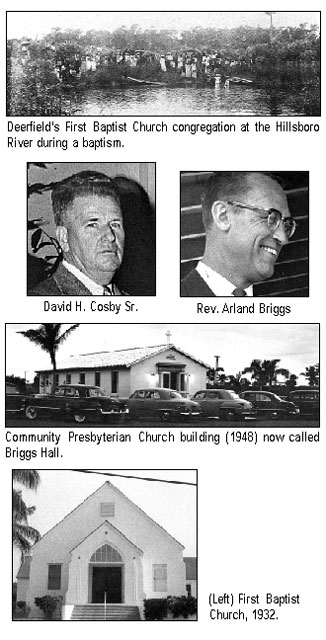
Up until the mid 1940’s the only formalized church in Deerfield was the First Baptist Church. Founded in 1910, the small congregation started meeting at the home of Mr. and Mrs. Robinson, whose home stood at where the Midas Muffler shop is today on the south side of Hillsboro Avenue, just east of Dixie Highway. Mrs. Robinson was actually a Methodist, but was very active with her Baptist husband in the Baptist church, but never actually joined it. This is probably because in order to join she would have had to have gotten re-baptized by immersion, as opposed to sprinkling, which is the method of the Methodists.
By 1912 the congregation had grown to 12 adult members, officially joined the Southern Baptist Convention of churches, and called the Rev. Samuel S. Gibson to be its first pastor. By 1914 the church had grown to an average attendance of 33 and had built its first sanctuary adjacent to the present site of Kraeer Funeral Home. The church was doing well until blown down by the huge “killer” hurricane of 1928. However, by 1932, a second church capable of seating 75 was constructed in the 700 block of S.E. 2nd Street across the street from Deerfield Elementary School.  My parents, Marlin and Lorena Eller, joined the church in 1934, when both were 18 years of age. They were baptized in the nearby Hillsboro River, which was the custom then because the small church building did not yet have a baptismal pool.
On New Year’s Day, January 1, 1941, prisoners from the local jail were being used to clean the city cemetery behind the church. It must have been cold because they made a fire from the palm fronds they had gathered to keep warm. A sudden wind came up and blew fire debris onto the dry wooden shingle roof of the church, causing it to catch on fire. With their church badly damaged, the congregation decided to build a new, larger church to seat 200 people next door, and repair the old church and use it as a parsonage. This worked until 1960, when the congregation had outgrown that church and built the present church to seat 500, plus a large gym and Christian Life Center.
Meanwhile, Presbyterians and other faiths were coming to Deerfield. David H. Cosby, Sr. from New Jersey arrived in the mid 1930’s with his wife from Ocala, Florida. They had both worked for AT & T and apparently knew how property could be obtained for rights of way and other purposes. The effect of the 1928 hurricane and the depression that followed here meant that many people owning property locally could not pay their ad valorem (property) taxes. When ad valorem taxes are not paid on a piece of property, the county government allows others to pay the taxes with an interest charge added, and get a tax lien on the property. If the taxes and interest are not paid within about three years, the government allows the owner of the tax lien to go through a legal process, which allows them to ultimately get clear ownership of the property. David Cosby, an expert at this, was very interested in Deerfield’s beach area, and essentially arranged to buy most of it through the tax lien process within a few years. He developed the shopping Center in the “S” curve on A1A, but sold most of the rest of the beach to others for millions in profits over the ensuing years.
A devout Presbyterian, he donated the land in 1944 for the Presbyterian Church to be built on the beach, and became one of the first elders. The first church building was completed in 1948 and is now named Briggs Hall, after the Rev. Arland Briggs and his wife, Margaret, who served there from 1952-1981.
In 1974, Dr. Briggs gave recognition to four charter members after 30 years of church membership. Three of them: Susanne Glattli Anderson, Bertha Glattli Cosby, and Barbara Glattli Morrison, are related to our family, the Eller family, through the marriage of my son, Dana to their grandniece: Heather Glattli Eller.
David Eller, Publisher

Historical Essay 19

Mother’s brother, Uncle Forney Horton “Buys” the Cove Section of  Deerfield Beach for $1500/acre!

Published: 23 Aug 2007
My mother had two younger brothers who served in the military during World War II. They were close in age, only a little over a year apart. The oldest was named California Horton. My maternal grandmother, Etta Clem Horton, had gotten pregnant with him just about the time she and Granddad Horton had planned to leave their cotton farm in south Alabama and move to California. Granddad told her they couldn’t leave for California with her pregnant. So they stayed and planted another crop of cotton. Grandmother got her frustrations out, however, by naming the baby boy, born on November 19, 1919, “California” Horton. He was quickly nicknamed “Forney”.
The cotton crop must have been good that year, or the weather real cold, because Forney was quickly followed within a year by a younger brother, whom they named “Wofford.” With two little boys nursing at the same time Grandmother never made it to California. The two boys grew up inseparable, more like twins than just brothers. My mother, Lorena Horton, three years older than Forney, and four years older than Wofford was their big sister, mentor and friend.
Forney was 22 years old and Wofford 21when World War II started. They both decided to join the U.S. Navy, hoping to serve together. However, the U.S. Navy was not as enthused as they were about them serving together and promptly, after basic training, sent Uncle Wofford to serve in North Africa and Uncle Forney to serve in the Pacific.
Uncle Wofford’s job initially was on a ship that picked up German prisoners of war from Field Marshal Erwin Rommel’s Deutsches Afrika Corps and brought them to the United States to military prisons. He once told me that he was surprised and a little intimidated to see such a bunch of good looking young men, mostly blond, blue eyed and muscular, but well behaved as they organized themselves by rank and marched on board the U.S. Navy prison ship. He also told me that one day he and a Navy buddy decided to taunt some of the prisoners as they were coming up the gangplank by shouting down at them: “Where’s your man Hitler now?” Suddenly one of the prisoners looked up at them and in perfect English shouted back: “Hitler is probably doing the same thing your man Roosevelt is doing tonight. Eating a good meal, drinking some fine wine and sleeping in a soft bed!”  With that Uncle Wofford gave him a “thumbs up” ….as they both smiled at each other. When the war was over Uncle Wofford bought a Texaco Service Station in Brewton, Alabama, about one hour’s drive north of Pensacola, Florida. Over the next few years he parlayed that into 15 more gas stations in Southeast Alabama, plus a Holiday Inn in Brewton.
Meanwhile, Uncle Wofford’s brother, Forney, married Margie Rogers of Greenville,  Alabama, simultaneously with joining the Navy. He was assigned to the Seabees, trained as a bulldozer operator, and shipped to the South Sea Pacific islands. His main job was to help build airports and roads on the islands that the U.S. Marines and Army had captured from the Japanese. However, the military also sometimes used the bulldozers as offensive weapons. Apparently that was part of the battle-plan, to bury the enemy alive in their caves with bulldozers. However, Uncle Forney was wounded once in hand-to-hand combat with a Japanese soldier who objected to his cave opening being covered over by the sand that Uncle Forney was pushing with his bulldozer. Several Japanese soldiers suddenly came out of the cave as it was being sealed, with bayonets flashing. Forney joined the Marines to repulse them, but one enemy soldier was able to swipe him across the belly with his bayonet before being shot down by a Marine. A relatively shallow wound, and Uncle Forney was back on duty within a few days.
Uncle Forney regularly sent letters to my mother, Lorena, and his wife, Margie, letting them know how things were going in the Pacific. Apparently things were going quite well after the initial battles, and he was having fun on those Pacific islands. In fact, he couldn’t help himself from bragging to my mother about some escapades he was having with some of the island girls. He even had a friend take a picture with him and a scantily dressed island girl embracing each other in a very suggestive manner. His intention was to send the picture only to my mother. However, he had simultaneously written a letter to his wife, Margie, describing how difficult life was over there. Unfortunately for Forney, he put the picture of himself and the island girl in the envelope addressed to his wife; and sent my mother the letter he’d intended for his wife. When mother received the letter meant for Aunt Margie, she knew immediately that there was a big problem brewing for her little brother. Aunt Margie was really upset when she opened the letter with pictures of her husband with the island girls, and decided to get even with him by eating. By the time the war was over, and Uncle Forney came home, she weighed about twice as much as she had weighed when they had gotten married. Unfortunately, she maintained that weight the rest of her life.
Uncle Forney was discharged from the Navy in November of 1945 and promptly moved to Deerfield Beach to work for my father. While working as a welder and mechanic for Dad for a year or two, he simultaneously studied to get a real estate and broker’s license. As soon as he received that license he resigned his job with Dad and opened up a real estate company on North Federal Highway in Boynton Beach, naming it “Boynton Realty”. He was phenomenally successful.
In the early 1950’s he made one of the largest sales ever recorded in Deerfield Beach. He was the real estate agent/broker who sold the 500 acres between US Highway No. 1, and the Intracoastal Waterway, from Hillsboro Avenue to what is now Lighthouse Point, the area now called “The Cove”, to housing developer Bob Sullivan for $1,500 per acre. It was purchased from the Kester family of Pompano Beach. More of how that sale happened, and the role that my father Marlin Eller played, will be described in future Historical Articles.
David Eller, Publisher


Historical Essay 18

Life throws me a curve at age 2 1/2

Published: 9 Aug 2007
In the spring of 1944, when I was 2 ½ years old, my mother took me with her to visit a friend in Boca Raton who had a son five years old. His name was Jimmy, and his last name started with a “B” and ended with an “N”; but I’d rather not fully spell it so as not to embarrass anyone. Anyway, he and I were playing, and I was probably teasing him, when he suddenly grabbed me by the ankles, lifted me up high in the air and slammed me down hard to their living room wood floor on my back. I landed with the bottom of my neck hitting first, followed by the back of my head, knocking me unconscious.
When I didn’t move for a few minutes, my mother picked me up and rushed me to the Good Samaritan Hospital in West Palm Beach, which was the closest hospital at the time. Mother later told me that I was unconscious for quite a while. When I finally awoke at the hospital, but still didn’t move, the doctors discovered I was paralyzed from the neck down. My five-year-old friend and his parents were devastated, of course, as were my parents and sister.  They kept me in the hospital for a while, trying to get me better, but apparently nothing was working. Mother and Dad were praying real hard, of course, as were many of their friends and relatives in Deerfield.
One day, my father’s sister, Nova Adams, brought her 3-year-old daughter, Sandra, to visit me in the hospital. Unbeknown to anyone at the time, Sandra had been exposed to whooping cough, and was just beginning to experience the effects. When she arrived at my bedside, according to my mother, little Sandra leaned in through the bed railing a far as she could, to look at me up close. Suddenly she coughed loudly right in my face. Mother quickly pulled her away and politely suggested that Aunt Nova take her home since she appeared to be sick. Mother was not happy that someone brought a sick child to visit me.
She and Dad continued to pray, and Mother remembers asking God why He would allow a sick child to be brought to my bedside, exposing me to even more danger. A few days later I started to cough, and the doctors said I had caught the whooping cough too. Mother and Dad were frantic.
I would surely die now, they thought.
But something was happening to my body as I coughed. Suddenly I started moving my legs. Then I moved my left arm, and later on my right arm. I was getting better. I was overcoming the paralysis. My mother always believed that it was a God thing and he had sent little Sandra to visit me with the cure I needed: whooping cough.
The doctors apparently could not figure out what was happening with me.They tested me for polio, which was rampant at the time, but the tests were negative. Eventually they discharged
me from the hospital, but requested mother to bring me back to see Dr. Martin once a week at the “Children’s Clinic” in Palm Beach. Those appointments continued on for several years, but eventually dropped to once every two weeks. I never felt sorry for myself because nearly every other child I saw at the clinic was really bad off. Some were even in iron lungs, which was a round cylinder device with only their head sticking out.
I remember getting back and right arm massages, and sometimes they would wrap me in a smelly brown blanket and put me in a hot tub of water. One day my mother got really mad at the nurse who was massaging me. She and the nurse had been talking about “the war” in Europe. The nurse, who had an accent, told Mother that she was from a place called Normandy in France, and that she was worried about her house there. She went on to say that she preferred the Germans to be there because they would take better care of her house than the Americans. My mother’s face got red as she told that nurse that one of her brothers was there and she did not appreciate what the nurse had said. Then Mother went to the clinic supervisor and told him she did not want that nurse working on me. I never saw that nurse again.
Eventually, they said I only needed to come once or twice a year. That was good. However, I remember Dr. Martin telling Mother and Dad that when I reached twelve years old, he wanted me to have a special examination. At the time I didn’t realize how special it would be, nor how it would affect my life for several years thereafter.
-David Eller

Historical Essay 17

The World War II years in Deerfield Beach

Published: 26 Jul 2007
In the last Historical Essay, No.16, I introduced myself as the newest citizen of Deerfield Beach; born on October 2, 1941. It was just a few weeks before the December 7, 1941 Japanese attack on Pearl Harbor, and I always suspected that I was planned by my parents to put my Father, Marlin, age 25 at the time, further back in the line of military draftees.  It seems the government drafted the single men first, then the married men with one child, then two children, etc. However, my parents denied that was the case, but always smiled many years tater whenever t would bring it up.
Regardless, my father was never directly in the military during World War II. However he was on the list next to be called if President Truman hadn’t dropped the big bomb in 1945. Maybe that is why Dad always thought Harry Truman was our best President.
However, Dad did contribute to the war effort by utilizing our company facilities and manpower to help maintain the equipment at the new Army Air Force base in Boca Raton. I remember being told that he received an official letter from the Army ordering him to put any of their needs in front of civilian needs for a certain period of time.
The Army had also taken over the Boca Raton Hotel at the time to house military pilots in training. Dad was also on call there to fix or repair anything needed by the Hotel. This obligation endeared him to the Hotel’s maintenance managers, which continued many years after the War. In fact I personally remember when the big hurricane of 1947 occurred, the Hotel managers invited Dad and our family to leave the insecurity of our little wood frame house on Dixie Highway in Deerfield, and stay in the big sturdy Boca Raton Hotel for the duration of the storm. It was neat to be there, but our room felt like a dungeon because it was dark and cold and there was no electricity once the winds started howling. Dad helped them fix things as the wind and rain did their damage.
Meanwhile, back to the war years, Dad also had a nighttime job at the Boca Hotel. He played guitars and sang in the Hotel band that entertained the soldiers. He played both Hawaiian and acoustic style guitars. Mother also sang in the band sometimes and they did duets together. They made a number of lifelong friends from the soldiers who passed through, many of who came back here to live after the war.
I have relatively few memories from those early years. However, I remember there was an airplane that crashed in the woods about 100 yards east of our house, which would put it in the middle of present day Pioneer Park. Years later my friends and I would still find pieces of it scattered around the area. I also have vague wartime memories of soldiers marching down Dixie Highway in front of our house. I remember the distinctive thud sounds of their boots striking the pavement, and the sight of them in their uniforms as I peeked through our white picket fence in the front yard. Occasionally a soldier would see me, grin and wave. I would give him my biggest smile and excitedly wave back.
-David Eller

Historical Essay 16

Owen McDougald

Published: 12 Jul 2007
After several years of requests from friends and family, I started writing these historical essays in the fall of 2006. It has taken 15 essays over nine months to get from my Grandfather Hoyt Eller’s arrival in Deerfield Beach in 1923 to the point historically where I was born on October 02, 1941, and became Deerfield’s youngest citizen. Well almost the youngest. It was actually a tie. Owen McDougald, who was destined to become one of my best early childhood friends, was born the same day at the same Good Samaritan Hospital in West Palm Beach. But his mother died in childbirth. His mother was a good friend of my mother. My mother for some reason used to feel guilty that her friend died, while mother lived through child birth, and was able to take me home.
Owen’s father was a farmer and Owen was his only child, which now had to be raised alone. The two of them lived in a large wood frame house painted gray, south of the present day US Post Office, about half way between Hillsboro Boulevard and 10th Street. However, before Owen was six years old his father also died, making Owen an orphan.
Owen was then “adopted” by an uncle, a County Deputy Sheriff by the name of A.J. Peterson and his wife (also a deputy sheriff). They lived across the street from Deerfield Elementary School’s northwest corner in the “Kester” house mentioned in the previous essay. However, Deputy Peterson and his wife were having some marital problems. Not too long after Owen moved in, as a small child, the Petersons got into a serious argument, shots were exchanged and one of them died. Owen became an orphan for the second time. Other relatives got involved this time, and using the money from his father’s estate arranged for Owen to go to a military school for boys up in Georgia. From then on we only saw each other for a few weeks every summer when he came “home” to visit. His story ends well, however, as when he grew up he married a pretty red head, had some children, and followed in his father’s footsteps as a horticultural farmer in Palm Beach County. He retired a few years ago with a considerable fortune made in nursery agriculture and real estate.
Meanwhile, I was the center of attention at the Eller household in Deerfield. They named me James David Eller, then proceeded to call me David. I had blue eyes with crinkles on the outside edges (which I still have). The quantity of my brown hair left much to be desired, but there was enough to make a little wave toward the front top (which I still maintain). But horrors of horrors, they then put me in a dress! Why? It seems that this was the custom back in those days. A custom, incidentally, that I’m pleased has disappeared with time.
My mother was knockout beautiful. Framed in black wavy hair, her face was a slightly lighter complexion than mine. This probably reflected the fact that on my Dad’s side, his Great Grandmother was a Cherokee Indian.
I was born just ten weeks before the beginning of World War Two. Therefore I used to wonder whether I was planned to keep my Dad from being drafted into the military. My parents always denied that, but their sly smiles when I would ask the question, gave them away.
I wish my parents had not named me James David , with the intention of calling me David. They should have named me David James if they intended to call me David.  It would certainly have made my life a lot easier.  Every time I do something official, like passing through an international airport, I’m called James. Often times I miss it when they call out that name. I complained once to my parents, but Dad explained that it was a family named which had continued for many generations. A few years ago I received a call from a man in California who was researching the Eller name. He explained that the name James, and/or Jessie, identified from which of the original immigrant brothers, our family was descended. I thanked him, and decided to stop complaining.
– James David Eller

Historical Essay 15

Deerfield was a small town…Boca Raton was a village

Published: 28 Jun 2007
The last two essays, number 13 and 14, featured two of my father’s largest customers for his pumps, farm implements and general machine shop work: the Butts family, and the Japanese Yamato farmers of Boca Raton. Between them they owned and farmed approximately 6,000 acres of what is now Boca Raton.
The Boca Raton Hotel owned much of the rest of the land in Boca, and was another major customer of my Dad’s. He provided the maintenance, welding and machine shop services for most of the equipment at the Hotel and their golf courses. Built by Mizner in 1926, the Hotel quickly went into bankruptcy and was bought by Clarence Geist of Philadelphia in 1927 who made it a private club. Most of the residents of Boca Raton at the time were dependent on Mr.Geist and his club for their jobs. To keep his hotel taxes down he organized his own employees, living in his own employee compound, into a majority voting bloc and quickly took over the town government. His control continued into the early forties when the federal government stepped in and made his hotel the housing for military officers being trained at the newly constructed Boca Raton airfield.
Meanwhile, Deerfield developed along a different path.  A considerable amount of land in Deerfield was also owned by one family, the Kester family of Pompano. However, there were many smaller land owners and farmers in the Deerfield area such as the Butlers, the Jones, the Vickers, the Wiles, the Bournes, the Gaskins, the McDougalds, the Ellers and others. However the Kesters owned the most land and the only bank in the area: the Pompano State Farmers Bank. The Kester family also did some housing development.  In fact most of the early homes in Pompano and Deerfield were “Kester homes”, and were distinguished by their clapboard wood siding, always painted white, with storm shutters of varying colors to distinguish them one from the other. You still see a few of them around today. In fact one is located across the street from Deerfield Elementary School’s northwest corner parking lot.
Incidentally, Deerfield got its name from the local Seminole Indians who hunted this area and named it Deerfield because it was a large flat meadow land heavily populated by local deer. And it may come as a surprise to many to learn that up until the 1940’s Deerfield had a considerably larger population than Boca Raton. Originally it was because the Florida East Coast Railroad (FEC) trains stopped in Deerfield along the south bank of the  Hillsboro Canal to get water for their steam engines. The FEC built houses here for their employees who made sure the water tanks were always full. Because the trains had to stop, Deerfield became a convenient place to load and unload passengers, as well as to load farm products going north and supplies coming down south. Therefore many farmers, merchants and the likes ended up living in the town of Deerfield, which resulted in a school, three grocery stores, two hotels, some churches and various shops serving a population measured in the hundreds. Meanwhile, Boca Raton for much of its early history was just a village two miles north of the Hillsboro River consisting of a few dozen permanent residents who primarily shopped, worshipped and went to school in Deerfield.
David Eller

Historical Essay 14

Our Japanese Connection

Published: 14 Jun 2007
The last Essay, No. 13, featured the Butts family, who were my father, Marlin Eller’s largest customer at the time, and who owned some 3,500 acres in what is now Boca Raton. However, there was another large farming group already in the Boca area before Butts, who also did considerable business with my father. It was a group of Japanese farmers and their families who had been recruited by the Florida East Coast Railroad (FEC) to colonize the northern Boca Raton area and grow pineapples to be sent by railroad up north.
The FEC had made arrangements with a young Japanese man (named Jo Sakai) who had recently graduated from New York University and gave him an incentive to recruit Japanese farmers to the area. He was immediately successful as the Russo- Japanese war was going on at the time, and young Japanese men were anxious to avoid being drafted into their military by emigrating.  The young farmers started to arrive by 1905 and they named their settlement Yamato, which roughly translates to “large peaceful country”. Yamato reached a population of about 40 people, and included the property now occupied by Florida Atlantic University plus somewhat north all the way to the ocean. It included a beautiful outcropping of rocks overhanging the Atlantic Ocean shoreline, which is still called “Jap Rock” by some old time locals.
Jo Sakai, Yamato colony founder and his wife Sada Sakai were wedded in an arranged marriage in 1907 in Japan after he had established the Boca Raton colony. She later shared with her daughter that she was very disappointed when she arrived to the colony and found it much smaller than her husband had described.
The Japanese immigrants grew pineapples and certain specialty crops and were good customers of my father. However, as WWII approached most of the immigrants left and returned to Japan. In May of 1942, those who were left were ordered by the United States government to vacate all their land in Boca Raton west of the FEC railroad so it could be turned into an airport and military facility. My dad recalled his main Japanese customer “George” Sukeji Morikami crying as he told my dad what had happened and simultaneously apologizing for what his former countrymen had done in attacking the United States at Pearl Harbor in December 1941.
George cried all the way to the bank, however, as he still owned considerable property which eventually netted him a fortune. He continued to farm his remaining land for many years, and I remember him coming in to our factory in Deerfield dressed in overalls and a straw hat to buy things for his farm and visit with my father into the 1960’s. Although apparently quite wealthy from farming and the landholdings he had sold, he continued to live hermit-like in a mobile trailer on his property. He was eventually granted American citizenship in 1967 at the age of 82, and showed his appreciation by donating the last of the property on which he lived for the South Palm Beach County Park, now appropriately named Morikami Park.
David Eller

Historical Essay 13

Efficient Pumps…make for lots of “beans for Butts”

Published: 31 May 2007
In Essay No. 11, it was explained how my Dad, Marlin Eller, at age 21, got started in his own manufacturing business in Deerfield in 1937 by buying his father’s machine shop for $900. It was located on Dixie Highway, where the tennis courts are now, across from City Hall. In Essay No. 12, Dad learned the hard way about the importance of getting patents when he saw his rotary seed planter invention scooped up by others.
Dad had developed the seed planter for his largest customer at the time, August H. Butts, of Butts Farm in Boca Raton and his two sons, Harold and Clarence. Butts Road in western Boca Raton is named after them.
When Harold Butts graduated from the University of Florida in 1933, his father already owned and farmed two 640-acre sections of land in Boca Raton. With Harold’s college-educated input, the family was able to grow the farm significantly. They gradually bought another 2,200 acres, and therefore owned and farmed nearly 3,500 acres, some six square miles, in what is now Boca Raton.
Town Center Mall, Boca Raton Square, Royal Oaks Hills, and many other western Boca Raton developments were built on the former land of Butts Farms. Incidentally, to help you visualize him, Harold Butts in his later years was a dead ringer for the patriarch of the Bonanza TV series, Ben Cartwright. He was a striking figure, especially on his horse, which most of the farmers rode in those days.
Dad worked with the Butts family closely and was their primary source for pumps and general machine shop needs. He helped them develop not only their irrigation system, but a number of specialized farm implements to help them grow their crops, which eventually became primarily green beans.
The pictures featured here and the quotes that follow are taken from the Boca Raton Historical Society Pictorial History Book, Edition 1990 by Curl and Johnson: “By building the best in irrigation systems and using the most up-to-date farming methods, the Butts Farm became one of the largest bean producers in Florida. In 1940, the farms regularly employed four hundred workers and added an additional five hundred migrant pickers for harvests. In that year they shipped 134,000 hampers, some three hundred boxcar-loads, from their own loading docks to the northern markets.”
“Harold Butts later said they purchased the additional land to keep other farmers from coming into the market and for the water. Pumps brought water to the cultivated fields from everywhere on the farm. The system was so efficient that the farm could sell surplus water to other farmers.”
Marlin Eller, my father, built those “efficient pumps”, and our company, now known as MWI Corporation / Moving Water Industries, still manufactures them, plus much more-advanced versions.
David Eller

Historical Essay 12

Dad, Marlin Elller learned the hard way

Published: 10 May 2007
Dad, Marlin Elller learned the hard way about the importance of getting a patent! In the last essay it way explained how my father Marlin Eller, bought his father’s garage on Dixie Highway in Deerfield, where the tennis courts are now, for $900 to start his own business at age 21 in 1937. It was already a small machine and welding shop providing services to the local farmers.
However, Dad had much bigger ideas. For instance, he had noted the frustration of the farmers trying to plant their seeds at a set distance apart so that one plant would not interfere with the other. Doing it manually was tedious work and difficult to manage. So Dad came up with an idea to place the seeds in a special bucket which could be pulled from behind a tractor. The bucket was built with two bottoms. The first held the seeds and allowed them to fall through a small opening at the outer edge of the bucket into the second bottom which was actually rotating in a circular motion, and contained evenly spaced seed sized openings. As the compartment with the seed turned through a mechanism timed with the tractor’s forward motion, it would drop the seed down a tube adjusted to place the seed evenly spaced every few inches laterally, and an inch or two below the soil surface. It was a brilliant idea which eliminated an enormous amount of labor and standardized the quality of the crop.
Dad started building these “seed planters” for the local farmers, but quickly realized that there was a much larger potential which would require much greater manufacturing capability. Thus he sent drawings of his design to all the main farm implement manufacturers in the Midwest and North asking them if they would be interested in manufacturing his new product.
He quickly received responses from some of them indicating a great deal of interest and suggesting they would like to come down and see it for themselves.
Dad was very proud. He invited them all to come and see for themselves his new product. They came, they marveled, they asked him if he had a patent!  Dad did not. They smiled and went back north. Within a few months they all came out with their own “rotary seed planter”.  They started selling them even in Florida at less than Dad’s cost for building them one at the time.
Dad learned his lesson well and he taught it to me, and I’ve taught it to my engineer children in the business:  never reveal to others a unique new product idea on which you do not have at least a patent pending.  About thirty patents and patents pending later, we still remember the story of Dad’s rotary seed planter, and we file a patent on every idea before introducing it to the market place.  Not every patented product turns out to be financially successful. However, like Dad used to say: “we manage to keep food on our table with those that have been…”
David Eller

Historical Essay 11

Dad, Marlin Eller and Granddad Hoyt Eller split

-Dad buys the family machine shop for $900-

Published: 19 Apr 2007
The last essay ended with Dad, Marlin Eller, having entered the trucking business at age 18, in 1934, hauling bagged fertilizer from Port Everglades in Fort Lauderdale to the farms around Lake Okeechobee. He bought a large flatbed truck, but his father, “Pop” Eller, had to sign for the loan since Dad was too young to legally sign the promissory note required by the bank to borrow the money. Therefore, the truck was technically in Granddad Hoyt Eller’s name.
But Dad was doing well in the trucking business. He soon hired his first employee, an African-American nicknamed “Alabama”. Shortly thereafter, he bought two more trucks with Granddad still signing the notes. He was on his way as a young trucking entrepreneur, hauling fertilizer, making substantial bank payments, and still able to save enough money to buy a house.
It was a three bedroom, pre-fabricated wooden house which he and mother ordered from Sears Roebuck Company out of their catalog. He also bought a lot on the east side of Dixie Highway, directly across from his father’s house, where the present-day tennis court office is located, on which to build the house. As described in Essay No. 1, the house was made of clapboard wood, painted white, with red shutters, which actually could be closed and locked in place to protect us during hurricanes. A white picket fence established the grassed yard boundaries in the frontage on Dixie Highway, and on the south side next to the neighbor family Gaskin’s residence. The back- yard was open to what is now Pioneer Park, but then it was just open woods of pine trees, palm trees and palmetto bushes.
Granddad Eller’s “workshop” bordered our house on the north side. The house sat on short concrete piles about 18 inches above the ground with cypress beams and pinewood floors. This was because when the hurricanes and floods came in the summer, the Hillsboro Canal sometimes overflowed into our yard. Therefore, a small rowboat was left in the backyard to maneuver around during flood times.
The Army Corp of Engineers eventually solved that problem in cooperation with the South Florida Water Management District, and Dad was eventually able to retire the rowboat. He finished the house in 1937 and moved in, just in time for my sister, Linda, to be born in 1938. However, trouble had started brewing between Dad and his father Hoyt. It was over the trucks Dad had bought and paid for with his backbreaking fertilizer hauling business.
When Dad turned 21 in 1937 and made what he thought was his last payment on the trucks to the bank, he asked for the
titles, the bank refused. It seems that the bank considered the trucks still to be collateral for Granddad Eller’s farm loans. Dad was furious! He had paid for those trucks, not Granddad, and he wanted the title. The bank refused claiming it was part of Granddad Eller’s overall loan portfolio.
Unfortunately Granddad, had had a couple of bad years in his farming business, was apparently behind in his loan payments and was not able to get the trucks released from the bank either.
Dad, as they say, was fit to be tied. He was mad at the bank and mad at his father as well. Granddad Hoyt soon sold the trucks, however, and worked out a deal for my dad, Marlin, to buy the family “machine shop”, on the north side of dad and mother’s new house, for $900. Thus at 21 years of age, Dad had at last his own place of business from which to start making a living: building and repairing farm equipment – mainly pumps – for the local farmers.
However, Dad was still mad at his father, and unfortunately, never got over it, speaking to him only on special occasions. Eventually Granddad sold his Parkland farm and Deerfield home and moved to Boynton Beach, where he bought a substantial amount of land west of town for $52,000 on which to farm.
To be continued…
David Eller

Comments Off on Historical Essays 11 to 20

Historical Essays 1 through 10

Posted on 05 April 2007 by LeslieM

Historical Essay 10

Dad, Marlin Eller, starts his second business at age 18…

-Port Everglades opening provides opportunity-

Published April 5, 2007
After graduating from Ft. Lauderdale High School in 1934, Dad sat down with his father, Hoyt, and mother, Mattie, and confessed that he had been married since the previous summer to my mother, Lorena Horton, of Flomaton, Alabama. To put it mildly, my grandparents were not very happy.
However, after sleeping on it, they told Dad that he should go get her and bring her to Deerfield and move in with them in their large, five-bedroom house on north Dixie Highway (across the street, just west of the present-day tennis courts.) But they also told Dad that his plan to go to Atlanta to attend Georgia Tech University with his best friend David Long at their expense was not going to happen. They further told him that as a married man he had to go to work to support his wife.
At first, Dad was devastated. He and David Long had long planned to attend Georgia Tech together. But being the friends and entrepreneurs that they were, they came up with an alternative plan: David would proceed to Georgia Tech and buy two books for every class, sending Dad one of them. When he took a test or did a report he would send Dad the graded test or report so Dad could follow David’s progress in college and study the subjects simultaneously with his best friend via correspondence. Thus Dad became a great engineer by correspondence, and considered himself a “rambling wreck from Georgia Tech” his whole life.
However, he still needed to make a living, and did not want to farm. He did have his own truck by that time doing the garbage business for Deerfield (described in previous Historical series no. 9). However, that was only part-time work and did not bring in enough money to support a wife or have a proper future. So, his entrepreneur genes kicked in again as he talked to Granddad Eller’s cousin, Warren Eller, who had come to Ft. Lauderdale about the same time as Granddad (1923) and had started Port Everglades. The Port needed truckers to meet the ships coming in with fertilizer, and haul the fertilizer to the large farms around Lake Okeechobee.
So Dad negotiated with Warren Eller, who agreed to give Dad a contract to haul fertilizer from Port Everglades to the big farms being established at the time around Lake Okeechobee. Therefore, at 18 years of age, with contract in hand, Dad went to buy his first large flatbed truck. But because he was still a minor, the bank required Dad to have his father officially sign the note for the truck. Granddad Eller agreed and signed the note. So Dad bought his first big truck and made all the payments. Business was good and within the year Dad bought two more big trucks. He was on his way.
To be continued….
By David Eller

Historical Essay 9

My Dad, Marlin Eller, was Deerfield’s first garbage “man”

Published: 22 Mar 2007
In the last essay I shared that Dad and Mother, both 16 years-old, had gotten married secretly in the summer of 1932 in Greenville, Alabama. Dad left her shortly thereafter and returned to Florida to finish his senior year at Ft. Lauderdale High School.
He again drove the school bus from Deerfield to school. But like most teenagers, he wanted his own car or truck. However, he needed to make more money in order to afford it.
There weren’t too many opportunities for a young man in Deerfield to make money in those days. However. Dad’s entrepreneur instincts kicked in. He noted the residents of Deerfield at the time had to carry their own garbage to the dump, then located in Boca Raton. The dump was in south Boca, about a quarter mile north of the bridge on Dixie Highway, just west of the East Coast Railroad tracks. Boca was a small village at the time mostly made up of a couple hundred people who worked at the Boca Raton Hotel. Deerfield, with about a thousand people, is where most of the farmers, workers and business people lived, but they had to cart their own garbage right by the front of granddad’s house on Dixie Highway to dump it in Boca Raton. (Sorry to all my fancy friends now living in Boca, but that’s the way it was. You were Deerfield’s dump. Smile.)
Anyway, Dad took note of this dump traffic and started surveying Deerfield residents to see how many he could sign up for him to carry their garbage to the dump. He soon had enough commitments to persuade granddad Eller to sign the bank note he needed to buy a truck on which to load the garbage. Thus Dad became Deerfield’s first garbage man; or maybe it would be more correct to say…. Deerfield’s first garbage contractor!
David Eller

Historical Essay 8

Marlin Eller at age 16 is Broward school bus driver

Published 15 Feb 2007
Deerfield’s public school in the 1920s and 30s was located adjacent to the present day city hall, and is still there as a historic building. The grades went from first to eighth. Students wishing for further education had to go to Pompano High School seven miles south down Dixie Highway, (US No. 1, Federal Highway, did not exist yet).
However, Pompano High School was limited in the courses it offered. For instance, math courses in algebra and geometry were not offered at Pompano. Therefore students in North Broward County, aspiring to a higher education such as engineering, which required algebra and geometry courses in high school as a prerequisite for college, had to attend Ft. Lauderdale High School some 14 miles away.
Dad’s best friend, David Long, had already moved to Ft. Lauderdale when his father got a job as a manager at the Broward County jail. Therefore, he was already attending Ft. Lauderdale High School. Dad, however, was stuck with going to Pompano High School, which did not offer the courses he needed to be accepted at Georgia Tech, which he and David both aspired to attend.
Dad needed to attend Ft. Lauderdale High School to get the courses he needed, but Granddad Eller refused to approve him riding his motor scooter back and forth every day to Ft. Lauderdale. Thus dad was stuck with attending Pompano High School for 9th and 10th grades. However, as soon as dad reached his 16th birthday, he took and passed his driver’s license and immediately applied for a job as a school bus driver for the Broward County School Bus System.
Amazingly, he was hired and assigned a school bus to drive from Deerfield to Ft. Lauderdale, picking up students along the way. Thus dad attended and graduated from Ft. Lauderdale High School in 1933, by driving a Broward County School bus back and forth from Deerfield to Ft. Lauderdale every school day while only 16 and 17 years of age.
My dad had two girl friends at the time. One, Lorena Horton, age 16, lived just north of Pensacola, Florida, near the little town of Flomaton, Alabama, on her daddy’s cotton farm. One of seven children, she had been dad’s “girlfriend” since they started first grade together in 1922. Dad’s family when he was eight years old had moved to Deerfield, but nearly every summer his father, Hoyt, drove the family back up to Alabama to visit relatives and friends, including my maternal grandfather L. Allen Horton. Therefore, Marlin Eller and Lorena Horton had known each other since age six, and kept in touch after dad moved to Deerfield via summer visits and letter-writing.
But when dad started to attend Ft. Lauderdale High School he was smitten by another pretty girl by the name of Virginia Young. She and dad dated their junior year, and dad took her to the prom. But when he went up to Alabama that summer he and Lorena Horton decided suddenly to get married. (No! For those of you with dirty minds, she wasn’t pregnant, but later admitted to simply wanting to “check mate” Virginia Young. No one knew about it except Lorena’s older brother, Harvey, who encouraged them, made the appointment with the Justice of the Peace in Greenville, Alabama, and served as their best man. However, there arose a serious problem, because back in those days you were not allowed to attend a public high school if you were married. Therefore, they had to keep it a secret for a year, which they did. Only my Uncle Harvey Horton knew.
Virginia Young later on became the Mayor of Fort Lauderdale, and served about 20 years through much of the 60’s and 70’s. Fate set us next to each other at a political event many years ago and she confirmed with me that I was Marlin Eller’s son. After complimenting me as a look-alike to my dad, she shared how he “broke her heart” their senior year in high school when he did not “take” her to their senior prom. She went on to share that within minutes of their actual graduation ceremony at Fort Lauderdale High in 1934, when my dad, with his diploma in hand, rushed to her to apologize for not dating her their senior year, and explained that it was because he was married. She then shared with me that he had really smitten her by playing the guitar and singing to her on some of their dates.
David Eller

Historical Essay 7

Granddad Eller buys new land to farm west of Deerfield – now known as Parkland

Published 1 Feb 2007
Granddad Hoyt Eller with a fresh $,3000 in his pocket from selling the land that is now Quiet Water Park for $15 per acre was ready to farm on land that was not so rocky. So he looked west and found some cheap property which is now called the City of Parkland. The soil was friendlier there, so he was able to clear the land and plant his first crops of green beans and peppers. Labor was a problem, however, since the Butlers (Essay No. 2) and another new farm family, the Jones brothers, Alvin and Emery from Georgia, were soaking up all the laborers needed to work the farm.
Granddad was in a crisis. His crop was planted yet he didn’t have enough labor to harvest it. Desperate, he came up with an idea: he would offer 10 percent of his farm produce to be “shared” with laborers who would agree to pick the other 90 percent!
Suddenly the word got around and laborers came out of the woodwork. Silvia Poitier, our former mayor, former county commissioner, and current city commissioner, was a young teenager at the time. She has shared with me that once the word of my Granddad’s “deal” spread throughout the community, she and her friends jumped off the other farmers’ labor trucks and onto my Granddad’s trucks to go to his farm and be “partners” with Granddad. Thus Granddad Eller came up with one of the first business profit-sharing plans, and it worked.
Granddad prospered and soon built one of the largest homes in Deerfield. It was a five bedroom house on the west side of Dixie Highway about 100 yards south of the Hillsboro Bridge. It had a big white clapboard porch on the front with screened windows, and a huge living room with a fireplace located next to Granddad’s piano which, many years later, he played for all of us grandchildren. I remember as a child that on Sunday afternoons the family would gather around granddad’s piano and he would play gospel music and sing tenor. My grandmother Mattie would play the banjo and sing soprano, while my father, Marlin, played the guitar and sang bass. My mother, Lorena Horton Eller, had the best voice of all, in my opinion, and sang strong alto. This is how we spent many a Sunday afternoon in Deerfield in the old days.
David Eller

Historical Essay 6

My father, Marlin Eller, was a natural born mechanical “genius,” at least in my opinion

Published 18 Jan 2007
My father, Marlin Eller, was a natural born mechanical “genius,” at least in my opinion.
The proof of that on paper is that he was the recipient of a number of patents on mechanical products later on in life.
However, his genius started to show in 1930 when he was only 14 years-old. He and his best friend, David Long, (who I was named after) built fully functioning airplanes in Granddad Eller’s garage in Deerfield on North Dixie Highway in year 1930. Both boys were enthusiastic mechanics and bought and studied Mechanics Illustrated magazine on how to build your own airplane.
Using Granddad Eller’s tools and shop, and utilizing small gasoline engines, they were able to craft working models of airplanes, one of which they intended to expand to full size and fly themselves.
In fact, it was the feature story on the Deerfield News front page on July 4, 1930.
Unfortunately, however, they were never able to complete their project and fly their own plane. It seems someone (my Grandfather probably) arranged for them to get an inspection from the U.S. government agency in charge of airplanes, or at least from an Air Force officer, to certify their main airplane design as appropriately air- worthy. When this occurred, the officer complimented them on their plane, but told them they would not be permitted to fly it even if completed.
Dad was disappointed but never lost his enthusiasm for airplanes and flying. Up until the time he passed away in 1977, he could quickly identify any airplane he saw as to manufacturer, and vital statistics such as speed, altitude rating, distance capability, etc.
However, his best friend, David Long, actually put their hobby into practice by joining the Army Air Corps right out of Fort Lauderdale High School. He became an experimental pilot for the military airplanes being developed just prior to World War II. Unfortunately, he died in a test flight crash in one of them in 1938. Dad honored him by naming me after him when I was born a few years later.
David Eller

Historical Essay 5

Al Capone comes to Deerfield

Published 28 Dec 2006
My father Marlin Eller was 12 years old when he first met Al Capone. The year was 1928. Dad’s father, Hoyt Eller, had bought the gas station from J.B. Wiles (see Essay No. 3) in 1926, after the hurricane had destroyed his own house across Dixie Highway. Granddad was busy trying to get his own farm started west of town, so my then 12-year-old father, Marlin, was designated to pump gasoline for customers at the family gas station/garage on the east side of Dixie Highway about 100 yards north of the Hillsboro canal, where the tennis court headquarters is today.
My father told me the following story, and repeated it to others in my presence several times: When he was 12 years-old and “running” the gas station for his father Hoyt, a big black car filled with several men, pulled in to get gas. The first time they stopped in they were coming from the north; the car had Illinois license plates. Dad heard Chicago mentioned, and they had a lot of inner tubes from tire punctures on the road from the trip which needed to be patched. My Dad patched them for them, and when they picked up the tubes later on their way back north, the “boss man” of the group paid for the gas and tire patching, and then handed my father a $10 tip!
This was a huge tip for a 12-year-old boy at the time. My Dad thought he was the nicest man in the world! But later on, when Al Capone was arrested and his picture was in the newspaper, my Dad saw the picture and realized who it was that had tipped him so generously. My grandmother, Mattie Eller, was an excellent seamstress and told her daughter, my Aunt Lavelle Tubbs, that she used to make extra money making dresses for the girls who “worked” at Mr. Capone’s private “establishment.” Located where the Intracoastal Waterway intersects the Hillsboro Canal, the “fish” import business, also had lots of gambling machines and fancy girls around.
Therefore, although Al Capone had a big home in Miami Beach, his main “business” was in what was then the very remote little village of Deerfield Beach. Capone would generally travel by boat from Miami Beach to visit his Deerfield “business.” Capone also owned the 60-acre island directly north of his place. The island was artificially created when the Intracoastal Waterway was dredged out, as it served as a spoil location.
Officially named Deerfield Island a few years ago, many locals still call it Capone Island, because legend has it that the island is where Capone hid all the booze during prohibition. He brought the liquor from Europe to the Bahamas, and then smuggled it onto Capone Island where it was put in the bottom of watertight containers, topped off with fish and dry ice and delivered to the railroad station for onward shipment to Chicago. Capone became enormously rich in a very short time via this illegal Deerfield Beach- connected enterprise.
When the Fed’s convicted Al Capone of tax evasion and put him in prison in 1931, they also confiscated all of his property in Deerfield and put his Intracoastal Waterway “speakeasy” up for auction. It was bought by Mr. Bill Stewart, who then opened it up as a public restaurant which he named “The Riverview.” He operated it from the thirties to the fifties when he died and left it to his nephew, also named Bill Stewart, who became a good friend of mine. The Riverview Restaurant was decorated with the leftover old gambling paraphernalia on the walls, and was considered the premier restaurant in town in the 60’s and 80’s, specializing in Florida lobster, local fish and “the best steaks in South Florida”! Unfortunately the building was damaged beyond reasonable repair by a hurricane a few years ago, and actually torn down last year, 2005!
As a final point, when I was a young teenager here, we used to hear rumors that Al Capone had hidden a lot of his money on “his” island. Therefore, as a young teenager I personally spent many hours swimming over to the island with friends, digging holes looking for Al Capone’s hidden treasures. The only things we actually got were blisters and sandspurs.
David Eller

Historical Essay 4

Granddad Eller loses out on tens of millions of dollars!

Published: 14 Dec 2006
When Granddad Hoyt Eller’s first house started coming apart during the 1926 hurricane, he was able to get his wife and five children, including my 10-year-old father, Marlin, across Dixie highway to J.B. Wiles’ gas station which was constructed of concrete rather than wood. J.B. told me later that it soon became apparent after the storm that the gas station was too crowded. He suggested to my Grandfather Hoyt that maybe Hoyt should buy the gas station. Hoyt agreed, bought the gas station, and thus began the Eller family investments in Deerfield. Meanwhile, J.B. and baby girl Molly temporarily moved north to Boca Raton to stay with friends there.
My Granddad Eller, however, was not satisfied with only owning a gas station. He wanted to farm. So entrepreneur that he was, he located some property west of Deerfield, now known as Quiet Waters Park, and bought it for $1 per acre!
However, there was a problem with farming that particular piece of property. It seemed that when they tried to plow the land and prepare it for planting, the plows were torn up by the extensive amount of rock just beneath the surface. My father, Marlin, 14 at the time, shared with me that it was a big problem trying to keep the plows operating. Eventually they gave up and sold the property to someone else for $15 per acre.
Generations later, I jostled with my Dad about how “wrong” it was for Granddad to sell what is now Quiet Waters Park for $15 per acre. My Dad would then look at me seriously and ask me: “How many investments have you made, son, where you got 15 times your investment when you sold it?” With that I would shut up and be real quiet. I guess Granddad did relatively alright.
However, unbeknown to him, there was a fortune of road rock just beneath the surface on the property he had owned. To make matters even more dramatic, it was the northern end of the limestone formation of road rock beginning in Dade County coming north;meaning that all the roads and highways north of Deerfield, including the Turnpike and I-95, for decades would depend on the rock mined from Granddad’s property, now known as Quiet Waters Park!
Thus tens of millions of dollars of road rock was mined from Granddad’s former property which he sold for only $15 per acre, or about $3,000 total!
David Eller

Historical Essay 3

Photos

Published: 30 Nov 2006
Page 6 of the November 9 issue of the Observer, had the first of a series of historical articles about the founding families of Deerfield Beach. These stories will continue until at least the next Founders’ Days, February 17-20, 2007. To read the first two essays, visit www.deer fieldbeachobserver.com and select the “History of Deerfield” section. Essay number three is mostly pictures of the people written about in the first two essays. Enjoy!
Click here to see Photos
David Eller

Historical Essay 2

Deerfield’s unique location attracts farmers

Published: 16 Nov 2006
Essay number one ended in 1926 when Granddad Eller’s finish carpentry work-contract for the Boca Raton Hotel was completed, and he built his own house on the west side of Dixie Highway about 100 yards south of the Hillsboro canal bridge. Most everyone in Deerfield at the time lived near Dixie Highway because it was the only road going north and south, and it was near the very essential Florida East Coast railroad which Henry M. Flagler had completed around 1900. Later in 1912, when the Hillsboro Canal was dredged, the steam engine coal-fired trains had to stop in Deerfield near the canal in order to get water for their steam engines. While the trains were stopped, local farmers could load their winter-grown produce packed in bushel baskets on the trains for shipment up north, and receive essential materials and passengers at the FEC Railway Station.
Two brothers from Texas, J.D. and George Emory Butler, came to town during this period of time and perfected the growing of vegetables in large scale on the “sugar sand” soils around Deerfield by applying large amounts of fertilizer. Deerfield eventually became such an important stop for the FEC Railroad that they had four houses built for the workers to man the watering point and direct the loading the Deerfield-area-produced farm products. Thus, when Granddad Hoyt Eller finished his contract at the Boca Raton Hotel, he decided to stay in Deerfield and take up farming.
However, before he could even get started on his new career, the infamous 1926 hurricane hit Deerfield full force, and Hoyt’s new house was destroyed. Fortunately, he and the family were able to take refuge across the street in a gas station operated by J.B. Wiles.
Now, Wiles is an interesting man who lived in Deerfield from the age of 20 until he died a few years ago at the age of 102. He was a friend of my Granddad Hoyt, my dad Marlin, and a friend of mine. J.B. loved to talk about the “old days” in Deerfield. A few years ago, I asked him if I could record him on video, telling his story. He agreed, so the video was made and donated to the Deerfield Beach Historical Society, where you can view it if you are so inclined.
J.B. Wiles was born in South Georgia, and at age 18 was drafted in to the U.S. Army to be sent into World War I. He had just completed basic training when the war was declared over, and he was summarily discharged. Jobs were scarce, so he ended up going to Cuba to work helping to construct a sugar mill. When the mill was finished, he made it back to Florida, bought a bicycle and headed up Dixie Highway on his way back to Georgia. Arriving in Deerfield, he stopped at the Australian Hotel, then located at the intersection of Hillsboro Blvd. and Dixie Hwy. He immediately liked Deerfield because people were friendly and several invited him to come back. He didn’t forget.
He married when he got back to Georgia, and his wife soon became pregnant. But the only job he could find was operating a one-man, coal-powered electric generator, supplying electricity for a small town in South Georgia. The work was hard as it consisted primarily of shoveling coal into the furnace of the generator. Sometimes he would get so tired that he’d fall asleep, the generator would stop running, and the mayor of the town would come out, angrily wake him up and threaten to fire him. Finally, the mayor told him the next time it happened, he would be fired.
One night, his young wife went into labor. J.B. had made arrangements with someone else to take over the generator responsibility, but he dropped the ball. Unaware of that problem, J.B. rushed to his wife’s side to be with her. He stayed until, unfortunately, she died in childbirth. Before dying, she had given birth to a beautiful little baby girl, which they had agreed beforehand to name Molly.
Completely distraught, J.B. was trying to figure out what to do, when someone sent word that the mayor, true to his word, had fired him. So, J.B. wrapped his little girl up in swaddling clothes, placed her in the basket of his bicycle, with the rest of his possessions tied to the back and headed down south on Dixie Highway to join the friendly people in Deerfield who had been kind to him and invited him to come back. He not only came back, he spent the last 80 years of his life here as a businessman, a farmer and a politician. He eventually was elected and served as both a Broward County commissioner and a Deerfield Beach city commissioner. Wiles Road is named after J.B. Wiles as it runs adjacent to his former farm. His little girl, Molly, grew up to become a beautiful woman and married Jack Butler, the son of George Emery Butler, the Texas farmer and Deerfield’s first mayor. Molly and Jack still live here. (To be continued…)
David Eller

Historical Essay 1

The Beginning….at least for me ….

Published: 9 Nov 2006
The Good Samaritan Hospital in West Palm is where most people around here, including me, went to be born back in the 1940’s. I was the second child, the first son, of Marlin and Lorena Horton Eller, both 25 years-old. They brought me home to their Sears RoeBuck pre-fabricated three-bedroom house on the east side of Dixie Highway, a block south of the Hillsboro Canal bridge. I later noticed that the house was made of clapboard wood, painted white, with red shutters and had lots of red flowered poinsettia plants on the perimeter. The house sat on short concrete piles about 18 inches above the ground, which later on provided a good place for me to scoot when playing hide and seek. A white picket fence around the front yard established a boundary between our house, the sidewalk and Dixie Highway. The back yard extended to a small rock road dividing our property from the pine woods in back of the house. Those woods within a few years, with my father’s help, became Pioneer Park.
My sister, Linda, about three-years-old, was always happy to see me, I’m sure. She still is, although she lives in Vero Beach now. My father’s parents, Hoyt and Mattie Gunter Eller, lived across the street in a larger clapboard wood house also painted white.
Grandad Eller brought his wife and five children to Deerfield in 1923 to help build the five-star Boca Raton Hotel. He was a skilled finish carpenter, and Mr. Addison Mizner hired him to do the fancy carpentry work on the columns, ceiling and walls in the main lobby. Grandad’s work is still there beautifying that grand entrance. However, there were no places here for a man with a wife and five children to live, so grandad brought a large tent with him and camped out on the south bank of the Hillsboro canal near Dixie Highway. He and his family lived in that tent until 1926 when the Boca Raton Hotel was finished. He saved his money and built a house on the west side of Dixie Highway directly across from the present day tennis courts.
Grandad’s ancestral Eller family had originated in a little mountain village in Switzerland called Elm, about 40 miles from Zurich. Trying to avoid a religious war going on at the time, they migrated to Germany, to the banks of the Rhine River not too far from Dusseldorf. They started a winery, which is still there, growing some of the best grapes and making some of the finest wines in Germany. However, the family was producing more children than the winery could financially support, so four of the sons enlisted as Hessian mercenary soldiers, and came to America to fight during the American Revolutionary War. After the war they decided to stay in America, with three of them settling in western North Carolina, and a fourth in Illinois. Our old family Bible records indicate the Eller men were quite prolific. By the time the Civil War, or War between the States, occurred in 1860s they had sired enough Eller men to put 63 Confederate soldiers in the field from North Carolina alone, with the highest rank a Captain, coincidentally named David Eller, from Ashe County, North Carolina. The Illinois brother branch of the Eller family, however, fielded a proportional number of Eller Yankee soldiers, including a Colonel Eller.
Generations later Grand-dad Hoyt Eller’s father moved his family south from the mountains of North Carolina to the mountains of North Alabama; and then Granddad moved his family on down to Deerfield , Florida in 1923. (To be continued)
David Eller

Comments Off on Historical Essays 1 through 10

Advertise Here
Advertise Here