Search Results | "election"

Historical Essays 41 to 50

Posted on 20 August 2009 by LeslieM

Historical Essay 50

Linda Eller “markets” Deerfield Beach

20 Aug 2009

I admit to being a little embarrassed when, as a 12-year-old boy, pictures of my 15-year-old sister,
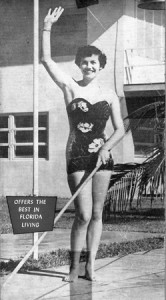
Linda, posed in a bathing suit, was the front page of the 1954 Chamber of Commerce brochure promoting Deerfield Beach. However, I was also kind of proud of her, even though I thought the bathing suit she had borrowed for the photo session from her good friend Shirley Jones in Pompano Beach was ugly. Mother wouldn’t allow her to wear a two piece.

The Chamber brochure was very successful, and helped Deerfield nearly triple its population to 9,573 people by the 1960 census. Most of that population increase, however,
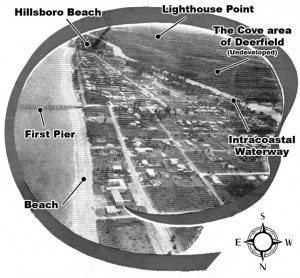
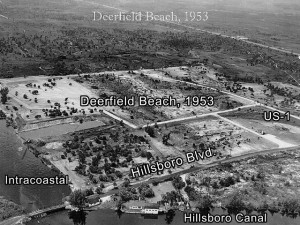
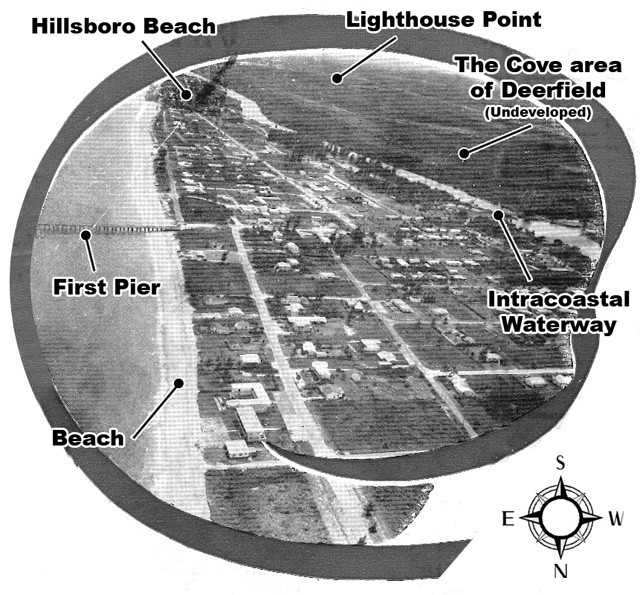
was brought about by one man, Bob Sullivan, (see Historical Article No. 19) who bought and developed the 500 acres called “The Cove” just east of Federal Highway all the way to the Intracoastal Waterway and from Hillsboro Boulevard south to Lighthouse Point. Although Deerfield had been incorporated as a city in 1925, it had grown slowly until Sullivan and a few other developers started “pushing it” in the mid 1950s. Meanwhile, Lighthouse Point was incorporated on June 13, 1956, when 107 people there voted to do so. Mr. R.E. Bateman was the first one there to buy any extensive acreage for development.

Meanwhile, my sister, Linda, mastered the piano as a young lady and went on to play and sing semi-professionally for a few years. She also attended the University of Florida in Gainesville, where she met her husband, Jim Boudet. They raised their five children in Vero Beach, where she still lives.

Historical Essay 49

Deerfield gets it‘s first Black Policeman in 1954

-Moses Bryant hired by Police Commissioner, Marlin Eller-

9 Jul 2009

When my father, Marlin Eller, was elected to the Deerfield Beach City Commission in the early 1950s, and made Commissioner of Police, Deerfield had a substantial number of African-Americans, or blacks in its population, but it had none in its small police force. The white policemen were afraid to go into the black neighborhoods, especially at night. So the black population of Deerfield was left unprotected from the criminals in their midst.

When Dad first ran for commissioner, he knew this was a problem and promised his black friends and employees he would try to do something about it. However, there were a lot of strong feelings from some of the whites in the community to having a black policeman. I remember one of our neighbors across the street telling my Dad that if he hired a black policeman and that policeman tried to arrest his wife or daughter, that would be the last person he ever arrested.

Dad was not amused. But he waited until the second half of his commission term to make his move. After interviewing a number of prospects, he hired Moses L. Bryant to be Deerfield’s first black policeman.
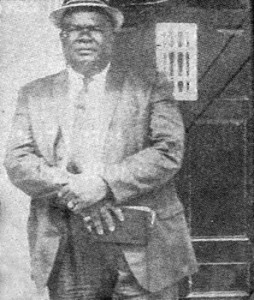
To put it mildly, all hell broke loose within parts of the white community. In fact, Dad had to ride with Moses when he went on duty for awhile to protect Moses from threats which were being made.  Dad put out the word that anyone wishing to cause a problem for Moses would have to deal with Dad first.  Dad in his prime, well built, nearly 200 pounds, with boxing as a hobby, was not challenged as far as I know.

Moses eventually was accepted by most of the community and life in Deerfield went on. When he moved to Deerfield from Shamrock, FL, Moses had three sons: Bobby Lee, Robert Lee and Clarence. While on the police force he had seven more children, three more boys and four girls, for a total of 10 children. Most went on to get a college education and some became school teachers. When Moses eventually retired from the police force, he became a Christian minister.

The City of Deerfield Beach honored him a few years ago by renaming SW 5 Court, Rev. Moses L. Bryant Court. My Dad, Marlin Eller, would have been proud.

Historical Essay 48

Local Little League Team Wins 1954 State Championship

-Goes to North Carolina for National Playoffs –

11 Jun 2009

As my classmates and I gather for our 50th reunion, I wanted to write about our Little League experience. Since our family, the Eller family, has lived in Deerfield Beach since 1923, I’ve often been asked to put in writing some of the history of the area, either experienced personally, or that I heard from my parents or grandparents.

– David Eller, Publisher

Life was good in 1954. Dwight Eisenhower was the U.S. President.
On Feb. 23, the first mass inoculation for polio prevention was done with Salk vaccine. On Mar. 1, the U.S. exploded its first 15 megaton hydrogen bomb at Bikini Atoll .On Mar. 15, The  CBS Morning Show premiered with Walter Cronkite and Jack Paar. On Mar. 20, the first newspaper vending machines were used. On Apr. 2, plans to build Disneyland in California was announced. On Apr. 5, Elvis Presley recorded his debut single, “That’s All Right.” On Jul. 12, President Eisen-hower put forward a plan for the interstate highway system.

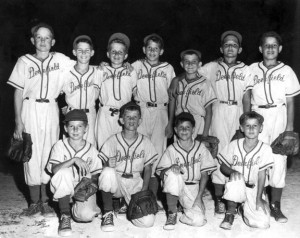
Meanwhile, in Deerfield Beach, Pompano and Wilton Manors, large crowds were coming to watch the North Broward Little League Baseball Team All Stars beat Ft. Lauderdale, Palm Beach, Miami and Orlando teams. Winning the South Florida Little League Championship qualified the team to go to North Carolina to play for the National Championship of Little League.(Florida was divided into two halves at the time by the Little League: South Florida and North Florida)

Our parents drove up to North Carolina. The team took the

train. Someone, I was later told it was “Uncle Jim” Butler, who came to every game sitting in his car and watching us, donated new uniforms for us to wear. Rev. Briggs, of the recently established Presbyterian Church in Deerfield, was at every game, helping Police Chief Manning and Policeman Roy Bennett coach us.

We were good. At least we thought we were. My own claim to fame was that my Father’s good friend, Herb Dudley, a professional pitcher, had taught me, a left-hander, how to throw curve balls that would “break” one to two feet just as they reached the plate. My fast balls weren’t anything to brag about, but my curve balls struck out lots of batters. That is, for about five innings —after which my elbow would hurt so badly I had to retire to the dugout.

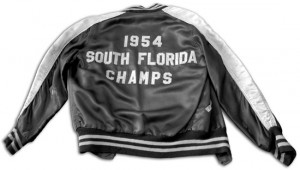
We arrived in Greenville, NC and stayed in the dormitory at East Carolina University. We thought we were hot stuff and unbeatable. When it was time for our first game, we came out early to warm up. We looked good in our new uniforms and maroon colored jackets with “1954 South Florida Champs” printed on the back.
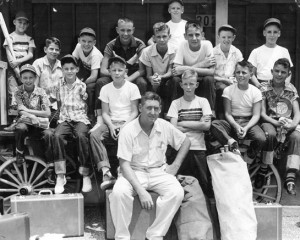
I’ll never forget what it felt like when our North Carolina opponents arrived on the field.  They came from a mountain area and were an average of four inches taller than us. Some of them had slight beards. Their voices were several octaves lower than ours. They were wearing overalls. Our coaches were concerned and wondered out loud about the ages of our opponents. But, when the umpire shouted “Play Ball! “ it was too late to worry about it. We played our hearts out. They scored the first run. We came back and tied them. We held them until the fifth inning, when they scored their second run. We never scored again, so the game ended with them beating us two to one. We cried, and it was the end of my baseball “career.” I never played again, although some of my teammates went on to play high school, college and a couple made it into the Pros.

Historical Essay 47

Famous Golf Pro Sam Snead can’t beat my Dad -out of money, that is-

4 Jun 2009

When I was a child in Deerfield in the early ‘50s, the “Boca Raton Resort & Club” was the main source of economic activity, next to farming, in this area. Other than the hotel, most of the land in Boca Raton was largely owned by the Butts family (See Essay No. 13) or the Japanese farmers (See Essay No. 14). Thus, Deerfield, with its approximately 1,000 residents, was actually much larger in population than Boca Raton at the time. And, it provided much of the small business support for both communities — like two grocery stores, two clothing stores, a drug store, two gas stations and one welding/machine shop, which my Dad, Marlin Eller, owned. It was located on Dixie Highway, where the tennis courts are today. We lived next door to the shop in a wood house painted white with red storm shutters and a white picket fence all around.
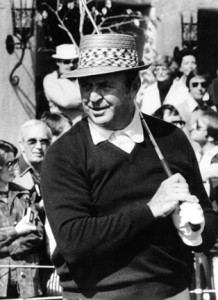
Dad would get up early every morning and sit at the dining room table drinking coffee and reading the Bible before going next door to open “the shop” about 7 a.m. We were one of the only machine and welding shops between Ft. Lauderdale and West Palm Beach at the time. Local farmers were our main customers, but we also provided service to the State Road Department, Vrchota Trucking, Deerfield Rock Industries and the Boca Raton Hotel.

One night over supper, Dad told us about an incident he’d had that day with a gentleman wearing a hat who had come in to get some welding done on some sort of golf ball handling device. It had gotten broken and needed to be welded. We had a minimum charge at the time of $3. When the job was complete, Dad made out an invoice to “Cash” for $3 and handed it to the gentleman. The man looked astonished and said to my Father, “You’re not going to charge me, are you? Don’t you know who I am? I’m the pro at the Boca Raton Hotel and my name is Sam Snead!” Dad, who did not play golf, was a bit taken back and responded with, “I don’t care if your name is George Washington …or Abraham Lincoln. You owe me $3!” Sam, reluctantly, reached for his wallet, paid up and left muttering to himself. Dad later found out that Sam Snead was the most famous golfer in America, but had a reputation for trying to avoid paying for anything. He didn’t “get” Dad, but I sure wish Dad had gotten his signature. It probably would have been worth a lot more than the $3!

Historical Essay 46

Deerfield’s Horne Family

14 May 2009

In the last essay I mentioned that Joel Horne was my Sunday School (Bible)
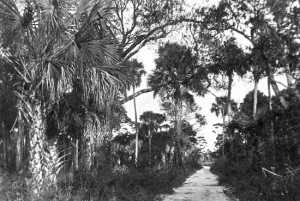
teacher when I was 12 years old in 1954. Joel’s mother and father, J. R. and Ardena Horne, had moved in 1903 from the Lakeland, FL area to this small village, then called Hillsboro,* later changed to Deerfield. Citrus growers and vegetable farmers, they came to Deerfield because the steam-powered trains on the recently built Florida East Coast Railroad had to stop here to take on water from the Hillsboro River to make steam. This stop allowed farmers located here, including the Hornes, to load their winter-grown crops and citrus on those trains for onward transport to northern markets.

J. R. Horne was quite successful and ended up owning a large amount of land in the area, including what is now the Deerfield Beach Country Club, which was his citrus grove, and lands east and west of that all the way to Powerline Road.
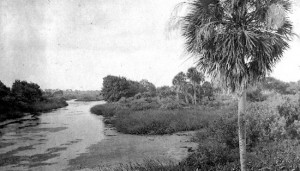
But unfortunately, he was murdered at his citrus grove in 1920 when he came across thieves, reportedly railroad workers, stealing his citrus. The murderers were never caught. His wife was left with small children to raise and had to sell off their property to support the family.

*The area’s name originated from the Earl of Hillsboro, who had received large land grants from King George III during England’s hold on the area between 1763 and 1783. In 1897, reportedly an engineer working on the construction of the Florida East Coast Railroad named C.E. Hunt renamed the area from Hillsboro to Deerfield because of all the deer in the area.

Historical Essay 45

God and Me in 1954 at age 12

9 Apr 2009

Last week, I wrote an essay entitled “Seeking God as a 12-year-old boy in 1954.” This is a sequel to that story. When I had NOT joined most of the youth in my church by “going forward to accept Christ” during a church-held religious retreat, our pastor Bob Rowe asked me “Why?” When I explained that I needed to know more about other religions of the world first, he encouraged me to do just that. He told me that our Christian faith was about God reaching out in love to mankind, as opposed to mankind having to fear a vengeful God. My subsequent studies verified that to me. I started my Bible study by re-reading the first chapter of Genesis where it starts off by saying: “In the beginning God created the heavens and the earth …” It took me a few days to get almost through the second book, Exodus, where in Chapter 20 God used Moses to give us the 10 Commandments. I started scanning through the rest of the Old Testament, ending with the last book of Malachi, in one particular series of verses where God is speaking really got my attention: Malachi 3: “Will a man rob God?  Yet, you rob me.” But you ask, “How do we rob you?” “In tithes and offerings … Test me in this,” says the Lord God Almighty, “and see if I will not throw open the flood gates of heaven and pour out so much blessing that you will not have room enough for it.” I really liked that scripture, still do, and

I am a living testimony that it is true. During the next few months, I read all of the New Testament and got excited about how the birth and life of Jesus fulfilled many prophesies made in the Old Testament hundreds of years prior. About that time, in the summer of 1954, we had an evening revival at our church led by a young minister named Bill Taylor. The first night I went into church with my best friend at the time, James Stills. He was one of my classmates who had “gone forward to accept Christ” a few months prior. We went down the right aisle of the church about midway and he went in to get seated on the right side first. He stopped shortly after stepping into the seat section, leaving me to his left right next to the aisle. After appropriate singing, the Reverend Bill Taylor started preaching. He was a lot
younger than Reverend Rowe and seemed to be preaching directly to me. After the sermon, we were standing up singing when he invited all those who would like “to accept Christ” to come forward, Suddenly, my whole body got stiff. I couldn’t move. James, without even bothering to say anything to me, just shuffled to his left, poking me softly with his left arm pushing me out into the aisle. I stumbled sideways into the aisle for a moment, steadied myself and looked up as the Reverend Bill Taylor, 30 feet away, had his outstretched arms reaching out for me.  Suddenly, I felt myself, in an almost out-of-body experience, “floating” forward toward the Reverend Taylor. When I reached him, he hugged me and said something like “Praise the Lord! “I found out later that nearly everyone in church was praying for me to go forward to “accept Christ.” It worked and is still working. I was baptized by immersion the next Sunday.

Historical Essay 44

Seeking God as a 12-year-old boy in 1954

2 Apr 2009

An age-old question in many cultures is when does a boy start to become a man?
I noticed at age 12 that my parents started treating me a little differently.  For one thing, I was the only child in the church my age that had not “gone forward” — that is, walk down the aisle at the end of a church service during the invitation to “accept Christ.” Most of the kids my age had “accepted Christ” when the Church Pastor Bob Rowe had taken the whole youth group at First Baptist Church up to Ft. Pierce  for a retreat. Intensive Bible study for a week was followed by emotional preaching, ending with invitations for all of us to come forward to accept and commit our lives to Christ.  I was the only young person from our church who did not go forward to “accept Christ” at the retreat and agree to get baptized. Since my parents had always said that it was important that I made that decision on my own, I decided to wait. Pastor, Rev. Rowe was concerned.  He sat with me on a park bench later and asked me why I didn’t want to “accept Christ?” I told him that I wanted to find out about other religions in the world and what they believed, before making such an important decision. He seemed to understand and suggested that I might want to use the new Compton’s encyclopedia that he knew my parents had just bought, and go to the religious section and see what I could learn about other religions.  He further offered to loan me any of the books in his personal library, which might help. Furthermore he suggested that I might want to read the entire Bible,  starting with Genesis of the Old Testament and ending with Malachi. Then I should read the New  Testament starting with Mathew and read all 27 books ending with Revelation. And most importantly, he said I should pray each time before reading and ask God to help me understand the truths that He has revealed to us through His Holy Scriptures. Rev. Rowe then said  that he would be available anytime if I wanted to consult with him or ask any questions. Thus began my quest at age 12 in the year 1954 to do a lot of reading on faith and religion. I wanted  to learn more about who I was, where I came from and where I was going. Fortunately, I was supported in this endeavor by both of my parents, my Sunday School teacher, Joel Horne, and, of course Rev. Rowe. It was a great year.

Historical Essay 43

Deerfield Beach used to be a Party Town!

19 Feb 2009

In the early fifties, television changed social life in Deerfield Beach, just as it did in communities throughout the United States. Before television, Deerfield had an active social scene with people regularly visiting neighbors and friends and often bringing food and sometimes musical instruments with them to make their own entertainment.
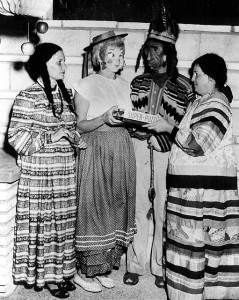
House parties were common and sometimes involved a theme or even costumes. My parents, Marlin and Lorena Eller, were active participants, both throwing and attending parties. One party in particular that I remember them attending was at the large new home of Alvin and Betty Jones on Hillsboro Boulevard. It was a costume party. Dad went as an Indian Chief and mother as a cartoon character, Little Annie. They won first prize and received a Super-Puzzle game. I remember Dad telling me he had to wear his sleeves long to cover up his hands in order to keep people from recognizing him.

Mary Jones, to mother’s right, dressed as a Seminole Indian, hosted the most parties in town. She could afford to because her husband Alvin was a successful farmer and Chairman of the first and only bank in town at the time, the Deerfield Beach Bank and Trust Company. Ethel Jones, to Dad’s left, also in Indian garb, was married to Alvin’s brother, Leo Jones.

We knew all of our neighbors then. Life was simple. Life was good. We didn’t even have to lock our doors at night. Brownie, our mutt dog, protected us with his bark and, if necessary, with his bite.

David Eller, Publisher


Historical Essay 42

From dead buzzards, to best drinking water in the state

22 Jan 2009

There are a lot of reasons that cause people to run for public office. My Dad, Marlin Eller, ran and was elected as a city commissioner in 1953 (see Essay No. 38) on a platform to improve and increase the city’s parks and recreational areas. Victorious in the election, he was confronted immediately with the fact the City didn’t have money for such projects. However, being the resourceful businessman that he was, he was able to find more money for the city by getting hundreds of acres of vacant land, in what is now called The Cove, reevaluated in value for the tax roll.(See Essay No. 39 ). The City used these additional funds then to build the pier on the beach, assist with the beach pavilion project, and install the boat ramp at Pioneer Park.

Just prior to Dad’s election, the City had built a new elevated water tank located where the fire department is now at Federal Highway and Hillsboro. I remember being happy because the water pressure was much stronger, allowing me to fill the bath tub up quicker and to squirt my sister with the hose outside from a further distance. However, as time went on, we all noticed that the water tasted worse and worse.

One morning I heard my parents talking about it. Dad had met with the men running the water department and had determined that they all seemed to be doing their jobs properly and the water tasted fine there. Something else apparently was happening to make the water taste bad before it reached our homes. Someone reported that they had seen birds flying around the top of the new elevated water tank. So Dad took Chuck Craven, a welder that worked for Dad, and who had worked in Chicago for a company who built elevated tanks, with him to climb up that tank and check it out.  Dad was a little afraid of climbing so high, but Chuck helped him and they went up together.

When they reached the top, they couldn’t believe what they found. Everyone had always assumed that there was a top on the city water tank. However, Dad and Chuck found out there was no top. It was wide open, and full of dead birds, including buzzards. I remember Dad saying the stench was awful and made him nauseous.

Back on the ground he immediately called an emergency meeting of the City Commission to discuss what to do. Chuck offered that he could put a top on the tank, based on his experience in Chicago, but would need some help and would expect to get double pay for the risk and difficulty involved. This was conveyed to the other commissioners who immediately agreed to have Chuck do it on an emergency time and material cost basis. Dad abstained from the vote but everyone else voted to do it. Thus Deerfield got a top on its first elevated water tank, and has had excellent, good tasting water ever since.

Years later when Dad was up for reelection, I remember a sleazy looking newspaper reporter from the Palm Beach Post, wearing dark glasses and a crumbled dark brim hat, came to our house one night, apparently with a hidden agenda. Dad welcomed him and when he started asking questions about the water tank project Dad went next door to our shop office, and got the file. He invited the reporter to look through the time cards to verify the charges, and suggested he could interview Chuck and other employees as well. The reporter declined and then wrote a nasty little article with insinuations which were completely untrue. It made my mother cry. This event shaped my opinion of the newspaper business. It made me realize how important it is that newspaper reporters be fair and accurate in their stories, without a hidden agenda. If mistakes are made, they need to be corrected, and opinions should be reserved for the editorial pages by those assigned the task for doing so.

And incidentally, since then, the water in Deerfield Beach has won many awards for quality and is rated one of the best in the State of Florida.

David Eller, Publisher


Historical Essay 41

Christmas 1953: The Tree and the Tramp

18 Dec 2008

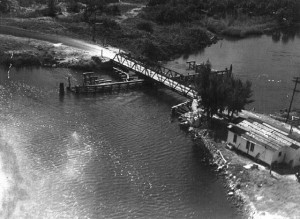
When I was 12 years old Deerfield was just a small rural community. Dixie Highway was our main north-south road, and our family home was the first house on the east side coming south from Boca Raton.  There was no such thing as a store-bought Christmas tree back then —at least not in Deerfield. So at age 12, a few days before Christmas, it became my job to go find a tree “in the woods” (i.e. in Boca Raton), cut it down and haul it on my wagon back to the house down Dixie Highway. I’d received my own hatchet for my birthday in October, so I was anxious to use it to cut down a tree. I hid my wagon in some bushes and searched the area just north of the bridge on the east side. While searching, I heard some voices down by the river. So I crept down to see what I could see. I saw three hobos sitting under the bridge talking. One was coughing badly and he looked really skinny. I felt sorry for them, especially the one coughing (because it was really cold and they didn’t have on jackets). But I knew better than to approach them, as they might be dangerous. They hadn’t seen me, so I headed back north by the highway looking for a Christmas tree. I finally found one that was shaped just right and about as big as I could put on my wagon. So I chopped the tree down, dragged it to the highway and put it on the wagon. Then I pulled the wagon with the tree back over the bridge, above the hobos, and to our house about 100 yards south of the bridge. When I got the tree home, Mom congratulated me and we installed it in a special sand-filled bucket container with spreader legs that Dad had made for that purpose. We added a little water and started the decorating process. While we were decorating, I mentioned to Mother about the hobos I’d seen and how cold they looked and how one was coughing real bad. I knew that sometimes Mom had made sandwiches for hobos who knocked on the door. So after we finished the tree, she went into the kitchen and started making peanut butter sandwiches. She put them in one brown bag and then got another bag of old sweaters and jackets which Dad didn’t wear very often and one old blanket. She then told me to go back down to the bridge and drop the two bags down to the hobos without saying anything to them. Then I was to run back run back home quickly making sure they didn’t see where I went. With mission accomplished, I was proud to have done something to help those poor fellows. I remember Mother and Dad talking about it that night and Dad saying that it happens every winter. When it gets cold up north, the vagrants, as he called them, come south looking for warm weather. They apparently don’t realize that it can get cold down here, too. So they end up unprepared when a cold spell hits. The next day was a Saturday and I was watching Hop-Along Cassidy on TV when the police car pulled up front. The policeman, Mr. Lloyd Newman, came to the front door carrying the same brown bag I had dropped down to the hobos the previous evening. He said, “Mrs. Eller did you make some peanut butter sandwiches for some hobos by any chance?” Mother said “Yes, I did. David dropped them off to the hobos down by the bridge yesterday afternoon.”  Officer Newman continued, “Well, we found a dead man, a hobo down under the bridge this morning, with a half of a eaten peanut butter sandwich in his hand. We just wanted to make sure he hadn’t been poisoned or anything like that. But if you made the sandwich then I know everything is alright. So…you have a Merry Christmas, you hear?”  Mother responded “Thank you Lloyd. And Merry Christmas to you too!”     I share this true story as a reminder that we all need to be sensitive to the needy in our midst. Happy Hanukkah and Merry Christmas to all.

David Eller, Publisher
Comments Off on Historical Essays 41 to 50

Publisher's Perspectives 2008

Posted on 04 December 2008 by LeslieM

George Will – Shame on you! – paid by Japanese to diss U.S. car manufacturers

4 Dec 2008
Last week George Will, the famous syndicated columnist for The Washington Post, wrote a stinging editorial entitled “Bailout won’t fix the dying auto industry.” Reading on, I realized he actually meant the U.S.-owned auto industry should be shut down in America, and not the foreign-owned auto industry operating here.
Being a fan of George’s for many years, I read on with some concern as he gave reason after reason why our government should not do anything to prevent our U.S. car manufacturers from collapsing. Finally at the end of his editorial, there was the following disclaimer: Disclosure: Mrs. Will is a public relations consultant for the Japan Automobile Manufacturers Association.
That really made me mad. And frankly it should make all Americans mad to know that a famous columnist like George Will had been bought and paid for by the Japanese to trash their American competitors, and suggest the American car companies should be put out of business. This proves without a doubt that the U.S. automobile manufacturers, their employees, retirees, investors and bond holders have been operating in a very unfair competition situation. The U.S. government, using money taxed from the American people and companies including General Motors, Ford and Chrysler, was right there to help pay for rebuilding the Japanese, European and Korean automobile companies after their countries’ wars. Now some of these same foreign companies are trying to prevent the U.S. government from helping our own U.S. car companies to rebuild!
That is outrageous. Doesn’t the term “conflict of interest” have any meaning to Mr. Will? By writing this editorial slamming Detroit, he is providing direct assistance to his wife, who is paid by the Japanese to promote their cars.  And now knowing the Japanese have hired George Will to dump on our American companies, how many more of our press, opinion leaders and politicians have been compromised? I now suspect it is not just a few. No wonder our economy is in shambles.
But looking to the future, hopefully the U.S. car manufacturing executives will come up with a plan for continued viability that Congress can support. And if it requires the executives and union members to lower salaries and perks to survive, they should get on with it. Furthermore, since the foreign car companies are subsidized about $1,500 per car for their employee’s health costs paid for by their governments, something should be done by the U.S. government to equalize that playing field for the Americans.

Congratulations to Obama!

— and all our African-American friends, too —

13 Nov 2008
If anyone had any doubts about the status of racism in the United States, his or her doubts should now be answered. Martin Luther King started the peaceful march against racism, but it was Obama who finally crossed the finish line. Hopefully race will not be an issue in future Presidential contests, or any other elections either, because of him. That is wonderful, and makes me proud to be an American.
The only fly in the ointment is those who keep harping about the amount  of money he spent  to get elected, and where it came from. I wish they would leave him alone about that.  It was only $200,000,000 — about a third of the total money he raised, in small amounts – for which he hasn’t identified the donors. Why does it matter where it came from? Remember how popular he was when he traveled overseas? And besides, he is really busy organizing things right now!
But seriously, he needs to get that question behind him as quickly as possible or it may jeopardize his Presidency. If there is nothing to hide, just release the names of all of his contributors like John McCain did, and George Bush did, as well. If some are foreign, illegal, or unidentifiable, the money should be returned or donated to charity. If he has to make a special fund-raising effort to make up the difference, we will understand, praise him for doing it, and make a contribution.
Hopefully he will get the air cleared on this matter so he can go about running the country and get everyone fully behind him to help.
Furthermore, John McCain should devote the remainder  of his career in the U.S. Senate to closing the loophole that now permits candidates in federal campaigns to raise unlimited amounts of small credit card contributions via the Internet with absolutely no record as to who is making the contribution, where they reside or whether they are even qualified by virtue of U.S. citizenship or a Green Card to make any contribution.
David Eller, Publisher

Which Presidential candidate will be best to protect you and your loved one’s job?

30 Oct 2008
That is an easy question to answer: If you work in the private sector, Obama’s proposals to increase taxes on the people who own businesses could cost millions of people their jobs. If you work in the private or even the government sector, the job loss could possibly be yours.
The formula is relatively simple. Every business requires a certain amount of working capital, i.e. money, to operate. The amount varies depending on the type of business. For instance, the manufacturing industry, which I know about, requires an average investment of about $125,000 per employee for buildings, machinery and working capital. Most of that money typically has to be borrowed. To employ 20 people, therefore, a company has to find a bank willing to lend $2,500,000, which the bank typically wants to have paid back over a 10-year period, or $250,000 per year. Add interest at 7 percent, or $175,000, and you have a minimum obligation of $425,000 per year or  $35,400 per month.
The $175,000 per year interest is deductible from taxes on any profits the business might make. But the additional $250,000 principle they have to earn each year to pay the bank back is taxable, less depreciation, before they get anything for themselves. That tax is already one of the highest in the world at 35 percent, and Obama is proposing to raise it!  Consequently, many small business owners already make less in actual take home pay, after paying the bank and the government taxes, than many of their employees. I know because I am one.
Now, Obama promises to make it worse by raising our 35 percent taxes higher. Either he doesn’t understand, or doesn’t care, that a lot of people are going to lose their jobs because of that tax increase. Jimmy Carter had our taxes at 70 percent; people got laid off and our economy collapsed. Reagan lowered them to 26 percent, our economy boomed, people got hired and the U.S. government received more in taxes the next year than it ever did before.
Incidentally, to those of you in government jobs, when we in the private sector lose our jobs, there is less tax money to pay for you or fund your pensions. Therefore, guess what? You’re next! Think about that before you vote next Tuesday.
David Eller, Publisher

If you liked Jimmy Carters’ Foreign Policy, you’ll probably love Obama’s

23 Oct 2008
Barack Obama’s Vice Presidential running mate Senator Joe Biden said last week that he expects a serious international crisis to occur within the first six months of the next U.S. President’s term. Let’s reasonably assume that it involves Israel, since that country has been threatened over and over again with annihilation. For instance, Iran could acquire a nuclear warhead from Pakistan, mount it on one of their long-range missiles and strike Israel. It would be a sneak attack to try to completely destroy Israel and knock out Israel’s ability to retaliate.
If this possibility concerns you, who do you want to be President of the United States at that time? Who might our enemies fear the most as our President? Who would, hopefully, keep such a scenario from happening in the first place? I suspect our enemies would fear McCain the most … which is a good thing!
Remember when Iran took dozens of Americans hostage during Jimmy Carter’s administration? The Iranians did not respect or fear Carter, acted accordingly, and the American people suffered the consequences. Reagan had not been sworn in as our President for 5 minutes when the Iranians let our people go. The Iranians admitted later that they were afraid of what Reagan was going to do as our new President. That’s called respect. It is not saying “I will sit down with [terrorist nations] and negotiate,” as Obama is fond of saying.
All due respect to Joe Biden, but it would not be his call to make as Vice President — how to retaliate. It would be the President of the United States’ responsibility as Commander in Chief. If elected, Obama would be the only one ultimately making the decision on what to do … if anything.
Meanwhile Obama’s Chicago neighbor and [friend] Jesse Jackson was at the World Policy Forum at a French lakeside resort last week, where Jackson was quoted as saying: [that under Obama] “decades of putting Israel’s interests first” would end.
Jesse should know. Jesse knows him well. He calls him his “neighbor.” He says, “We helped him start his career;” and says his daughter went to school with Obama’s wife Michelle. Therefore, we can assume that Jesse knows what he is talking about.
So the bottom line is: If you liked Jimmy Carter’s foreign policy, you’ll probably love Obama’s. And if you really care about Israel, the choice is clear.
David Eller, Publisher

McCain made a good choice…

18 Sep 2008
in selecting a woman as running mate
but must realize he can’t treat her as he might a man
”In revenge and in love, woman is more barbarous than man”
–Friedrich W. Nietzsche, Beyond Good and Evil, 1865
My wife, who doesn’t normally like politics very much, called me excitedly last week.
”McCain has just announced he has selected a woman, the Governor of Alaska, to be his running mate!” I frankly was surprised by my wife’s reaction, even though we’ve been married 40 years.
She continued:  “and she has five children, including a son in the military going to Iraq, three daughters and recently birthed a baby son who has Down’s Syndrome!”
“Wow,” I responded.
“And that is not all,” she continued, “She got into government to clean up the mess and corruption some men had made. Even though some were in her own political party … she exposed them, ran against them and won with about 80 percent of the vote!”
“Wow,” I said again.
“Sounds like superwoman to me!”  “Yes,” she said. “She even looks like superwoman!”
“Wow.” I said again.
“I can’t wait to see … uh … hear her!”
Thus was my introduction to Governor Sarah Palin. Later, when I got a chance to listen to Sarah Palin speak, heard her joke and saw the twinkle in her eye, as she obviously was enjoying herself, I could understand my wife’s enthusiasm.
There are those who say she doesn’t have the experience to be Vice President. However, she is the only candidate of either party who actually does have the executive experience of running something: Alaska, the largest state geographically in the United States. And before that, she was a mayor, i.e., chief executive of an important city in Alaska. Compare that to either of her current political opponents, who have zero executive experience between them, yet aspire to be chief executives of the land.
John McCain, who also lacks executive experience, was wise to pick someone with executive experience to help him run the government. However, if he and Sarah win, President John McCain and his staff better be careful. His Vice President, Sarah Palin, has a proven record of going after members of her own party and administration if she sees them abusing their positions in government. Therefore the “good old boy network” in Washington might be in for a shock.
Now how about that for a change and some fresh air in DC?
David Eller, Publisher

Warning, Non-Citizens who vote could go to jail along with those who assist them

21 Aug 2008
Publisher Perspective: Warning, Non-Citizens who vote  could go to jail along with those who assist them
I was sitting in my office just west of Dixie Highway a number of years ago, when a middle aged lady, who worked for the Broward County Welfare Office as a bus driver, came to see me. Their office was located in a building we had just bought for the Observer. She immediately apologized for the interruption, but said “I’ve just got to tell someone what is happening.” She went on to explain that she drove a bus for the county, and her bosses were having her drive the bus around for them to find people to register to vote.
What was bothering her was that it appeared her “bosses” were intentionally registering non-US citizens to vote. She said they would pull the bus up to areas where foreign workers were apparently known to congregate, and where “runners” had already gone out ahead to gather them up. The “runners” were being paid by the number of people they brought to the bus. She noted that most of the people being brought to the bus did not speak English. Once on the bus her “boss” would tell them loudly in English: “Raise your hand if you are a U.S. citizen.” Most of them, according to her, would just look confused. So her “boss” would hold up a box, as though she was going to give them something of value, and repeat the question, simultaneously raising her own hand in a motion for them to mimic. Those who raised their hands were immediately given a voter registration card application to fill out with the help of the “runners” and the “bosses.” My informant then begged me not to confront her bosses about this as she would certainly be fired.
So, the next day I drove down to the Supervisor of Elections office in Ft. Lauderdale to find out what could be done about this. I talked to Easter Lily Gates, who at the time was  Supervisor of Elections and an old friend of my father’s. A kind, matronly looking lady with a hat on, she explained to me that it was against the law for them, the supervisor or her staff, to even ask someone for proof that they were a U.S. citizen. Anyone who applied for a voter’s registration card was automatically given one with no proof of citizenship required.
Flabbergasted, I personally spent years trying to get the system changed to make sure only citizens could register and vote. It was finally changed a few years ago here in Florida, but only after it was discovered that eight of the 19 September 11 hijackers were registered to vote in either Virginia or Florida. It was determined that the registrations were obtained when they applied for driver’s licenses. So now if someone who is not a U.S. citizen registers and votes, it is a felony crime. Do your part to make sure our elections are fair. If you know of someone who is not a U.S. citizen, yet has registered to vote, contact the Supervisor of Elections office and let them know.
David Eller, Publisher

The British love Deerfield…..to visit

17 Jul 2008
My wife and I recently took my wife’s mother, Julia Ackerman Frey, on a cruise to the Norwegian fjords to celebrate her 85th birthday. The Princess Cruise Line ship we were on, departed from Southampton (SP) England and went through the English Channel to carry us all the way up the coast and islands of Norway. We went way north of the Arctic Circle. Although the ship was huge, approximately 100 yards long and 15 stories high, and carried about eighteen hundred passengers plus hundreds of crew, it was able to venture all the way up a number of these Norwegian fjords. The fjords, some 60 miles long, were formed by glaciers cutting their way through the rocky mountains of Norway thousands of years ago as the last ice age receded. The scenery was breathtakingly beautiful, consisting of rock cliffs as high as 3,000 feet on each side with snow still on the top melting, thus creating waterfalls tumbling down the mountain into the crystal blue water of the fjord. I counted twelve waterfalls in one scene as we came around a bend. Being a boatsman myself, I was also worried about the ship running aground until the captain assured me there was no danger of that, since the water was at least 450 feet deep, even at the mountain end of the fjord.
The captain also shared that our cruise passengers were about 50 percent British, 25 percent American, 5 percent Canadian and the rest from some 20 other countries.There were many occasions, of course,  to engage in conversations with our fellow passengers. At first I would simply identify myself as being an American. The British would never allow me to get by with that. They wanted to know where in America. When I said “Florida,” I nearly always got a “I’ve been there!” reaction, with a “where in Florida?” follow up question.  When I responded “Deerfield Beach,” it was amazing to me how many of them knew our city and some of them knew it well.  One fellow said he generally stays at the Embassy Suites and likes to jog in that neighborhood. There seemed to be two main reasons they chose to come here: shopping was first, and our beach was second. The shopping part proves the truth of my Economics 101 class (taken long ago) that people typically will go to great lengths to save money. Thus, Britain’s high taxes on clothes and other items drive their citizens to Deerfield Beach.  When I suggested he might want to buy a place here, he declined, saying “your property taxes are too high.”   My Economics 101 professor was right again. Our city and county politicians need to take note!
David Eller, Publisher

Changes at the Observer

3 Jul 2008
It is with mixed emotions that we announce that Ric Green will be leaving us as editor of the Observer. The first emotion is one of sadness as we have grown to love and respect his work here. The second emotion, however, is one of happiness for him. As the newly appointed CEO/President of the Chamber of Commerce for Pompano Beach, Ric will have the opportunity to use his enormous promotional and personality skills to help take that organization to its next level. As a native son of Pompano Beach, this is certainly a win-win for both Ric and the greater Pompano Beach area.
We at the Observer are fortunate to have a professor of Journalism, David Volz step in as our new editor. David has lived in South Florida since 1980 and with a masters degree in Communication from Fla. Atlantic University has taught in both Miami Dade and Broward, including Nova Colleges. In addition to teaching and writing, David devotes much of his time to his wife, Nancy. We look forward to receiving David’s leadership and guidance as we take the Observer forward to serve you even better in the future.
David Eller, Publisher

Moses in the Bible tried to warn Eliot Spitzer “be sure your sin will find you out”

13 Mar 2008
In HIS Holy Scriptures the Lord God has given us humans a lot of good advice. HE used Moses as HIS instrument to write much of it. For example, in the Scripture’s Old Testament Book of Numbers, Chapter 32, Verse 23, it is written: “if ..ye have sinned against the Lord, be sure your sin will find you out.”
It has been both amusing and scary to watch events of this past week play out in regard to former chief prosecutor, Attorney General and Governor of New York Eliot Spitzer. As the chief law enforcement officer of New York he famously pursued many people and businesses, including prostitutes and their organizations, to enhance his own reputation. It was a strategy which he obviously intended to use to promote himself to higher office. It is said he even planned next to run for President of the United States.
Now that he has been caught using prostitues, his name will be famous all right. Want to call someone “two-faced”? Just refer to them as an “Eliot Spitzer”. Want to call someone a “demagogue”? An “Eliot Spitzer” will do just as well.
To some that will be amusing, and well deserved. However, it is not amusing to many of you, and us, who are trying to encourage the young people in our society to reach for higher goals. How many people, young and old, may now make dreadful decisions, negatively affecting their lives, while maybe even sub-consciously thinking of Eliot Spitzer and justifying it as “everybody does it”. That’s the scary part.
Well…everybody doesn’t do it! And if you want God to bless you, you must live your life in a way that is blessable. Watch what happens to Eliot Spitzer in the future. You can be sure it will be the opposite of blessed.
David Eller, Publisher

Prayer at city hall?

14 Feb 2008
In reviewing this week’s letters to the editor, and one particular column by my friend, columnist Herb Siegel, I am reminded of Rodney King’s lament a few years ago saying “Why can’t we all just get along?”
It all started last week when Pastor Dr. Joseph Guadagnino of South Florida Bible College, located on Federal Highway here in Deerfield Beach, attended the Deerfield City Commission meeting with about 100 fellow Christians requesting that the City Commission re-instate clergy-led prayers to open their meetings. He went on the say that, “For a time, Pompano Beach did not allow clergy-led prayers, but they do now. We oppose your decision to not have clergy-led prayers. I am offended. Christians are under attack.”
Mayor Capellini then read a letter from the ACLU suggesting the organization would sue the city if clergy-led prayers were not halted. An attorney in the audience offered to defend the city free of charge if that happened. Commissioner Pam Militello asked what was wrong with one moment of silence?
As a matter of coincidence, before I came into the Observer office that morning, I had been watching the U.S. Congress on C-Span. They opened their session with a prayer by a minister. Why isn’t the ACLU threatening them? Could it be because they know they would lose, maybe already have lost, and find it much more convenient to go around with bully tactics threatening towns like Deerfield Beach?
God bless Dr. Guadagnino and his congregates. I’m not one of them, but I appreciate what he and his congregation are doing to shine some light on this matter.  And Herb, God bless you too! But incidentally, you were wrong when you assumed Christians don’t study the Old Testament. I know they do because I teach it at my church.
David Eller, Publisher

Vote “Yes” on Amendment 1

24 Jan 2008
Don’t think about going to the polls next Tuesday and trying to comprehend the meaning of Amendment 1. Here are four simple reasons why you should vote YES:
1. Your “Save Our Homes” is not only protected, it is doubled to $50,000. School taxes are not affected at all and even inexpensive condos will still pay full taxes on the appraised value between $25,000 and $50,000, as well as on everything above $75,000.
2. Passing Amendment 1 will finally allow you to transfer your accumulated “Save Our Homes” benefits to a new homestead. This will free up homeowners who are now trapped in their homes and will spur the real estate market, which is the backbone of the local economy.
3. It will create a $25,000 exemption on assessed value of tangible personal property and this will be a big benefit to small businesses throughout the state.
4. It will limit assessment increases for specified non-homestead real property to 10 percent each year.
Amendment 1 is a good start at much needed reform and deserves your full support.  You can look forward to voting on a revenue cap amendment sometime in 2010, which will end, once and for all, the out-of-control spending habits of our local governments.
You should be aware that there is considerable confusion about one provision toward the end of Amendment 1 that would provide for “homestead exemptions to be repealed if a future constitutional amendment provides for assessment of homesteads ‘at less than just value’ rather than as currently provided ‘at a specified percentage’ of just value”.
Regardless of this provision, Florida voters will still always remain in control of maintaining their “Save Our Home” benefits and will never vote to eliminate them.
Vote Yes on Amendment 1 next Tuesday, January 29.
Presidential Preferences
This is undoubtedly the most “open” Presidential election since 1952 and for the first time in our history, prospective voters have been absolutely deluged with information about the Republican and Democrat candidates for President. Between the candidates’ websites, the Internet, mailings, personal appearances, news articles and the numerous debates, every voter can know exactly what position a particular candidate has taken on a possible issue. Because of this unprecedented access each of us has had into the “minds” of each candidate, we do not deign to recommend one Republican or one Democrat over another.
Next Tuesday, the choice is yours. You know what kind of world we live in. Choose the candidate who can best lead us in the next four years.
David Eller, Publisher

How Long Do We Have?

17 Jan 2008
A guest Editorial by Professor Joseph Olson of Hemline University School of Law, St. Paul, Minn.
About the time our original thirteen states adopted their new constitution in
1787, Alexander Tyler, a Scottish history professor at the University of
Edinburgh, had this to say about the fall of the Athenian Republic some 2,000
years earlier:
‘A democracy is always temporary in nature; it simply cannot exist as a permanent form of government.’
‘A democracy will continue to exist up until the time that voters discover they can vote themselves generous gifts from the public treasury.’
‘From that moment on, the majority always vote for the candidates who promise the most benefits from the public treasury, with the result that every democracy will finally collapse due to loose fiscal policy, which is always followed by a dictatorship.’
‘The average age of the world’s greatest civilizations from the beginning of history, has been about 200 years’
‘During those 200 years, those nations always progressed through the following sequence:
1. From bondage to spiritual faith;
2. From spiritual faith to great courage;
3. From courage to liberty;
4. From liberty to abundance;
5. From abundance to complacency;
6. From complacency to apathy;
7. From apathy to dependence;
8. From dependence back into bondage’
Professor Joseph Olson of Hemline University School of Law, St. Paul,
Minnesota, points out: The United States is now somewhere between the ‘complacency and apathy’ phase of Professor Tyler’s definition of democracy, with some 40 percent of the nation’s’ population already having reached the ‘governmental dependency ‘ phase. If Congress or a future presidential administration grants amnesty and citizenship to 12 million or more illegal criminal invaders and they vote, then we can say goodbye forever to the USA as we have known it, as the USA follows the Athens Republic over the historical cliff of “has been” nations.
David Eller

HAPPY NEW YEAR, JANICE!

3 Jan 2008
Now that we’re “out” with the old and “in” with the new year, it is a good time to reflect on life, and among other things, make sure we do not take ourselves too seriously. For example, my good friend and first-grade classmate, Janice Brown Rogers, recently wrote the following to this publisher:
Dear Publisher and friend David Eller,
“For the last several months I have enjoyed reading your articles ‘Publisher’s Perspective: Historical Series’. Having grown up in Deerfield, I am amazed at your memory of events. I have reminded myself that these are the historical views, embellishments, and memories of a child and not necessarily fact!
You have indicated you were a mighty force to reckon with in fights. I don’t remember your boyhood altercations but I do recall, and as you have admitted yourself, to you pushing the girls off the sidewalk into the sandspurs……”
Janice goes on to challenge my memory on other issues such as the number of boys in grades one through three, and claims that Dewey Bennett didn’t arrive in Deerfield until fifth grade, not third grade as I had written.
Well Janice, as it would happen, Dewey’s sister Carol was in town this week and verified that her family moved to Deerfield when Dewey was in third grade, and she (Carol) was in fifth. So I stand on what I had written. However, I did enjoy the copy of our “6th Grade Will” you sent that was dedicated to the 5th graders behind us in school. Please note the following two bequests:
“David Eller wills his sweet disposition to Billy Hall.”
“Janice Brown wills her habit of arguing to Maria Stevens.”
I guess some things just never change. I love you Janice and dedicate the following funny stories about elementary age children to you:
A little girl was talking to her teacher about whales.
The teacher said it was physically impossible for a whale to swallow a human because even though it was a very large mammal its throat was very small. The little girl stated that Jonah was swallowed by a whale. Irritated, the teacher reiterated that a whale could not swallow a human; it was physically impossible. The little girl said, “When I get to heaven I will ask Jonah.” The teacher asked, “What if Jonah went to hell?” The little girl replied, “Then you ask him.”
A kindergarten teacher was observing her classroom of children while they were drawing. She would occasionally walk around to see each child’s work. As she got to one little girl who was working diligently, she asked what the drawing was. The girl replied, “I’m drawing God.” The teacher paused and said, “But no one knows what God looks like.” Without missing a beat, or looking up from her drawing,the girl replied, “They will in a minute.”
One day a little girl was sitting and watching her mother do the dishes at the kitchen sink. She suddenly noticed that her mother had several strands of white hair sticking out in contrast to her brunette head.  She looked at her mother and inquisitively asked, “Why are some of  your hairs white, Mom?” Her mother replied, “Well, every time that you do something wrong and make me cry or unhappy, one of my hairs turns white.” The little girl thought about this revelation for a while and then said, “Momma, how come ALL of grandma’s hairs are white?”
To Janice and all our Observer readers and advertisers:
HAPPY NEW YEAR!
David Eller, Publisher

Comments Off on Publisher's Perspectives 2008

Historical Essays 31 to 40

Posted on 20 November 2008 by LeslieM

Historical Essay 40

1953 at Deerfield Elementary School

Published: 20 Nov 2008

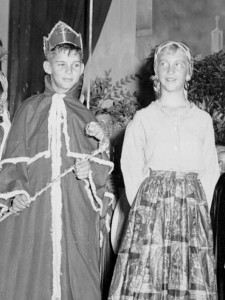
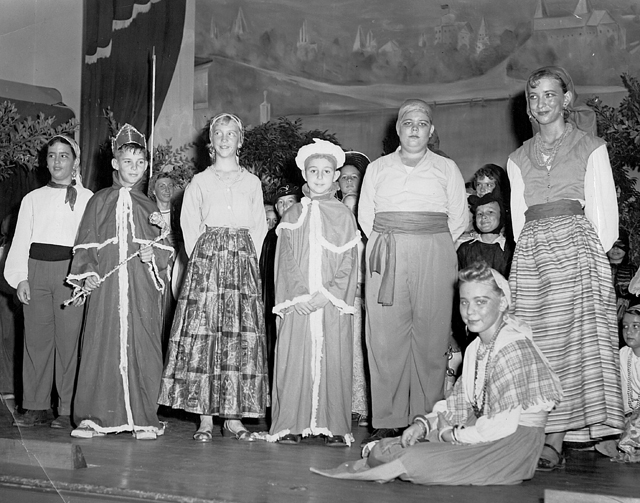
While my father, Marlin Eller, was busy serving on the Deerfield Beach City Commission, I was enjoying myself in the sixth grade at Deerfield Beach Elementary School. At first we didn’t have a teacher for our grade so Mrs. Henry, the principal of the school,did the teaching until Mrs. Sawitzke arrived to take over the job. She was a very good teacher and even introduced us to acting in a play about gypsies. I was King of the Gypsies and Lynda Dame was Queen. It was a little embarrassing because over the previous summer Lynda had grown to be about 6 inches taller than I was. I don’t think she grew an inch after that summer, so I eventually caught up and passed her in height.  The “lead” actors in the play (left to right) were Tommy Gannon, yours truly David Eller, Lynda Dame, Richard Rieth, Jimmy Phillips, Peggy Hahn (seated) and Beatrice Manning. Richard Rieth was the shortest member of our class, but very smart in math and science. He wrote the following: “With the help of my scientific mind and my chemical analysis, I am going to try to look into the future and tell what I see my classmates doing 10 years from now. I see, yes, I see Dewey Bennett playing big league baseball with the New York Grankees, I mean, er…the New York Yankees. I also see Tommy Gannon leading a big band in New York, and his name in neon lights. As for Mildred Gordon I see her as a nurse working in the largest hospital in the world. Yes, and David Eller playing baseball with the Boston Beans, oh, I mean the Boston Red Socks. As for Beatrice Manning I see her working as a clerk in a bakery. I also see Diane Ash as a schoolteacher teaching sixth grade, and doing just as wonderful a job as our teacher Mrs. R.S. has done. The night of our operetta, there was a big movie producer from Hollywood, California in the audience, who promised great careers for Peggy Hahn and Lynda Dame. Now they can be seen in the great musical hit South Atlantic. I also see Jimmy Phillips working in a circus as a trapeze artist. Yes, and Donald Williams and James Stills becoming great farmers and growing new kind of fruit trees by use of chemicals and grafting. With Deerfield growing as it is, I see a newspaper all its own, published and edited by Janice Brown and Jessie Beard, with the gossip column headed by Susan Whitney. As for myself, with my interest in electricity and my experimenting with chemistry, I’ll be lucky if I’m still here 10 years from now.”   Richard Rieth. Note: One of his predictions came true: Tommy Gannon, a tremendous trumpet player even in sixth grade, went on to have his own big band in California. Richard Rieth graduated from our high school a few years later and received a full scholarship to Rensselaer Polytech  University in New York to study engineering. He went on to help develop our modern telephone systems. Yours truly, David Eller, ended up as publisher of the newspaper in Deerfield instead of Janice Brown and Jesse Beard. And finally, Mildred Gordon wrote the following poem dedicated to the graduating sixth grade class at Deerfield Elementary School in 1953:

Six more years have we to go

down the path of life abroad,

Down the sunny lane to school

Where we always obey the rule.

We’re half way through the school life now,

Six more years upon our brow.

When it’s hot when it’s cool

We’ll still be in school;

Even though we’re half way through

We’ve still got six years to do

Now we sing farewell to you

And to wondrous teachers too

David Eller, Publisher      11-20-08

Historical Essay 39

Elected to the Deerfield Beach City Commission

Published: 16 Oct 2008

Elected to the Deerfield Beach City Commission in 1953, my father, Marlin Eller, had campaigned on promises to the voters to build more parks and recreational facilities for the town. Once elected, however, he found out that the town was nearly broke and, thus, could not afford any such projects. Dad was very frustrated. He had hoped to build a boat ramp on the Hillsboro River in Pioneer Park and a fishing pier and pavilion at the beach. But the city did not have enough tax money coming in to afford such projects. Frustrated, he started looking into the city finances.  The problem was that most of the land in Deerfield was owned by the Kester family of Pompano Beach, who also owned the only bank in the area, the Pompano State Farmers Bank. Mr. Kester was content to keep the hundreds of acres of land he owned in Deerfield essentially undeveloped, since it was on the tax roll valued at only $500 per acre, and, thus, did not cost him much each year in taxes to leave it undeveloped. Dad suspected that the Kester land was undervalued. He decided to get an opinion from one of the only real estate brokers in the area at the time:

Boynton Realty (See previous Essay No. 19 ). Shortly thereafter, Boynton Realty notified Dad that they had a qualified buyer who would pay $1,500 per acre for the Kester owned property in Deerfield. Dad had the city clerk notify Mr. Kester that the city was going to meet on a certain date and vote to increase the taxable value on his property to $1,500 per acre. Mr. Kester was not a happy camper. In fact, he showed up at the meeting, stood up and angrily said that he would sell every piece of property he owned in Deerfield if they raised the tax value to $1,500. Dad responded by asking him if he was sure of that? Mr. Kester responded in the positive. With that said, Dad invited Mr. Forney Horton of Boynton Realty and his client Robert Sullivan to the podium. Mr. Sullivan presented a letter from his bank guaranteeing that the funds were available to buy the approximate 500 acres of land at $1,500 per acre that the Kesters owned in Deerfield, running from Hillsboro Boulevard to the current Lighthouse Point boundary and  from the Intracoastal Waterway to  Federal Highway. Mr. Kester, apparently surprised, immediately agreed to the sale, in front of the whole audience. Thus, the City of Deerfield nearly tripled its income that night, and Dad was able to proceed in accomplishing his promises for a boat ramp, a fishing pier and a beach pavilion for the citizens.

David Eller Publisher        10/16/08


Historical Essay 38

Marlin Eller, my father, wins big in 1953 election … for Deerfield City Commission

Published: 2 Oct 2008

Dad ran for the Deerfield City Commission in 1953 and won, receiving nearly 80 percent of the votes cast. In fact, he got more votes than anyone else running for any of the commission seats that year. There were only a little over 500 voters in that election, and Dad got more than 400 to vote for him. He was 37-years-old and very happy. Deerfield did not have a City Manager form of government at that time. It had a mayor and four commissioners, each of which was responsible for managing a portion of the city government. Each commissioner selected the part of the city government he or she would like to “run.” The commissioner who received the most votes could select first. There was a commissioner responsible for utilities, a commissioner responsible for streets, another for the fire department and another for the police. Dad selected to be the commissioner of police.  It was not such a big job, because there were only four or five policemen. Deerfield even had its own small jail at the time, approximately where the city council chambers are located today. The police also had their office there. It was only a block from our house and factory, which made it very convenient for Dad to go there as needed.   Dad had not run on a campaign to be the Commissioner of Police. He actually ran on a campaign to improve and increase the city’s parks and recreational areas. Once elected, however, he realized he could do more for the city as Police Commissioner to fight for some other issues which were festering in our small southern town. For instance, Deerfield had a sizable black population, but had no black policeman. Crime was rampant in the black neighborhoods, and the white policemen seemed afraid to go there. When they did, there seemed to be a tendency to use too much force, out of fear, or other reasons. Dad had many friends in the black community who had supported him and quietly solicited their help to find the right person to hire. Meanwhile, he started working on other projects which the city needed. The most urgent was that there were not street markers at the corners of most streets which identified the street. Without street signs, it was very difficult for visitors to find their way around. Dad brought it up at his first commission meeting. The city clerk, Mr. Richardson, reported that Deerfield’s budget did not include any money for pursuing such a project.

In frustration, Dad blurted out that he thought he could get concrete street markers donated from the new concrete company which had recently moved into town. The other commissioners then agreed that if Dad could get the street markers donated, they would pay to get them installed… The new concrete company Dad was depending on to make the donation was located just east of the Sea Board Railroad crossing, where JM Family’s headquarters is today. Dad had done the owner a few favors by working at nights and on weekends doing some emergency welding and machine work on some of the concrete company’s equipment. He took me with him on Saturday morning to see the owner, a tall bald headed man, and make the request. I could tell Dad was a little nervous. He finally got the request out for 6- by 6-inch concrete pilings, 5 foot long to be donated to the city. Without hesitation, the owner said, “Marlin, is that all you want? Just let me know how many. It would be our pleasure.”   By the following Saturday, the piles were delivered to our shop. That’s when I learned that it was going to be my job to help paint the street numbers, through stencils, on the pilings. When I think about it, I can still smell the black asphalt based paint we used to give Deerfield its first street markers.

David Eller Publisher      10/02/08


Historical Essay 37

President Eisenhower’s Inauguration … caused me to break my arm

Published: 28 Aug 2008

I was 11 years old, and maybe it wasn’t directly Ike’s fault. But if it hadn’t been for his being inaugurated as U.S. President on January 20, 1953, I probably would not have broken my arm that day.  It began with my mother, who was President of the PTA at Deerfield Elementary, requesting Mrs. Hendry, the principal of DeerfieldElementary School, to allow me to leave school early and come home to watch the inauguration on our new television set. Mrs. Hendry approved it with the caveat that I was to give a report to the class the next day. When I got home from school to watch, my parents along with some neighbors, were already watching the 14-inch black and white TV in our living room. It was a little after 11 a.m., and after about 30 minutes of watching politicians talk, I got bored. I heard the announcer say that the big event, or actual inauguration itself, would not take place until noon. My parents were busy watching the TV and talking to their friends, so I decided to slip out into the backyard to play on the new monkey bars Dad had recently made for me. I climbed to the top and instead of using my hands like you’re supposed to do, I decided to see if I could walk across the top of the bars.  That was a big mistake because I didn’t even get a third step

in when I found myself falling and twisting at the same time. I put my right arm out to break the fall and landed on the palm of my hand with a stiff arm carrying all my weight. A loud cracking sound of my right arm breaking … is a sound I will never forget. The pain was intense. Crying and embarrassed, I ran back into the house holding my arm. Everyone followed me out into the backyard as I explained what happened. The closest hospital to Deerfield  at the time was the Good Samaritan Hospital in West Palm Beach. My parents let their friends and neighbors stay to watch “Ike” get inaugurated as president on our new TV, while they drove me to the hospital. My parents were especially irritated as it turns out because it was the first time either had a chance to actually see a live presidential inauguration. Things did not get better at school the next day. Mrs. Hendry, the principal, saw me coming into school with a cast on my arm. She asked me what had happened. I told her. She looked upset as she said: “I let you out of school to watch the presidential inauguration, and you went playing instead! I’m surprised at you David. See what happens when you don’t do the right thing!” I never forgot her scolding. If I had been watching the inauguration like I was supposed to be doing, I wouldn’t have gotten hurt. Another lesson learned.

David Eller, Publisher


Historical Essay 36

A Giant Catfish and the Devil … got me into trouble!

Published: 14 Aug 2008

I was a very busy boy in my eleventh year of age in 1953. My job every Saturday morning, working in my father’s machine shop as an assistant to Roosevelt LeGreer, was now bringing me in one dollar each week, which Dad paid me with four quarters. I kept two of those quarters in my pocket to spend and saved the other two in a glass canning jar made by the Ball Company, with a brass colored metal threaded cap on top. I kept the jar in my bedroom on a shelf next to my bed. Every day I counted the quarters, so I knew exactly how much money I had. I decided then to only spend two quarters each week, one half of my income, and save the rest for what some people might call a rainy day. But in my case, I was thinking about saving for times like when the fish weren’t biting (see previous Essay No. 35). It is a habit I never broke and continue to this day. My Saturday afternoons were filled with Little League Baseball practice or games. My Sunday mornings were taken up with Bible study at First Baptist Church. Most Sunday afternoons were spent with my mother visiting my grandparents, aunts, uncles and numerous cousins in Boynton Beach. Therefore, between work, baseball and church, I wasn’t getting in much fishing anymore. I really missed it. So I started thinking about my weekly schedule and what I could do to get in more fishing time? Suddenly, an idea entered my eleven-year-old brain from somewhere, which my mother later said was the Devil. I could hide one of my fishing poles and some bait down by the Hillsboro Canal, about where the dock and boat ramp is today. After Sunday School, I could walk into the church, making sure my parents saw me, and then scoot out the back door before service started and run down about 100 yards to the canal where I’d hidden my fishing gear the night before. I could then fish for about an hour and then show up back at church about the time the service was getting over. My scheme worked the first week. It also worked the second week. However, by the third week the Holy Scripture prediction “be sure your sins will find you out” came true for me. I hooked and caught the largest catfish I had ever seen, even until today. It  was about 30 inches long and twenty-five pounds in weight. I fought him for about thirty minutes before I was able to slide him up on shore. I knew church was going to be over soon, so I ran the 200 yards or so to my house to get my wagon. I ran back with it and loaded the catfish in the wagon. I pulled the wagon with the fish as fast as I could through Pioneer Park to our house where the tennis courts are today. I left the catfish still breathing in the wagon in our backyard and ran east through the park again to the church.  Fortunately Reverend Rowe was long-winded that day, and I arrived back to church just as people were coming out. Mom was the first to spot me as I tried to stroll casually up to the church, breathing heavily. “Where were you during church, David?” she asked. I couldn’t lie to my mother so I just blurted it out, “Mom, you got to see this huge catfish I just caught!” She didn’t smile.  Neither did Dad. The ride home seemed to take forever. First out of the car, I ran to my wagon and pulled it with the catfish right up to the back door seeking approval. Dad didn’t even come out to look at it. Mother came out, took one look at it and said loudly, “David, that is a Devil fish! The Devil made you skip church and go fishing! Now take that fish and throw him back into the river!”  I did, and the catfish, still alive, slowly swam away. I never fished on Sunday morning again — even up unto today. David Eller, Publisher

Historical Essay 35

Fired at age 10….so I go fishing

Published: 24 Jul 2008

I first started work when I was nine years old. My Dad cut off my 25 cents per week allowance and told me I had to start working for a living. He offered me a job paying 50 cents per week to sweep and clean up his office adjacent to our machine shop, which was next door to our house on Dixie Highway. The job had to be done every Saturday morning. Dad also had a long time African-American employee named Roosevelt LeGreer who swept up the rest of our shop. Roosevelt and I were good friends, but I always felt funny when he would call me “Mr. David”. Dad liked him, too. He even gave him his own water fountain. There was a little sign above that fountain that said “colored”. I tried it out one day but I couldn’t tell any difference in the taste from the water in the other water fountain, and it didn’t seem to have any color to it either. When I asked my Dad about it, he seemed to get a little embarrassed. The next day the sign was down, the fountain was gone, and Roosevelt had to drink from the same fountain as everyone else. When I reached ten years old Dad was still only paying me 50 cents per week. I wanted to make more money. I asked Dad how could I make more money. I understood him to say something to the effect that to make more money you had to do more work, and suggested I talk to Roosevelt. Roosevelt suggested I take over the part of his job, which included cleaning up the metal shavings falling to the floor from the lathe cuts. It was hard work using a shovel, a broom and a wheelbarrow. I worked hard the first Saturday, filling up the wheelbarrow and dumping the shavings in the scrap yard area behind the shop. When I finished, I went to Dad expecting to get at least 75 cents. Dad grinned and suggested I go talk to Roosevelt, “because he hired you.” When I asked Roosevelt for my money, he just shrugged his shoulders and said he didn’t have any money. Then I heard the other workers laughing, including my Dad. They thought it was funny, and I was the butt of the joke. However, at ten years old I didn’t think it was funny. So I took the wheelbarrow back out to the scrap yard and loaded all the shavings back into it. I rolled the wheelbarrow back through the shop right to my Dad’s office. My Dad had already gone back inside. I dumped the whole wheelbarrow load of steel shavings out right in front of my Dad’s office door as the workers continued to laugh. I scooted out the side door toward our house to get my fishing pole when I heard my Dad come out of his office and shout; “You’re fired!” I didn’t really know what that meant, but I knew I wasn’t going to work for him or anyone else and not get paid.  So I rode my bike down to Pop’s Fish Market, which at the time was on Dixie Highway about a block south of Hillsboro Avenue. I went in to speak to Pop. A kindly older man, who generally wore a cap, he knew me well. I asked him how much he would pay me if I caught fish for him. He said he would advance me bait on credit and pay me 5 cents a pound for mullet and junk fish, and 10 cents a pound for snapper or snook (which were legal to catch at the time). So I went to work for Pop. I went back home and got my cast net, my gig, and two more rods and reels. I set up on the Dixie Highway Bridge going over the Hillsboro Canal and started fishing. By five o’clock that afternoon I had caught twelve mullet with my cast net, eight mangrove snappers with my rods and reels, and gigged a fifteen-pound snook. I put them all in my wagon and rushed back to Pop’s.

He weighed everything and paid me $2.80 after taking out for the bait. Back home in time for supper I proudly displayed the money from my afternoon’s “work”. Mother was proud and Dad seemed impressed. He apologized for teasing me at the shop and told me I could have my job back and he’d pay me 75 cents. I promptly declined and told him, “Why would I work for you for 75 cents on Saturday when I can make $2.80 fishing?” Dad just smiled and seemed to agree. So the next Saturday I started fishing early. I fished all day and only caught two little snappers and three mullet. Pop paid me 30 cents after deducting for bait. The same thing happened the next Saturday. Fishing was bad for some reason. Maybe the moon wasn’t right? Anyway I decided by the next Saturday that the assured 75 cents from Dad for a couple hours work in the shade was a lot better than fishing all day in the sun for 30 cents. Dad agreed to hire me back, and the rest is history.

David Eller Publisher


Historical Essay 34

“Be careful who you talk about in Deerfield”

Published: 10 Jul 2008

In Deerfield, the Butlers are related to the Wiles and the Jones… who are related to the Rileys… who are related to… etc. I remember my mother, Lorena Eller, once giving advice to a new friend who had just moved into the small town of Deerfield in the old days, i.e. 1950’s. “Be careful who you talk about in Deerfield,” my mother advised, “because a lot of people here are related to each other.” That is bound to happen in any small town, of course, and

Deerfield was no exception. In Historical Essay No. 2, which we published on November 16, 2006, I wrote about how the Butler family had moved here from Texas in 1915 and were instrumental in establishing the vegetable farming industry. It revolved around the Florida East Coast Railroad’s trains having to stop at the Hillsboro River to get water for

their steam engines. This stop-over allowed local farmers to load the train up with fresh vegetables, grown here in the winter time, to carry to northern markets. Jim and Emory Butler were the first members of their family to come here, and they were so successful that other family members eventually followed. Their sister, Nellie Lee Butler, married William Belton Jones of Georgia and moved here in the 1930’s. Belton Jones and his son Berney became the first bridge tenders at the Hillsboro Ave. and Intracoastal Waterway bridge. Eventually, their other five sons, Clarence, Osrich, Leo, Alvin and Emery Jones, also moved here from Georgia, as well as their daughter, Corrine Riley. Emery and Alvin Jones were my father, Marlin’s age, and the three of them became good friends. In fact, my Dad had gotten into the trucking business about that time, hauling fertilizer from Port Everglades to the Lake Okeechobee farms, and occasionally Emery Jones would go with Dad for the ride and give him a hand. The Jones boys were
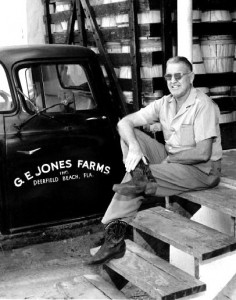
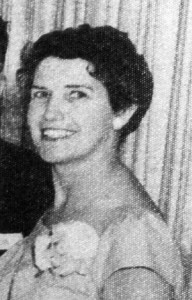

also good farmers. Whereas the Butlers were mostly growing beans, the Jones got into staked tomatoes. They were so successful that when Alvin Jones decided Deerfield needed a bank in the 1960’s, he started Deerfield Bank and Trust Company, which was Deerfield’s first and only bank for many years. Emery’s daughter, Janice Jones Stills, is a retired school teacher still living in Deerfield; as is Kenneth Jones, Alvin’s second son, who is retired from the banking business. When my Grandfather, Hoyt Eller, decided to retire in the 1950’s he sold his farm west of Boynton to Alvin Jones for a little over $50,000, which allowed Granddad to retire. Alvin grew tomatoes on it for thirty plus years. J.B. Wiles once told me that when Alvin’s widow, Mary, eventually sold my Granddad’s old farm, she got a little over $15 million for it. He then said, “What do you think about that!” I said, “God Bless her, and God Bless America!”’

David Eller, Publisher


Historical Essay 33

In 1952 we got our first new car…and our first television set…

Published: 5 Jun 2008

Dad’s manufacturing business by 1952 was going great guns. His new patented Slice-O-Lator land clearing machines were the main reason, but the pump business was also doing well. He had enlarged the factory on Dixie Highway just on the west side of Pioneer Park, bought some more lathes, hired more welders and even got a secretary for his office. The secretary was the twenty-something-year-old daughter of a family from Georgia who had recently moved into town, and was renting a house Dad owned down the street. Her name was Lanette, and I could tell immediately that Mom didn’t like her. At first it was something about the short shorts she wore around town being too short. After she applied to work for Dad and he hired her, the girl started wearing high-heeled shoes and fancy dresses to work. Mother really didn’t like that. Dad apparently agreed and admitted that his workers were spending too much time in the office. So his new secretary started wearing blue jeans to work. Mother said something to the effect that the jeans were so tight that she must be pouring herself into those jeans every morning. As a 10-year-old boy, I couldn’t figure out what Mother meant, but the next thing I knew Lanette didn’t work there anymore, and mother was working in the office part-time. Lanette and her family moved back to Georgia a few months later, and Mom worked in the office the rest of her life, some 36 years. Dad also bought us our first TV set that year. Mother had been after Dad to get us a TV set ever since I’d gotten in trouble breaking into Allen Ballard’s house to watch TV (see Historical No. 30). Dad resisted

buying the TV because he’d just spent a lot of money buying us a new Chevrolet from Mayes Chevrolet in Pompano.  “Bugs” Hardy, the salesman, worked real hard to get Dad to buy that car. The word that Dad was spending money apparently made its way over to Wesley Parish’s General Electric Store on Atlantic Boulevard in Pompano.  Wesley, who had gone to Pompano High School with Dad, called and invited Dad to come look at the latest TV sets. The new black and white screens were 14 inches measured diagonally, which apparently impressed my father since the ones before that had only been about 10 inches. So on Saturday afternoon our family got into our new Chevrolet and drove to Pompano to shop for a TV. I was really happy. Wesley met us and started going over how the TV worked. Dad asked a lot of questions. But when it got to the price, I could tell Dad was not pleased. He finally shook his head, turned to leave, and told Mr. Parish to call when the price went down. I looked at Mother and could tell she was disappointed and embarrassed. We all followed Dad out the store, and Mr. Parish followed us to our car.  He told my Dad that he would try to do something about the price, but meanwhile would Dad allow him to bring the TV to our house in Deerfield for us to try it for a week. My sister and I started shouting “Yes Dad!” “Please, Dad!”  I looked at Mother, and she was smiling. Of course, Dad reluctantly agreed. After a week, all of us, including Dad,

were watching TV each night. There was no way Dad could have refused to buy it. It was a lesson I took note of, and many years later used to sell our own products. When Wesley came to pick up the TV the next Saturday, Dad wrote him a check for the TV. It was only the third TV in Deerfield Beach. Our lives changed forever.

David Eller, Publisher


Historical Essay 32

Playing baseball beat out Scouting

Published: 22 May 2008

1952 was a busy year in Deerfield. My father, Marlin Eller’s decision to run for City Commission as described in previous essay No. 31, was going to keep him busy during much of the year… Meanwhile, I had joined the Boy Scouts in January, along with a few of my 10- and 11-year-old friends. Mr. Dickens was our Scout Master. He was also a school teacher at Pompano High School, teaching shop class. The main reason we joined was that Mr. Dickens told us we could all camp out in tents and fish on his and his wife’s acreage. It was located about five miles west of downtown Deerfield, on the west side of the Turnpike, right on the Hillsboro River/Canal, where the Adios Golf Club is today. He also had rock pits there with perfectly clear water full of bass. It was a beautiful spot, and his son Johnny Dickens, who was already 13 years old, would be our leader.  It was a lot of fun for a few months. We memorized a lot of things and swore to be loyal to God and Country. We all started off as Tenderfoots, received a few pins and moved up to Second Class and some to First Class as we learned and advanced in Scouting.  However, the opportunity to play Little League Baseball suddenly entered the picture. Deerfield did not have enough boys to support both Boy Scouts and Little League Baseball at the same time. I distinctly remember Mr. Dickens telling us that if we chose to play in the Little League Baseball Team being organized, it would conflict with being Boy Scouts, and we needed to decide which we wanted to do.  It took me a minute or two to decide that I’d rather play baseball. Everyone else made the same decision, which ended the Boy Scout experience, and began my three-year baseball career. This is a picture of the first Little League Baseball team in Deerfield Beach. It was 1952. This writer, David Eller, is the second from the left, standing up, with his eyes shut. I was a left-handed pitcher known for a mean curve or drop ball. I learned to pitch from a professional ball player named Herb Dudley. He had pitched on the official U.S. Navy Softball team, with my mother’s brother, Uncle Forney Horton being his catcher. After the war, Dudley had taken a job with the Boca Raton Hotel, who paid him to pitch for their official softball team. He spent a lot of time eating meals at our house. After eating we would go in the backyard, and he would teach me how to pitch curve balls, drop balls, and even an occasional knuckle ball. When not pitching, I played shortstop or first base.  The player to my left, with our arms around each other, is Donald “PeeWee” Williams. He played shortstop or second base. His father owned the Williams Dairy in Deerfield on the property which he later sold to Irvin Levy, who built Century Village on it. PeeWee’s father also helped sponsor our teams’ uniforms, and did some coaching. To my right was a big red-headed boy named Lee King, an outfielder whose favorite past-time was hitting home runs, bull riding and fighting.  Next to PeeWee was Dewey Bennett, our catcher. I can’t recall the short fellow next to Dewey, but the taller fellow with his arm around him is Henry Harden, a fastball pitcher and the only member of our team who went on to become a professional baseball player. My buddy, James Stills, who played outfield is next to him. In the front row are Steve Rowe, a third baseman and the son of Rev. Bob Rowe, the Baptist preacher at First Baptist. He substituted at several positions, but mainly second base. Next to him is Ray Boggs, a pitcher and first baseman. Substitutes Kenny Bennett and Pete Manning rounded out the team. Our coaches were all policemen: Lloyd Newman, Roy Bennett and Chief Manning. Our biggest fans were probably Presbyterian Minister Reverend Arlen Briggs and his wife, Margarett,  who had recently moved to town and attended nearly every game. Within two years of this picture some of us would earn our participation in an All Star Broward County Team, which beat Miami, Palm Beach and Orlando, and went to Greenville, North Carolina, representing the State of Florida in the National Little League championship series in 1954. We had a lot of fun and learned about values like discipline, loyalty and hard work.

David Eller,  Publisher

“Pee Wee” Williams recalls DB Little League Dear David: This is a “voice from the past,” saying it has been a long time indeed! I wanted to write you, and let you know, that a friend, read your article of March 6, 2008, on the history of Deerfield Beach, Fla., and mailed me a copy. It was a nice surprise to me to see your name on this newspaper article, and that you remembered my father and me, and his family in such a nice memory. Thank you so much. My father enjoyed being involved in the community of Deerfield Beach, Florida, with Little League Baseball. I enjoyed playing the game, going through high school baseball in Pompano High. My father moved his dairy to Okeechobee County, Bassinger, Florida, in 1960, and continued to be involved with Little League Baseball. There was no organization for little league baseball at the time, just a few games a few teams, etc. My father sponsored the “Indians,” and I was the coach. We had a great time building the baseball field in his honor. I am very proud of that. I found this picture in my album of our ball team when you and I were little guys. You are second from left, standing, I am third from left, standing next to you. This picture does bring back some good memories.

Sincerely , Don “Pee Wee” Williams


Historical Essay 31

My dad, Marlin Eller, gets into politics

Published: 1 May 2008

I was 10-years-old in 1952 when my father, Marlin, decided to run for the Deerfield Beach City Commission. I remember my mother, Lorena, was not happy about it. She did not want Dad to get involved in politics. In retrospect, I realize that mother knew his tendency to be outspoken, knew what some of his issues would be, and was concerned that he would probably create some enemies within the establishment in the community. Besides, Dad’s business had started to grow rapidly. The U.S. Government had recently awarded him a patent on a land-clearing machine, which he called a “Slice-O-Lator”, and the farmers were almost standing in line waiting to buy them at $500 each. He eventually sold hundreds of them, and had to hire more people, and expand the little factory on Dixie Highway, to keep up.  Dad had also come under the influence of Deerfield’s first lawyer, “Dutch” Ulrich, who had just recently moved into town and caused a minor uproar at city hall when he insisted on registering to vote as a Republican. It seems the city clerk had only one book for registering voters, and it was marked “Democrat”. This was typical of southern USA towns at the time as a carryover from the War Between the States, or Civil War, wherein Lincoln’s Republicans were victorious over southern Democrats, and some ill will continued in the South even a hundred years afterwards.   Apparently all voters in Deerfield, including my dad and mother, had been registered as Democrats until “Dutch” came along, and the city clerk, Mr. Richardson, had to drive to Pompano to buy another book for Republicans. Anyway, I remember “Dutch” coming to our house one night and talking to Dad about running for the city commission in order to straighten out some things in town which both he and Dad thought were wrong. For one thing, a U.S. senator from Tennessee by the name of Kevaufer had recently held congressional hearings in Ft. Lauderdale having to do with the influence of illegal gambling on Broward County politics. In seemed that an illegal game of chance called bolito was going full blast with the full cooperation and protection of some Broward political, business and police interests. I remember Dad saying that it was a problem in Deerfield, too, as a lot of the workers in our little factory were spending most of their money on this illegal game, resulting in their wives coming to Dad to borrow money to buy groceries. Dutch Ulrich convinced Dad that someone needed to stand up for right, and convinced Dad to run for city commission by quoting the famous Edmund Burke: “ The only thing necessary for the triumph of evil is for good men to do nothing.” Dad agreed and signed up to run for Deerfield City Commission. At 35 years of age, with a wife, three children, and a growing business in town, he was also frustrated about some other situations. For instance, Deerfield had a nice beach, but there was no place for people to change clothes or take a shower after swimming; and there was no pier on which to go fishing. Dad had recently bought a 14-foot fishing boat, but there was no boat ramp in Deerfield to launch it. Deerfield’s streets were not marked with any street signs, so it was difficult for strangers to figure out how to find their way around. The town had just built a water plant, and the water was being pumped to an elevated tank, but it did not taste right. There were rumors that not everyone was being billed for, nor paying for water. The town had a substantial black population, but all three Deerfield policemen were white, and reportedly afraid to go into Deerfield’s black areas to enforce the law. Thus, Marlin Eller, my Dad, having lived in Deerfield since he was eight years old, and now 35 years old in 1951 and committed to stay here, filed his papers to run. Politics in Deerfield was about to get interesting.

David Eller, Publisher


Comments Off on Historical Essays 31 to 40

Historical Essays 21 to 30

Posted on 17 April 2008 by LeslieM

Historical Essay 30

Watching Hopalong Cassidy on TV in 1951 got me in trouble with the law

Published: 17 Apr 2008
Well,  I guess it wasn’t really Hopalong’s fault. But when you are 10-years-old and are used to watching the exciting adventures of the famous cowboy Hopalong Cassidy every Saturday morning, it hurts when you can’t watch it one Saturday. My problem was that we didn’t have a TV set. In fact, hardly anyone in Deerfield Beach had a TV set.
The first person in Deerfield to get a TV set was Doctor Higgins. He was a very tall man, kind of bald, and the only doctor in town. He practiced his medicine initially in the same house where he lived with his wife and daughter, Betsy, who was my age. Their house and office was on Hillsboro Boulevard, across from the U.S. Post Office, in the same house that the Kraeer Funeral Home is in today. Betsy was tall and skinny, had long blonde hair and wore glasses. We were friends, but not too good of friends. She was taller than me by two or three inches, and one of my biggest  competitors for getting the best grades in our class at school. When the Higgins first got a TV set, we were all invited to come over and watch on Saturday. But after the second or third week, Betsy told us we couldn’t come anymore because her father had said that he had patients coming and we might disturb them.
We children were heartbroken. No TV? No Hopalong Cassidy on Saturday?
But it didn’t take long for one of our fathers to step up and pay the price to buy “all” of us kids a TV set. Well maybe it wasn’t really for “all” of us, but it seemed like it at the time. Mr. Allan Ballard (the father of Johnny Ballard, who recently retired as the longtime chief of police in Hillsboro Beach) stepped up to the plate and bought the second TV set in Deerfield Beach. Not only that, but he and his wife, Miriam, let it be known that all the children in the neighborhood were welcome to come to their house on Saturday morning and watch it with Johnny and their daughter, Susie. Their house was located on property which is now part of Deerfield’s City Hall east side parking lot.
Everything was going along fine with our TV watching for months until one Saturday morning we got to their house and no one was home. One of the kids said that he heard they had gone up to Georgia on a vacation or something. I remember thinking, “They must have left us a key or something so we could get in to watch Hopalong.” We looked under the front door mat. No key! We looked under all the flower pots. No key! We started to panic, because Hopalong was going to start in a few minutes. Maybe they forgot to leave us a key!
Suddenly I got a great idea. I told the kids I’d be right back. I ran as fast as I could the 100 yards or so to my Dad’s shop. I ran in to where I knew there was a crow bar. I grabbed it and ran as fast as I could back to the Ballard’s house. Someone scooted an old chair from their backyard up to a side window.
I stood up on the chair and used the crow bar to pop open the wood frame window. Pushing it up as far as it would go, I pulled myself up to the window sill and scrambled inside their house. I ran to the TV and turned it on, and then came back to help the other kids get into the house. We all made it inside and sat down on the floor to watch just as Hopalong Cassidy came on. “Whew,” I thought. “Barely made it!”
We hadn’t been watching Hopalong five minutes, when suddenly a deep voice came through the open window: “What do you kids think you’re doing breaking into Ballard’s house?” I looked over and recognized the policeman. Everyone else kind of froze, so I got up to explain to him that we always come over on Saturday morning to watch TV at the Ballard house. He responded by asking, “Do you always come in through the window?” I said, “No, but I’m sure it is all right. Mr. Ballard just forgot to leave us the key!”

I could tell he was trying to keep a straight face. He asked who brought the crow bar. I raised my hand. He told everyone else to go home, but ordered me and Tommy into his car. He drove us the 100 yards or so to my father’s machine shop. We got out and went in. Dad was running a lathe. The policeman told Dad where he’d found us. Dad stopped the lathe, looked around real serious-like, and said “Guess you’ll have to put ‘em in jail!”
I couldn’t believe it. I started to cry. As we turned to get back in the car, Dad hollered out and told the policeman, “Be sure to get their fingerprints too!”
It seemed like a long ride back to the police station,” even though it was only two blocks. We went in and the policeman had us dip our thumbs in an ink pad and put them on a pad of paper. Deerfield had its own jail at the time and most of the prisoners were local drunks. I could hear them laughing and making fun of us; and I was really scared. About that time, Dad walked in. He said something to the effect, “Do you think he’s had enough?” The policemen nodded, and then he and Dad started laughing. The policeman then said to us: “Let this be a warning. The next time we might have to put you in there with those guys,” as he pointed toward the drunks in their cells.
It was a lesson I never forgot.
David Eller

Historical Essay 29

James and I thought we were Tom Sawyer and Huckleberry Finn

Published: 3 Apr 2008
My friendship with James Stills got off to a rough start. When he arrived at Deerfield Elementary School from Tennessee, he immediately became the biggest kid in our class of fifth graders. With his large crop of wavy black hair, brown eyes and enormous hands, he was also an inch or two taller than me and classmate Dewey Bennent, and probably out-weighed us by 10 or 12 pounds.  When recess came on his first day at our school, Dewey pulled me aside and suggested that we needed to find out “how tough” the new kid was. Dewey said that he would get on his knees behind James and I should walk over and pretend to “fall” into James so that he would be knocked over Dewey. We did it perfectly, expecting James to get up ready to fight.  James got up from the fall, but did not respond to our belligerent attitude. He simply looked at us and our fists poised for a fight and said, “My mother told me not to be fighting.”
I was immediately relieved as I’d already figured out that I didn’t want to fight him anyway, and I didn’t think Dewey did either. It was just our way of sizing him up. I kind of liked the way he handled us, and decided immediately that I wanted to be his friend. So on Friday, I invited him to come to Sunday school and church at First Baptist on Sunday morning at 9:30. Sure enough, he showed up with his mother and his sister, Barbara, who was two years older than him. Thus began a life-long friendship, which continues to this day.
We began our friendship as 10-year-old boys by exploring the swamp near our house just east of Dixie Highway. The swamp was just over the Dixie Highway Bridge north of the Hillsboro River in what is now part of Boca Raton. Boys of Southern heritage at the time were expected to learn how to shoot a gun by around the age of 10, and I was no exception. Dad and Mother had given me a pellet rifle for my 10th birthday and Dad had taken me down to the swamp to practice. We shot land crabs. They are interesting creatures with blue bodies about four inches in diameter, with eight legs which can carry them quite rapidly  when they decide to run. They typically live in swampy areas in holes in the ground, which they dig down a few feet to hide from predators like big birds and 10-year-old boys. James and I took turns shooting the rifle and watching the crabs explode.
One of the books that was required reading in school at the time was The Adventures of Tom Sawyer and Huckleberry Finn.  James and I were just the right age to really get into that book. One of the episodes, which thrilled us both a lot, was when Tom and Huck built a raft with a sail and rudder to explore the Mississippi River.  With encouragement and help from my parents, James and I built our own raft to sail up and down the Hillsboro River. The main body of the raft was made from bamboo, which at the time was plentiful growing at the edges of the Hillsboro River. We only selected and cut down bamboo shoots that were at least four inches in diameter. We selected about 20 shoots and sawed them into lengths eight feet long. We then strapped them together with aluminum flat bar straps which Dad had provided, to make the raft. A steel plate with a pipe welded on top in the middle supported the mast for the sail. Mother provided a bed sheet sail for the mast, and I built the rudder from ¼” plate steel in our welding shop. Dad helped us get everything assembled and transported 100 yards or so, down to the Hillsboro River where we launched it.
It worked beautifully. We quickly became pretty good sailors. James worked the sail and I worked the rudder. Typically, we would let the tide current take us east, and then put the sail up and let the easterly breeze fill our sail and carry us back to the west. We did it over and over again until we got tired. Tom Sawyer and Huckleberry Finn would have been proud. We had lots of fun.
David Eller

Historical Essay 28

Standing up for German neighbors got me into a fight at school

Published: 20 Mar 2008
In the fall of 1951 we had a German family move into the two-story house at the end of our block. They had two children, a boy and a girl. The boy was my age and his name was Martin Marback. He had bright red hair, and wore leather pants with white shirts and suspenders. He did not speak much English when we first met, but he was really good at climbing the mango trees with me which were in the grove between our houses. Therefore, our play was mostly limited to climbing trees, gathering the mangos, eating some and putting the others in a box for my mother to give away. I quickly learned that he did not understand hardly anything I said, but would copy me in almost anything I would do.
His sister, who was two years older than him, also wore “funny” clothes: typically a white blouse over a red, black and white plaid skirt. She was way overweight, and had long brown pigtails. Whereas her brother Martin was kind of skinny like me. Martin would try to speak some English with me, but I do not remember his sister ever speaking a word. She would simply stand back and watch Martin and me play.
By the time Deerfield Elementary school started in September, Martin and I had become “friends”, even though we could not communicate very well.
We had only been in school a few days when “the fight” happened. About six of us were lined up in front of the water fountain to stand upon a wooden box and get a drink of water. Martin was in front of me. Robert Sloan, a year younger than us, but a few inches taller, was at the end of the line. Suddenly, when Martin started to get his drink in front of me, Robert Sloan jumped out of the line, rushed forward, grabbed Martin by the back of his head pushing his face into the fountain and twisted the fountain handle to keep the water flowing onto Martin’s face as though he was trying to drown him. He also was simultaneously screaming “you’re a dirty Nazi.” Martin started sputtering, lifted his head and tried to get away from Robert and the fountain.
Before I could even think about it I grabbed Robert Sloan’s shoulder with my left hand and shoved him backwards away from Martin and the fountain. He responded by hitting me with his right hand to the side of my face. I tackled him and we proceeded to roll around on the floor of the hallway with fists flying. Everyone else was screaming. Within seconds it seems, Ms. Henry, the school principal, was there and grabbed the back of my shirt collar pulling me up and off of Robert.
Ms. Henry took us into her office around the corner from the water fountain, and demanded to know why we were fighting. I told her that Robert started it by attacking Martin. She asked him why? He told her that his father had been a soldier and Germans had killed a lot of his father’s friends. She looked at both of us kindly, but firmly told us that fighting was not allowed. She told us to go to the chair next to her desk and bend over, then she reached for a wooden paddle. She proceeded to spank both of us with about three strong licks. Neither of us cried, but neither did we ever fight again.
David Eller, Publisher

Historical Essay 27

In 1951 the world is changing–Deerfield starts growing–and more boys my age move to town

Published: 6 Mar 2008
In 1951, the Korean War was going on and Seoul, Korea, fell to the communist forces from the north. The 22nd Amendment to the U.S. Constitution, limiting the number of terms a president may serve, was ratified. Julius and Ethel Rosenberg were sentenced to death for treason, having given the Soviet Union our secrets for building atomic bombs. The cost of a first-class stamp was $0.03. The NY Yankees defeated the NY Giants in the World Series 4-2. Color television was first introduced in the USA, and the Best Movies were The African Queen and A Streetcar Named Desire, and for most of the year, I was nine years-old.
My father always said that Deerfield and this northeast Broward County area started to grow because so many of the soldiers who were based at the Boca Raton Airfield during World War II liked the weather here, and eventually decided to come back to live permanently. I’m sure that was true in the big picture of things, but from my perspective as a nine-year-old boy, it was when the Williams Dairy arrived, located where Century Village is now, that Deerfield started to grow.
Mr. Williams moved his dairy here from Dade County in 1950-51. He had two sons, Mitchell, who was two years older than me, and Donald, who had the nickname “Peewee,” who was my same age. They were both very athletic, and could ride their own horses at their father’s dairy. Also two other boys, Jimmy Phillips and Jessie Beard, whose fathers worked on the dairy, were in our class, as well as Tommy Gannon, whose father was an electrician and mother was a nurse, had just arrived in town. Tommy and I became good friends as he lived only two blocks away. When summer came and our Baptist church had Vacation Bible School (VBS), he and I were both surprised and confused when his parents told him he could not go to our church for VBS. (An annual event in the summer where the kids learned stories from the Bible, and got lots of ice cream). His mother kindly explained to me that Tommy and their family were Catholics and even though they did not have their own church to go to in Deerfield yet, she didn’t want Tommy to get confused and therefore did not want him to go to VBS at our church. Tommy and I looked at each other in a somewhat confused manner, but quickly acquiesced to her instruction. When I asked my mother about it, she explained that this was normal, that it was good that Tommy’s parents were religious, and that Tommy and I could still be friends.
Meanwhile, Miss Hinson (my mother called her an old maid) was our teacher in the fourth grade at Deerfield Elementary School. She had previously replaced our third grade teacher, Miss Riggs, in the third grade. Miss Riggs only taught us for a few months, when our principal, Mrs. Henry “fired” her. I was later told that I was the one that had gotten Miss Riggs fired. I didn’t mean to. I only told my mother and father that Miss Riggs was a lot different than Mrs. Slover, our second grade teacher, or even our first grade teacher, Mrs. Hartman. Specifically, Miss Riggs did not have us say the Pledge of Allegiance to the American flag, and she had us singing songs from a country called Russia, which she had said was the best country in the world. My mother later told me that Miss Riggs had been fired because she was a communist. My, how things have changed.
David Eller

Historical Essay 26

Lyons Road named after Dad’s largest customer

Published: 31 Jan 2008
Back in the late 1940’s and early 1950’s, when I was a boy of elementary school age, my father Marlin would often take me with him after school as he visited customers. Our machine shop/pump factory was located on Dixie Highway in Deerfield, where the tennis courts are today. In previous Essay No. 13, I wrote about our good customer, the Butts family in Boca Raton, for whom the Butts road in Boca is named. In Essay No. 14 I also wrote about our Japanese customers in Boca and the Japanese farmers there for whom the Yamato Road and Park is named.
However, our largest customer back in those old days was a rancher and farmer west of Deerfield named Cossie Lyons. I believe he was originally from Tennessee. I do know that he owned an enormous amount of land in the northwest part of Broward County and southwest part of Palm Beach County, which is now part of Parkland, Coral Springs, and western Boca Raton. I remember my father telling me once that Cossie’s property, just on the west side of Highway US441/State road 7, was approximately six miles long and two miles deep. He raised cattle mostly, but also had large plots of vegetables on parts of it.
My dad and Cossie Lyons were good friends. Cossie, in his sixties, treated my father, in his thirties, like a son. In fact, I was there when Cossie offered to give my father 10 acres on the west side of Highway 441 for Dad to build us a new machine shop/factory. Dad, accustomed to walking out the back door of our house on Dixie Highway to go to work in our “shop” next door, turned him down. I remember Dad telling Mr. Lyons: “I don’t want to have to drive that far (seven miles) to go to work every day”.
Cossie was a single man with no children, and depended a lot upon his nephew, James, to actually run the farm. James, about my dad’s age, always wore a crumpled old brown hat, and had two or three horses which he took turns riding. Dad and Cossie would talk about what needed to be done on the farm, and James would make it happen.
Cossie also had a beautiful young secretary/bookkeeper named Alma. In her late twenties, she was taller than Cossie or my father by about six inches. She had long black hair and always dressed up, even in their office. She wore high heels and a fancy hat when she sometimes came to Deerfield’s First Baptist church, where she always sat alone midway down the left aisle. The hat and the heels made her look even taller.
One day Cossie confided to Dad that he and Alma were going to get married. When Dad told Mother over our supper table that night, Mother got very upset. I remember her saying that Cossie was way too old to marry that young woman. Dad just smiled.
Shortly thereafter Cossie Lyons and Alma were married in a private ceremony and went off on their honeymoon. The next day Dad got a call from Cossie’s nephew, James. He told Dad that Cossie had died from a heart attack on the first night of his honeymoon. Alma, therefore, became a rich young widow within hours of her marriage to Cossie.
Alma continued to come to our church occasionally, and was always friendly to my father. The women of the church, however, seemed to keep her at a distance. Within a few years she had sold off Cossie’s land and moved to Gatlinburg, Tennessee. She got married again to another short man and became Mrs. Alma Regan. Together they invested in real estate and helped build Gatlinburg into the huge resort that it is now. She died about 20 years ago, probably with a smile on her face.
David Eller

Historical Essay 25

Big 1949 Hurricane with 150 mph winds…plus another boy my age (8) arrives in Deerfield

Published: 13 Dec 2007
It was right before school started in 1949 when the big hurricane hit. Back then they had not gotten around to giving hurricanes names like they do now.  They simply numbered them in order. The center of Hurricane No.1 of the 1949 season hit “between Pompano and Palm Beach” about 6 p.m. on August 26. Winds had to have been over 150 mph when it hit because they were actually measured at 125 mph as the center crossed Sebring, Florida a few hours later.  Dad had shuttered up our house and driven the family to Boynton Beach to ride out the storm at my maternal grandparent Horton’s house, next to Boynton’s elementary school. However, as the hurricane approached the coastline, the winds picked up, and Granddad Horton’s wooden frame house started coming apart. There was a large screened porch facing south, which was the first to go. The screens blew out and the roof started tearing off in pieces. My father, Marlin Eller, ordered me, my mother, Lorena, and my sister, Linda, to follow him. He held my little brother, Dwight, in his arms and started toward our car parked in front of the house. But the wind was too strong to stand up, and tree branches and coconuts were flying through the air hitting us. So Dad lay on the ground and started rolling toward the car. We couldn’t hear his specific instructions through the loud howling of the wind, but we just naturally started doing the same thing he was doing and rolled on the ground to the car. He got one door open on the other side of the car and we all crawled in. I remember Dad was shivering and seemed afraid. Mother was crying.
Dad started the car, drove a few blocks over to Federal Highway, U.S. 1, turned left and headed north. I remember him saying that this direction should get us out of the storm. We drove through heavy rains and winds, for what seemed like hours, until we got to a town called Fort Pierce. There, palm trees had fallen across the highway, coconuts and tree branches were flying through the air, and it was impossible to proceed. Dad turned into a gas station and parked, joining dozens of other cars parked there. There we spent the night, in the car, mother especially praying for safety. It came the next morning as the winds died down. We got gas in the car, headed home to Deerfield, working our way around fallen trees and power lines all the way. Granddad’s house in Boynton was essentially destroyed, and had to be rebuilt. Our house in Deerfield, however, with wooden shutters closed, weathered the storm beautifully. The lesson I learned was that you should build your house strong enough to handle any known potential hurricane wind force, and stay home during the storm. Many years later I did that exact thing as I designed and built my own house for 200 mile an hour winds. It cost me about 10 percent more to build, but I’ve never worried about it weathering a hurricane, even until today.
The next thing I remember about the summer of 1949 was that Dewy Bennett arrived in town. Dewy was my age, eight years old, and would be starting third grade with me in the fall, which meant that I would no longer be the only boy in my class at Deerfield Elementary School. Dewy came to my backyard one day in the summer of 1949 with his cousin Butch Bennet. They started singing a song that was popular on the radio at the time by Hank Williams which went:  “Hey…good looking; what cha’ got cookin’, how’s about a’cooking something up with me!” I went out to meet them as they walked slowly over to the empty lot on the south side of our house, and started picking fruit off our guava tree. Seven-year-old Butch started talking first. He introduced me to his eight-year-old cousin Dewy, who he said had moved into town and would be in the third grade with me soon. Butch went on to say that he’d told Dewy about me beating him up (a few weeks ago), and that Dewy would settle matters with me. I looked at Dewy and figured he was about my same size. I asked him what he wanted to do. He said that he understood I had beaten up Butch, and would I like to try to beat him (Dewy) up. I replied that if Butch would stay out of it, “Sure”!  With that we both went at it. His head went into my belly knocking me backwards as he swung both fists. But I soon got him into a headlock and rolled him over on his back. He pushed me over, and we rolled around in the sandspurs for a few minutes. But once I got my right forearm around his neck with my left hand gripping my right wrist, pulling a hard scissors grip on his neck, I knew I had him.  He should have given up, but he refused. We rolled over in the sandspurs a few more times until we were both sweaty, exhausted and out of breathe. Finally one or both of us said, “I’ll stop if you’ll stop.”  With that we let go of each other, stood up, and Dewy gave me a great compliment:  He said: “You’re a pretty good fighter”. I said: “You are too!”  We shook hands, and became friends, which continues even until today.
David Eller

Historical Essay 24

Deerfield gets its first park –Pioneer Park!

Published: 29 Nov 2007
Deerfield got its first park in 1948. It was named Pioneer Park and was built just east of our house. There was a narrow rock road, later abandoned, between our backyard and the park. Our house sat where the office for the tennis courts sits today, with the front yard facing west to Dixie Highway and the backyard facing east to a forest of pine trees.
The park was built by the local Lions Club, part of the International Service Organization. My father, Marlin Eller, was a very active member of the club, and volunteered to be on the committee to get the park built. The first problem was to get the land. The Kester family of Pompano owned most of the land in Deerfield at the time, including the land on which the Lions Club wanted to build the park. The Kesters also owned the Pompano Farmer’s Bank, the only bank in North Broward County at the time, which provided financing for most of Deerfield’s businesses. My father told me once that Mr. Kester donated the land for Pioneer Park, as well as the land for the cemetery on the north side of First Baptist Church.
Anyway, all I knew at age seven was that one day bulldozers started pushing down the trees and clearing the land. I was very unhappy because those woods were my backyard playground. I practiced hiding behind trees and shooting at imaginary enemies in those woods. I could chase butterflies, or hide from my sister in those woods. Now the trees were being knocked over, pushed into piles, and set on fire. I cried.
Dad and Mother tried to reassure me that it would be better. They (the adults) were going to build a ballpark on that land. I pouted. Dad tried to get me into the excitement about having a new ballpark right next to our house. He suggested I help him and the other men to plant the grass for the park (back in those days there were no sod farms and grass was planted as individual twigs in the ground a few inches apart). So I rather reluctantly joined my dad and the other men in his Lion’s Club to plant grass for the new park.
However, the club also wanted to have big lights at the park to operate at night games on the top of high poles. My dad was in charge of raising the money for those poles and lights. Apparently it was hard to raise the money. I remember Dad complaining a lot, but he eventually got the money and poles donated, and Pioneer Park became a reality. Dad and Mother were both very happy.
Times were different then in many ways. In retrospect, I think the biggest thing was that people did not have television to take up so much of their time. Therefore, at nighttime after work, people provided their own entertainment, and neighbors socialized with each other extensively. The new ballpark quickly became the center of that activity.
Since Deerfield had a new ballpark, they needed a ball team to play at the ballpark. So the Lions Club stepped forward again and organized a softball team, complete with matching uniforms. It consisted of 12 players and a coach. There were five farmers, a sheriff’s deputy, a plumber, an electrician, a gas station owner, a railroad station manager, and a couple of small business owners. My father didn’t actually play ball, but he got very involved in the organizational part of the sport. In fact, he was appointed as the Soft Ball Commissioner for South Florida and served several years in that position. Our whole family typically went to watch the games. Unbeknown to me at the time, the ballpark experiences would affect my whole life, including up until today.
David Eller, Publisher

The 1948-1949 Lions Club Softball Team:
(L-R, bott
om row):  Willy Dame, Alan Ballard, Red Arnau, Bob Phlegal, Jack Butler, and unidentified; (top row): M.A. Peterson, Bob Butler, Milton Vincent, Jay Mosley, Barney Chalker, Hubert Morris, and Alvin Jones.
Photo courtesy of Jack Butler

Historical Essay 23

In 1948 Harry Truman wins…a child is b

orn…and my sister, Linda, saves me at Deerfield Elementary School

Published: 15 Nov 2007
1948 was a pretty good year, and I had learned to read by then. My parents had both voted for Harry Truman for President, which made them happy when he won. Right after the election my brother Dwight was born, and I started my life’s journey as a middle child. My parents were also glad when the country of Israel, where Jesus lived, was re-established. Dad, who read the Bible a lot, said this was very important because it had been predicted in the Bible, and was something that had to happen before Jesus could come back. He was also worried about a city in Germany named Berlin, which was being surrounded by the Russians and not allowing people in or out. He was happy when our government started flying airplanes in to bring the people food. Dad bought a PolaroidTM camera that year which had just come out, but he complained about the film costing so much. My mother always wanted to see the movies which won the awards each year, so she took us to the theatre in Fort Lauderdale to see Hamlet which had won the best movie award, with a man named Lawrence Olivier, who also had won the award for best actor as the star. I believe Dad went with us to see the movie Johnny Belinda, because he always liked Jane Wyman who had won the award for best actress.
When I started second grade at Deerfield Elementary School in 1948 I was again the only boy, although one more girl had moved into town, making the ratio six to one. Badly out numbered in my own class, I tried to make friends with other boys, specifically brothers George Bigler in the third grade, and his brother Jeff in first grade. Their mother was the school cook. They actually lived in Boca Raton, but the boys attended Deerfield Elementary because their mother worked there.
They were both fun to play with at first, and excelled at climbing up palm trees. But eventually the younger brother Jeff started poking at me for no reason that I can remember. He apparently thought it was cute to come up behind me and kick me during recess. When I tried to catch him to reciprocate in kind he would run to his brother, or into the school kitchen area for his mother’s protection.
One day we were playing on the grassy area on the west side of the
main building when Jeff snuck up and kicked me from behind. I had been watching for him, and spun around quickly and caught him by his ankle before he could get away. I jumped on his back as he lay on the grass and tried to get his left arm up to where I could twist it and make him promise to leave me alone.
Suddenly I heard the sound of someone running toward us, and felt the impact as his big brother George tackled me from behind. The impact knocked me off of Jeff and the two of them proceeded with fists flying to teach me some sort of a lesson.

I was on my knees with both eyes shut, trying to cover my face, when I heard an even heavier running sound coming toward us with a guttural scream, which sounded quite familiar. I opened one eye and caught the image of my 10-year-old, fifth grade sister, Linda, (who incidentally looked a lot like Lucy in the Peanut cartoons) flying through the air horizontally in a counter attack against both boys.  I didn’t have to do anything as she proceeded to beat the tar out of both of the Bigler boys.
I never had a problem with either of the boys after that, and I gained a respect for my sister, which continues to this day. In fact, don’t try me. She’s still lives only two hours away.
David Eller

Historical Essay 22

Games and lessons learned in first grade

At Deerfield Elementary School…1947-1948

Published: 14 Nov 2007
In the last essay I shared how I was the only boy in the first grade at Deerfield Elementary School in school years 1947-1948. I shared the class with five girls. For some reason I thought that was normal. I know I liked it. The girls all seemed to like me for some reason. They taught me how to play a game called “jacks”. It consisted of sitting in a circle on the floor in the hallway during recess with a small rubber ball and a bunch of metal things called jacks. To play you would take 10 jacks and toss them on the terrazzo floor so as not to scatter them too far apart. Then the first player would pitch the ball up in the air slightly with one hand, and immediately sweep up one jack being careful not to touch any of the other jacks. The ball would bounce once during this pr
ocess, and you had to catch it before it bounced twice while simultaneously holding the jack you’d just swept up. You would put that jack back into the box and repeat the process sweeping up two jacks, this time being careful not to touch any of the other jacks on the floor. If you were successful you would continue sweeping up three jacks the next time, and the final four jacks after that. However, you would lose immediately if at any time you did not catch the ball, or if you touched any extra jack during the process. The loser would then pass the ball and the jacks to the next player, and the game would continue until someone won by picking up all the jacks in proper order without dropping the ball.
The girls already knew the game, as they apparently had been playing it at home before starting first grade. All my preschool games had been with my friend Elmo (see previous essay) and we only played boy games like marbles, catching frogs and climbing trees. Therefore I must have appeared clumsy to the girls, as I specifically remember them laughing at me at first as I struggled to pick up the jacks and catch the bouncing rubber ball. However, I eventually got the hang of it and was able to beat all of the girls some of the time and most of the girls all of the time; but I never achieved beating all of the girls all of the time!

One of the girls, Lynda Dame, apparently liked me a lot. She would show her affection by walking up during recess, punching me in the belly or on the arm, and then running away laughing. I’d always been told by my parents that boys did not hit girls. Therefore Lynda was safe from me responding in kind. However, one day my mother noticed a bruise on me, and asked how I had gotten it. I told her it was from Lynda hitting me at school. Mother looked a little angry. She asked me if there was a reason for her to hit me. I told her no, that she just did it for no reason. Mother then gave me what I thought was a direct order. She told me the next time she hits you, David, you hit her back. I took that literally. Sure enough the next day during recess, Lynda slipped up on me and hit
me hard. I remembered my mother’s instructions and started chasing her. As I caught up to her I knew I had to be careful to hit her in the right place, her back. I caught her, spun her around to get a good shot, and hit her with my left fist squarely in the back with all of my might! She went down crying. I walked away proudly thinking, “I did it just like Mother said to do. I hit her right in the back”!  Lynda never hit me again, and we eventually became great friends.
David Eller

Historical Essay 21

I was the only boy in the first grade  at Deerfield Elementary School…in 1947

Published: 4 Oct 2007
The first thing I noticed different in the summer of 1947, at age 5 ½, was that my mother started buying me some new clothes. We lived on Dixie Highway where the tennis courts are now, and the nearest clothing store, “Parman’s” was only three blocks further south on Dixie. We would walk there. The pants she bought me were all light brown khakis with turned-up cuffs on the bottom. I didn’t particularly like the cuffs because sand, sand spurs, and other debris would collect inside the cuff as I played outside. This would get me in trouble with my mom when the sand ended up in the house on the floor. She also bought me a bunch of short sleeve plaid shirts. Every weekday for years I was destined to wear a plaid shirt with khaki pants to school. It was not a requirement of the school; it was just the way Mom liked to dress me. Today you will not find a plaid shirt or khaki pants in my closet.
My best friend was Elmo. His mother worked for my mother helping her to clean the house, and wash our clothes.  Elmo and I mostly played marbles in a patch of gray sand next to the steps in the backyard. Sometimes we also played hide and seek, but Elmo didn’t stand a chance since my dog “Brownie” would always help me find him. During mango season, at the beginning of summer, we would climb the trees in our backyard, and stuff ourselves with mangos. What we didn’t eat, we’d put in a paste board box for Elmo’s mother to take and share with their neighbors.
Elmo was my friend, and we were the same age. However, one day Mother explained that I would be starting school soon, and Elmo would be going to his school. “Can I go to his school too” I remember asking?  “No” she tried to explain, “Elmo has to go to his school, and you have to go to your school”. “Why”? I cried.  “That’s just the way it is David!” she replied. So it was, back then.
The first day of school came, and I was up early. Mother wanted me to take a bath before getting ready for school. After the bath I put on my khaki pants and plaid shirt and was ready for an inspection. I remember Mom looking behind my ears for some reason, and then declaring that there was dirt behind my ears.  She grabbed a wet wash cloth, dipped it on the soap, and vigorously started rubbing. I thought my ear was going to come off before she got satisfied and declared me clean enough to go to school.
My seven-year-old-sister left early for school to meet friends there, so I had to walk the approximate five blocks by myself. I started out from the back yard to walk one block south and then four blocks east to the school. Just as I walked out the back yard I heard Elmo’s mother, who had just arrived without Elmo, say to my mother: “Are you going to dye today?” I heard mother say “Yes!”
I continued to walk for a few minutes, simultaneously thinking about what I had just heard. Mother is going to die today, I thought. I knew she had told me she was going to miss having me home with her. But could she actually miss me so much that she would die? Suddenly I felt nauseous. Mother is going to die because she’s going to miss me so much! I don’t want to go to school if it causes my mother to die, I thought.
Suddenly I turned around and started running back home. I ran as fast as I could. When I reached the back door I swung it open and rushed in to find Mother. There she was standing next to the washing machine with a box of blue powder in her hand. I rushed to her and started hugging her crying “Please don’t die. Please don’t die!”
Mother started laughing. “David” she said, “I’m sorry we must have scared you about this dyeing business. I’m not going to be dyeing like you’re thinking; I’m only going to be dyeing some sheets and pillow cases to make them blue today.”
Greatly relieved, I rubbed my eyes, pulled myself back together and headed off for school.  This time I ran all the way without stopping.  I knew my teacher was going to be Mrs. Henry, and that she was also called principal. When I got to the class room, which was next to her office, there were five girls my age there. I already knew three of them from church: Lynda Dame, Janice Brown and Mildred Gordan. However, I was the only boy in my first grade class. That’s how small Deerfield was in 1947.
David Eller

Comments Off on Historical Essays 21 to 30

Publisher's Perspectives 2007

Posted on 06 December 2007 by LeslieM

Immigration is number one issue

Published: 6 Dec 2007

A few years ago an American friend of mine, who had bought a Holiday Inn in Bimini, Bahamas, that included a marina for boats to park while their guests stayed at his hotel, called me. A three-day storm with winds exceeding 50 mph had blown a significant amount of sand from the ocean into the marina channel accessing his hotel, blocking boats, mostly American tourists, from entering or leaving. His business was in a crisis mode, and he was frantic to get the sand removed. He knew that our company had pumps capable of pumping sand. So he called me insisting I come over immediately to give him advice on what to do.

I arrived the next day at the Bahamian airport on a commercial airplane. I filled out the arrival forms and started through customs. I had a tape measure and a sight level (a six-inch engineering device for estimating elevation differentials) in my travel bag. The customs lady asked me about them, and I explained that I needed them in order to help my friend who needed some sand removed from his marina. She said: “So you are here on business!” I replied that I didn’t know whether I would actually be doing any business or not, but that I needed the instruments in order to make an estimate for my friend.

She asked me if I had a business permit for doing business in the Bahamas. I explained to her that I wasn’t doing any business yet, simply taking a look at a potential project, and assured her that if we actually did any business we would go through the proper channels to get all of the required permits. Suddenly she started shouting, and called for a policeman. She told the policeman that I was trying to do business illegally, and should be put in jail. The policeman, much more polite than the customs lady, took me by the arm and led me to a holding cell at the airport.

I couldn’t believe it. I asked the policeman if I could make a phone call to the Holiday Inn. He said I could, and took me to a phone. I called my friend and told him my predicament. He was as surprised as I had been, and said he would go get the chief of police for the island to come with him to get me. Within an hour my friend showed up with the Bimini police chief, who instructed the jailer to let me go.

I share this story because it is typical of what every other country in the world does when it comes to people entering, trying to get work. Other countries protect their own citizens’ jobs. Whether it is Haitians trying to get into the Dominican Republic, Central Americans trying to get jobs in Mexico, or Taiwanese trying to get jobs in Canada.

It is outrageous that our government has allowed over 12 million people to come here illegally and take jobs from Americans. That undoubtedly is why our local hero last week, Mark Spradley, was still unemployed. Some person here illegally has taken the job he otherwise would have had. It is time to stop the nonsense. Working Americans need to wake up and direct their votes in the next election to the candidates and political party who will best protect their jobs from the effects of illegal immigration.

David Eller, Publisher

Lower property taxes… by raising sales taxes

Published: 25 Oct 2007

A Realtor friend of mine recently lamented that our elected officials need to act soon to substantially lower property taxes. Otherwise, those of us who own homes, rental properties or businesses here will find ourselves on what he called… a sinking ship. He went on to give his opinion that our local city and county governments have loaded us down with so much real estate “tax cargo” that unless something is done, many more people will be forced to abandon this beautiful place called South Florida.

A local restaurant manager shared the same concern, with a slight twist, saying that people seem to be eating out less as the property tax burden has taken more of their money. It is a bit of a Catch 22 as our city and county employees who live locally also have to pay the same tax increases. Therefore, our local governments may have to consider outsourcing more to increase their overall efficiency, as many private companies have been doing.

The legislature keeps coming up with variations of “tax reductions.” However, it seems to have gotten very complicated as they apparently are trying to satisfy too many special interests. So what do we do?

I recently asked for a show of hands from a group of about 40 local citizens who were in attendance at our local Kiwanis Club meeting. I asked how many of them would support raising our sales taxes a cent or two, if ad valorem taxes were reduced proportionally and locked into place permanently? Every hand in the audience went up!

If you agree, cut this out and mail or fax it to your representative whose addresses are listed in the shaded box.

David Eller, Publisher

Florida Power and Light: A modern day robber baron?

Published: 6 Sep 2007

Last week was an expensive week in our household.  We received a $927 electricity bill from FPL, some 21percent higher than the same month last year. This was the result of the electric power rate increase which FPL was granted by the Public Service Commission, as a type of surcharge, to pay for their expenses for fixing lines and poles blown down during the previous hurricane season. In addition, last week we paid over $30,000 for a large electric generator to give us backup power.

A friend of our family who still works for FPL and used to be a lineman for them, shared with me that higher management pulled him and others off of regular pole and line maintenance a few years ago to do other chores. In fact, FPL reduced their workforce by a third, from 14,510 to 9,800. I don’t remember our bills being reduced any, but I have noted how FPL management brags in investment journals about their being one of the most, if not the most, profitable power companies in the United States. No wonder. They have cut their expenses by simply not maintaining their power poles and lines!  This is why you and I are suffering more power outages and having to spend hard-earned money on generators!

Then to add insult to injury, FPL brings in outside contract employees at $100 per hour to actually repair the lines and poles, and adds it as a surcharge on our bills!  It is a financial gimmick they have come up with to soak their customers, while paying huge bonuses to their management. In fact, Chief Executive Lewis Hays pays himself over $6 million per year!

This wouldn’t be happening if we went back to an elected Public Service Commission. When our governor Charlie Crist was running for U.S. Senate in 1998, he called for returning the PSC to elected positions as it was back in the 70’s. Legislation calling for an elected PSC has been filed several times in the legislature, but as soon as the FPL lobbyists get to work, it never gets out of committee. In fact it’s been reported that FPL maintains the highest number of lobbyists in the State.  It’s past time for the customers of FPL to get some relief, by reestablishing an elected PSC.  We all need to lean on our legislators and Governor to make it happen– sooner rather than later.

David Eller, Publisher

Get the shotgun Honey, and call 911

Published: 2 Aug 2007

Early last Sunday morning, about 1:30 a.m., I was sleeping lightly in our house near the waterway, when I heard a strange “thump, thump” noise coming from somewhere inside or outside of our house, and near our bedroom.  I turned on my back in order to hear well. I thought it may have been a squirrel. But when I heard it a second time near a different bedroom window I decided to wake my wife. We both lay still. Suddenly a louder sound came from just outside our bedroom wall in the living room area next to our indoor swimming pool. My wife jumped out of bed, threw on her robe, and before I could stop her, opened the locked bedroom door, flipped on the living room light, and shouted loudly: “Get the shotgun Honey, and call 911!” While I was getting my shotgun from the closet, my wife heard another loud sound in our patio area as furniture was being knocked over.

I grabbed my chrome plated, Winchester, pump action 12 gauge shot gun I keep in the closet and rushed through the bedroom door to protect my wife. I always keep it semi-loaded with four shotgun shells. The first shot would be a slug bullet, about 3/4 inch diameter, which is plenty big enough to bring down the largest man up close. The second and third are buckshot loads good for deer hunting in case I miss with the slug. The forth is bird shot, which shoots a wide pattern in case my first three shots miss. I stepped through the door and immediately pump-cocked the gun, which was already loaded but left in a half-way cocked position. “Ke-chunk, ke-chunk” it went loudly, which has got to be the worse sound a thief could hear. I stood there at the bottom of the stairs leading to our upstairs, and faced west toward the sliding glass doors, so I could cover both the stairs and the sliding glass doors going out to our patio and pool area. At that moment we actually thought someone may have already gained entry and were upstairs. Not seeing anything immediately, I gave my wife the gun (she’s actually a better shot than I am) and proceeded to the phone to call 911. I admit my voice was a little shaky as I told the operator, who answered after only two rings, where we were, what had happened, and could they send a deputy sheriff immediately.

I stuck another gun, a 38 caliber pistol in my pocket and came back out of the bedroom, taking the shotgun from my wife as she went to the front of the house to wait for the police. Two deputy sheriffs were at our house within five minutes. Deputy Bishop went upstairs first, searching thoroughly before declaring it “clean”. We then started looking around the patio and found the place the thief had entered. It was a sliding glass door at the corner next to our bedroom which we had neglected to properly secure, as it was covered with a large stained glass piece of art work my wife had made many years ago. The thief had popped open that door and pushed the stained glass piece forward about 10 inches. Unfortunately for him, we also have a baby grand piano in that corner which he was also pushing against. The piano slowed him down long enough for us to get up and into the same room. My wife’s flipping on the lights and shouting “Get the shotgun, Honey…and call 911!” apparently had its desired effect and he, or they, decided to make a quick exit, stumbling over patio furniture on the way out. The police found two other places they had tried to enter before selecting that particular sliding glass door.

Are there lessons to be learned from this experience? There sure are. The first is making sure you have complete security in ALL windows and doors. Thieves are experts at finding an unsecured opening.  We had extra locking pins and round wood blocking barriers in all the other sliding glass doors. It was only this one door, because it was covered by my wife’s stained glass work, which we did not have properly secured, and the thief quickly found it. Lesson one: Make sure all doors are properly secured.

Lesson Two: Although we have an alarm system, we had not armed it before going to bed. Big mistake. She thought I’d done it, and I thought she’d done it. Don’t make such assumptions. Set up a system and follow it. Lesson three: Be careful who knows when you are going to be away. My wife and I had been on a trip Thursday and Friday celebrating our 38th wed-ding anniversary. There were construction workers working on the outside of our house and our next door neighbor’s on Friday. Some of them knew we were gone. If it was related to one of them, they probably thought we’d be gone the whole weekend. Make sure no one knows except trusted neighbors or family when you’re going to be away.

And last, but not least, Lesson Four: Make sure you have the means to protect yourself if need be, and know how to use it. I’ve owned my Winchester chrome plated 12 gauge shotgun for about 30 years, but have not actually shot it in several years. For a moment, standing at the bottom of our stairs thinking I might need to pull the trigger, I was worried whether I had the safety on or off. It was off and ready to fire. But for a moment I was uncertain, and that moment might have made a big difference had the thief decided to stay and charge me. In other words, if you’re going to have a gun, you need to know how to use it, and practice occasionally. You also need to let the police know when you call that you have a gun in hand, so they don’t mistake you for an adversary and act accordingly.

Finally, even though I didn’t have to use it, I was sure glad to have that 12-gauge on my side last Sunday morning, Thank you, Mr.Winchester.

David Eller, Publisher

Uncontrolled immigration problem needs to be fixed!

Published: 28 Jun 2007

George Bush, Ted Kennedy and all the other politicians in Washington, D.C. are nuts! How dare they legalize at least 12 million people who have come here illegally! If they do that, there will be another 50 million illegals here ten years from now. Our country and lifestyle will eventually collapse without a limited immigration policy to regulate entry at our borders. This is what happened to Rome nearly 2000 years ago and we unfortunately seem to be on the same path. If you agree, you better let Senators Martinez and Nelson know this week as the Senate is expected to vote on it this week. Contact information for Senator Martinez is U.S. States Senate, 356 Russell Senate Office Building, Washington, DC, phone 202-224-3041 and fax 202-228-5171. For Senator Nelson, U.S. States Senate Building, 716 Senate Hart Office Building, Washington, DC, phone 202-224-5274 and fax 202-228-2183.

David Eller, Publisher

Now is the time to speak out

Published: 17 May 2007

“If any man can show just cause, why they may not lawfully be joined together, let him speak now, or else hereafter forever hold his peace.”

Solemnization of Matrimony

The Holy Bible book of Ecclesiastes, Chapter 3 puts it this way:

“To every thing there is a season, and a time to every purpose under the heaven.

A time to be born, and a time to die; a time to plant, and a time to pluck up that which is planted;…..a time to weep, and a time to laugh…a time to get, and a time to lose….a time to keep silence, and a time to speak!

Now is the time to speak out if you are concerned about the property taxes on your home or business. The State Legislature just adjourned without resolving the issue, but will meet again in June for final discussions and a vote on the matter. Several options are on the table. The House of Representatives seems poised to possibly eliminate all ad valorem (property) taxes on our homes and business in exchange for an increase in sales tax to as much as 8 ½ cents on the dollar.  The Senate, on the other hand, seems unwilling to give any substantial property tax relief except over an extended period of time of about five years.  The question, therefore, is whether people and our economy can hold out for several years under the Senate plan, while people are stuck with high taxes and not being able to sell their homes. Apparently, many people are not willing to wait on the Senate, as “For Sale” signs seem to be sprouting up everywhere.

If all this affects you in some way, then now is the time to act. Your State Representatives and Senators are listed below.   Speak to them by email, letter or in person now, or you may as well “forever hold your peace”!

David Eller, Publisher

I’m proud to be an American…a Deerfield Beach American!

Published: 15 Mar 2007

Congratulations, citizens of Deerfield Beach. You stood up to one of the largest assaults ever attempted to take over a city in local modern history. Because you went out and voted (nearly 20 percent of our citizens here went to the polls, compared to half that in surrounding communities), you saved over $50 million in existing firefighter related assets from being taken over by out-of-town special interests; plus another $25 million in bonds they thought you would be foolish enough to borrow and give them!

Frankly, I’m embarrassed for my friend Sheriff Jenne, who badly overestimated his popularity and power in trying to take over our fire department and its substantial assets; and who raised and spent close to $53,000 from out-of-town interests in the losing effort. For what it is worth, the “locals” spent less than $3,000 to beat him!

I’m also embarrassed for former Mayor Robb, as well as members of the “Original Save Our Beach Committee” who jumped ship from “saving” our Deerfield Beach assets to support giving them away! I’m a little embarrassed for the large daily newspaper south of us that endorsed all the ballot positions that lost, and declined to run stories on the destruction of campaign signs taking place.

But most of all, I’m embarrassed for our firefighters, who were led into overreaching by their union leadership. Most of them are fine citizens, but some apparently participated in stealing and destroying thousands of dollars of their opponents’ legal campaign signs, while posting illegal campaign signs of their own on private and public property.

Now the City Commission and Mayor have heard from the citizens of Deerfield Beach. I’m sure they got the message.

Vote ‘NO’ On #3!

Published: 8 Mar 2007

Special interests out to get Deerfield’s fire department–

And they are out to get it on the cheap!

“Show me the money!” Cuba Gooding, Jr. shouted over and over again in the movie Jerry Maguire. “Show me the money!”

In a variation of that theme, Deerfield Beach taxpayers need to start shouting to our elected officials, “Follow the money! Follow the money!”

If they do follow the money, they will see that special interests outside of Deerfield Beach, mostly located in Sheriff Ken Jenne’s hometown of Hollywood, Florida, are financing this campaign to take over Deerfield’s fire department! Specifically, as of last week, $34,250 had been donated, with 95 percent, $32,500, coming from businesses in Hollywood, obviously aligned with the sheriff. Almost none is coming from Deerfield Beach, and that ought to tell you something!

Those special interests obviously intend to make lots of money on this deal, otherwise they would not be financing it. And what a deal it is! Deerfield taxpayers turn over some $55 million of buildings and equipment to the sheriff, which we still have to pay for, plus another $25 million if No.2 passes, for a total of $80 million. The sheriff and special interests get control of our buildings and equipment, but Deerfield Beach tax- payers still have to pay all the costs (over which we now have no control, including more lucrative pensions) for the firefighters!

This, of course, makes no sense and would never be happening were it not for the second main special interest pushing this: certain firefighters, most of whom do not live in Deerfield Beach, who stand to double up on their pensions if it passes.

Therefore, if you follow the money, you will see it is being taken from your Deerfield Beach pocket and flowing to special interests in Hollywood, plus fire-fighters, most living in other communities. It’s a bad deal for Deerfield Beach residents. Therefore, you need to call your Deerfield Beach neighbors and get them to join with you next Tuesday and vote “NO” to No. 3!

David Eller, Publisher

Vote “Yes” for more parks

-on March 13 Referendum Item No. 2-

Published: 1 Mar 2007

It is going to be difficult for many people renting or owning property in this city to vote to further increase their expenses to live here by increasing property taxes for any reason. However, if there was any expense that might be approved during normal times, it would most likely be related to adding additional parks and recreational facilities.

The timing of the referendum is unfortunate, however, as many people here are already in “tax shock.” Hopefully, the Florida Legislature will find a way soon to re-adjust the taxing methods to relieve property owners, renters and businesses in general. Meanwhile, available property on which to build parks and recreational facilities is dwindling. It will require an act of faith on the part of voters to trust our city’s elected officials to spend the money wisely if they vote to proceed on taxing themselves more to pay for some $30 million for additional parks in Deerfield Beach.

David Eller, Publisher

DEERFIELD, VOTE NO!

-on March 13 Referendum Item No. 1-

Published: 22 Feb 2007

“Thinking to get at once all the gold the goose could give, he (they) killed it and opened it only to find………nothing”

–Aesop, 550 BCE

Here we go again. The Deerfield Beach firefighters are again overreaching and trying to kill the goose that lays their golden eggs. The firefighters’ very politically active leadership may lead them over the precipice this time, possibly forever, as they seek to intimidate the public about this latest bond proposal. To his credit, the mayor voted against it, but the other commissioners questionably put on the upcoming ballot what is a horrendously bad deal for Deerfield Beach citizens and taxpayers. Specifically, they are seeking voter approval to borrow $25 million to be spent for additional firefighter related assets, and then, if the ballot passes, give it all, plus another $55 million in Deerfield assets we already own, to the Broward County Sheriff’s Department! That’s an $80 million transfer from the City of Deerfield to the Broward County Sheriff’s Department, with the City of Deerfield taxpayer stuck with the bill!

Sheriff Ken Jenne, who I admit is a friend of mine, is no fool. He was smiling sheepishly as he and I spoke recently about him receiving what amounts to a huge windfall for his organization. He told me that although he could not pay anything to Deerfield to actually buy those assets, he is willing to pay some rent. He further admitted that he has not seen any financial information from the city, and therefore could not speak to what amount he could justify paying in rent.

This, of course, makes no sense unless you look at it from the standpoint of some of the senior firefighters in Deerfield Beach who are pushing it. They are already the recipients of one of the most generous retirement benefits at an early age imaginable, but they still want more. Many are already receiving, and many more looking forward to receiving soon, from the taxes placed on our homes and businesses, in the area of $70,000 per year in retirement while still in their forties or early fifties. However, if they can get the Broward County Sheriffs Department to take over Deerfield’s Fire Department, these individuals can start accumulating a second pension benefit from us as Broward County taxpayers, while simultaneously receiving their Deerfield pension income. They can, therefore, substantially increase their current income from the Deerfield pension fund, while double-dipping on the same taxpayers for their new Broward County pension! As I’ve said before, we simply cannot afford to have more financial burden put on our homes, businesses and rental properties. After all, you can only get so many golden tax dollars out of the geese in this town. And speaking of birds, this Referendum Item No. 1 is a turkey, and Deerfield citizens need to get to the polls en masse on March 13 and shoot this turkey down!

David Eller, Publisher

Comments Off on Publisher's Perspectives 2007

Advertise Here
Advertise Here